Plural Nouns Worksheets Built for Grade 1-2 Grammar
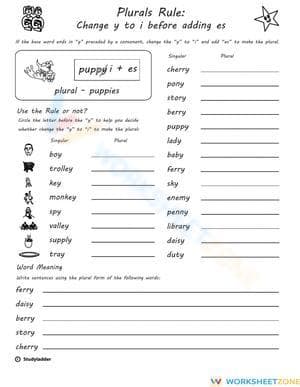
Plural nouns worksheets give K-2 teachers a fast, targeted way to move students from naming one object to writing about many. On this Worksheetzone collection, the practice pages focus on the exact skill sequence students meet in grade 1 and grade 2: forming regular plurals, handling -es spelling changes, and using frequently occurring irregular plurals. Because the pages isolate one rule at a time, you can drop them into whole-class instruction, a small-group table, or a quick review without rewriting your lesson.
Most first graders can add -s to a familiar noun, but the trouble starts when a word ends in s, x, z, ch, or sh, or when the plural breaks the pattern entirely. Worksheets that separate these cases let you see precisely where a student stalls, so reteaching stays specific instead of general.
Worksheetzone groups these pages by rule so you are not hunting through a mixed packet to find the practice a lesson needs. That structure matters most during a busy grammar block, when you want a single-skill page ready to print rather than a broad review that touches five rules at once.
Sequencing Practice From -s to -es to Irregular Plurals
Scaffolded instruction works best when each worksheet adds one layer of difficulty. Start with regular plurals formed by adding -s, using nouns students already read confidently, like cats, books, and desks. Once that rule is automatic, move to -es endings for nouns ending in s, x, z, ch, or sh, such as beach to beaches and box to boxes. This is where spelling and grammar overlap, so students benefit from saying the word aloud and hearing the extra syllable.
The -es rule trips up more students than any other regular pattern because it depends on the final sound of the base word, not the meaning. Worksheets that group all the s, x, z, ch, and sh words together let students hear the shared feature and generalize the rule instead of memorizing each word one at a time.
Only after regular forms are solid should you introduce irregular plurals like feet, children, teeth, mice, and fish. These words do not follow a rule you can sound out, so worksheets that pair the singular and plural side by side help students memorize each pair. Grade 2 is the typical point where irregular plurals move from exposure to independent use.
Regular vs. Irregular Plural Noun Worksheets
Teachers often ask which worksheet type to reach for first. Regular plural worksheets drill the predictable -s and -es rules, while irregular plural worksheets build recognition of high-frequency exceptions. Both belong in a grade 2 unit, but they serve different goals: one builds a rule, the other builds a memory bank.
A quick way to plan the sequence is to teach the rule-based worksheets first and treat irregulars as a separate strand that runs alongside. Students can practice -s and -es on Monday and Tuesday, then spend a short block on irregular pairs later in the week, so the two never compete for attention in the same lesson.
According to Around the Kampfire's guide, 8 Plural Noun Rules to Teach in Second Grade, second graders are expected to work through eight separate plural rules, from basic -s endings to words that change spelling entirely. Teaching all eight across focused worksheets, rather than one blanket rule, gives students a clear checkpoint after each pattern.
Targeting Common Student Errors
The most revealing errors on a plural nouns worksheet are overgeneralizations: a student who writes foots, mouses, or childs is not careless, but is actually applying the -s rule correctly to a word that breaks it. That mistake signals the -s rule has stuck and the irregular set is the missing piece. Track how many students make this specific error; if more than a handful write foots or tooths, reteach the irregular list before adding new spelling patterns. This one diagnostic tells you more than a raw accuracy score.
Using Worksheets for Small-Group Intervention
For students still confusing singular and plural forms, short worksheet sets work well at a small-group table. Pull four or five students who missed plurals on a recent check and give them a single-rule page with only six to eight items. A shorter page keeps the group moving and lets you watch each student form the plural in real time.
Intervention pages also benefit from immediate correction. When a student writes boxs instead of boxes, stop and have them say the word, listen for the extra sound, and add -es. Worksheets that leave room to rewrite the correct form turn a wrong answer into a second attempt rather than a red mark.
Keep a small stack of single-rule pages sorted by skill so intervention groups can start the moment you spot a gap. When a student masters -s plurals mid-week, you can hand them the -es page the next day without prepping anything new, which keeps momentum going while the skill is fresh.
Formative Assessment and Reteaching Checks
Plural nouns worksheets double as quick formative checks. A focused page of eight to ten items gives you enough evidence to sort students into got it, almost, and reteach without eating a full lesson. Keep the item count low so you can score the set at a glance and act on it the same day.
Use the results to decide what comes next. If most students handle -s and -es but stumble on irregulars, that is your next mini-lesson. If a few students still add -s to every noun, they need small-group time before the class moves on.
Save a few completed pages from across the year as a simple record of growth. A student's early page full of foots and mouses, set next to a later page with correct irregulars, shows families and specialists concrete evidence that the practice worked, without any extra data collection on your part.
Classroom Implementation
Worksheets do their best work when the plural nouns leave the page and show up in student writing. After a practice set, ask students to write two or three sentences using the plurals they just formed, so the skill transfers beyond isolated drills. A student who writes that the mice ran under three desks has done more than circle a correct answer.
Try these routines to stretch each worksheet:
- Pair a plural rule page with a two-minute sentence-writing task using the same words.
- Sort a stack of noun cards into regular and irregular piles before the worksheet.
- Post an anchor chart of the -es endings (s, x, z, ch, sh) students can check against.
- Send one completed page home as a model so families see the target rule.
Rotating these routines keeps practice varied while the underlying worksheet stays the same, which saves prep time across a unit.
Frequently Asked Questions
1. What grade level typically works on plural nouns worksheets?
Plural nouns are usually introduced in kindergarten and grade 1 with basic -s and -es forms, then expanded in grade 2 to include frequently occurring irregular plurals. By the end of grade 2, most students are expected to read and write regular and common irregular plurals independently.
2. What is the difference between regular and irregular plural noun worksheets?
Regular plural worksheets practice predictable rules: add -s to most nouns and -es to nouns ending in s, x, z, ch, or sh. Irregular plural worksheets focus on exceptions like feet, children, teeth, mice, and fish, which change form or spelling and must be memorized rather than sounded out.
3. How can teachers use plural nouns worksheets for small-group intervention?
Pull a group of four or five students who missed plurals on a recent check and use a single-rule page with only six to eight items. Watch each student form the plural, correct errors on the spot, and leave space for them to rewrite the correct form.
4. How many practice items should a plural nouns worksheet include for effective formative assessment?
For a quick formative check, eight to ten items is usually enough to sort students into got it, almost, and reteach without taking a full lesson. Keep the count low so you can score the page at a glance and reteach the same day.















 Interactive Worksheet Maker
 Quiz Maker
 Word Search Maker
 Crossword Puzzle Maker
 Word Scramble Generator
 Sentence Scramble Generator
 Handwriting Worksheet Generator
 Name Tracing Generator
 Fill In The Blank Generator