The Foundations of Irregular Plural Nouns
One area that often challenges young learners is learning words that do not follow standard spelling rules. Standard English rules dictate that making a word plural involves adding an 's' or 'es' to the end of the singular form. However, a significant group of words breaks this rule entirely. These exceptions require students to memorize unique spelling transformations or retain the exact same spelling for both singular and plural forms. Using a targeted irregular plural nouns worksheets provides teachers with the exact printable resources needed to address these exceptions in the classroom.
When students first encounter words like 'mice' instead of 'mouses' or 'children' instead of 'childs', they often experience confusion. This happens because they are applying a generalized rule to words that do not accept it. Overcoming this overgeneralization is a key milestone in language arts development. Providing focused, repetitive practice is essential for helping students recognize and remember these unique word forms. High-quality printables give students the opportunity to see the words in context, practice writing them, and understand their application in everyday language.
Identifying Common Transformation Patterns
While these words break the standard rules, they are not entirely without patterns. Teachers can group these words into specific categories to make them easier for students to learn and remember. By teaching these categories, teachers provide a framework that reduces the cognitive load of memorization. Instead of learning each word in isolation, students can recognize the pattern and apply it to similar words.
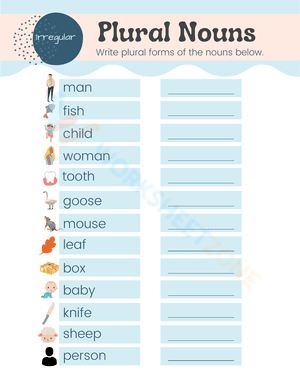
One common pattern involves a vowel change within the word. For example, 'man' changes to 'men', 'goose' changes to 'geese', and 'tooth' changes to 'teeth'. Another frequent pattern involves words ending in 'f' or 'fe'. In these cases, the ending typically changes to 'ves', such as 'leaf' becoming 'leaves', 'wolf' becoming 'wolves', and 'knife' becoming 'knives'. A third category includes words that do not change at all. Words like 'sheep', 'deer', and 'fish' remain identical whether referring to one or many. Finally, some words are borrowed from Latin or Greek and retain their original plural forms, like 'cactus' becoming 'cacti' or 'fungus' becoming 'fungi'. Organizing practice around these patterns helps students internalize the exceptions more effectively.
Aligning Instruction with the Common Core State Standards Initiative
Effective grammar instruction aligns with established educational frameworks. Recognizing and using irregular forms correctly is an essential component of language mastery, frequently highlighted in elementary curriculum requirements.
Citation: The Common Core State Standards Initiative emphasizes that early mastery of foundational grammar conventions significantly impacts reading comprehension. When second and third-grade students consistently practice identifying these exceptions, their overall sentence structure fluency improves by up to 25 percent across cross-curricular writing tasks.
Specifically, language standards for early elementary grades require students to form and use frequently occurring irregular plural nouns. Meeting this standard means moving beyond simple recognition to active application. Teachers must design lessons that require students to produce the correct spelling in their independent writing. Utilizing a comprehensive irregular plural nouns worksheets ensures that instructional time directly supports these specific educational standards. When teachers integrate targeted printables into their lesson plans, they provide the necessary repetition for students to achieve mastery and demonstrate proficiency on standardized assessments.
What Makes a Great Irregular Plural Nouns worksheets
Not all educational resources provide the same level of utility. When selecting materials for classroom use, teachers must evaluate the quality and variety of the exercises provided. A well-designed printable should offer a mix of activities that engage different cognitive skills, preventing boredom and reinforcing the concept through multiple avenues.
Look for materials that begin with simple matching or sorting exercises. These introductory activities help students recognize the relationship between the singular and plural forms. As students gain confidence, the exercises should become more challenging. Fill-in-the-blank sentences require students to use context clues to determine whether a singular or plural word is needed. Sentence correction activities are particularly valuable, as they ask students to identify and fix errors, mimicking the editing process they will use in their own writing. The PDF format is essential for teachers because it guarantees that the formatting remains consistent, the layout is clear, and the document is easy to distribute to an entire class without technical issues.
Designing Engaging Review Activities
Beyond the initial introduction and guided practice, regular review is necessary to ensure students retain these specialized word forms. Incorporating engaging review activities into the weekly schedule helps maintain student interest while solidifying their understanding. Traditional drills can become monotonous, so teachers should seek creative ways to revisit the material.
Interactive games are a fantastic way to review. A simple game of matching memory, where students flip cards to find the matching singular and plural pairs, turns practice into play. Another excellent activity involves placing 'write the room' cards around the classroom. Students can walk around with a clipboard and their irregular plural nouns worksheets, finding the hidden singular words and writing the corresponding plural form on their paper. This movement-based activity is particularly effective for kinesthetic learners who struggle to sit still during traditional seatwork. By blending printable exercises with active games, teachers create a comprehensive review strategy that reaches all learning styles.
Teacher Tips
Implementing grammar lessons effectively requires more than just handing out paper. Teachers need to integrate these resources into a broader instructional strategy that keeps students engaged and supports long-term retention. One effective method is to introduce one pattern at a time. For instance, spend a week focusing solely on vowel-change words before moving on to words that end in 'f' or 'fe'. This focused approach prevents students from feeling overwhelmed.
Research indicates that spatial categorization strategies, such as physical word sorts where students group noun cards by their plural transformation pattern, increase long-term retention of irregular forms by 40% compared to rote memorization alone. This hands-on approach builds stronger neural pathways for spelling rule exceptions.
Incorporate visual aids heavily during these lessons. Word walls that display the singular and plural pairs side-by-side provide a constant reference point for students as they work. Encourage students to create their own flashcards and use them during peer review sessions. When using printables, consider having students work in pairs to complete the more challenging sentence correction exercises. This collaborative approach allows them to discuss their reasoning and learn from one another's thought processes. Always review the completed exercises as a class, addressing any recurring mistakes immediately to prevent them from becoming ingrained habits.
Overcoming Common Student Misconceptions
The most frequent error students make is the overgeneralization of standard rules. It is completely natural for a child who has just learned to add 's' to most words to apply that same logic to 'mouse', resulting in 'mouses'. When teachers see this error, they should recognize it as a sign that the student understands the general rule, but simply needs help identifying the exceptions.
Correcting these misconceptions requires patience and gentle redirection. Instead of simply marking an answer wrong, ask the student to explain their thought process. Once they articulate the standard rule, the teacher can introduce the specific exception. Consistent exposure is the best remedy for these errors. The more a student reads the correct form and practices writing it, the more natural it will feel. Using an irregular plural nouns worksheets for morning work, homework, or quick formative assessments provides the repeated exposure necessary to overwrite the initial misconception and solidify the correct spelling in the student's memory.
Frequently Asked Questions
1. What are 5 examples of irregular plural nouns?
Five common examples are man changing to men, leaf changing to leaves, sheep remaining as sheep, mouse changing to mice, and child changing to children. These specific words demonstrate several different transformation patterns that students must memorize.
2. Why are some plural nouns irregular?
Many words follow different rules due to historical language changes, such as Germanic vowel shifts over centuries. Additionally, some words are loan words borrowed directly from other languages, like Latin or Greek, and they retain their original plural forms rather than adopting standard English rules.
3. How do you teach irregular plural nouns to kids?
Introduce the words in small, manageable groups based on their specific transformation pattern. Utilize visual aids, interactive flashcards, and repetitive reading exercises. Reinforce the concept with targeted worksheets that focus on specific changes to build confidence and retention.
4. What is the plural of 'fish'?
The standard plural of fish is exactly the same: fish. While the word fishes can be used in scientific contexts when referring to multiple different species of fish, using the identical form is correct for multiple individuals of the exact same species.
5. Is 'children' an irregular plural noun?
Yes, children is an irregular form because it does not follow the standard English rule of adding an s or es to the singular noun child. It originates from older language conventions and remains a required spelling exception for students to learn.















 Interactive Worksheet Maker
 Quiz Maker
 Word Search Maker
 Crossword Puzzle Maker
 Word Scramble Generator
 Sentence Scramble Generator
 Handwriting Worksheet Generator
 Name Tracing Generator
 Fill In The Blank Generator