


























Views
Downloads


Essential Regular and Irregular Plural Nouns Worksheet
Paste this activity's link or code into your existing LMS (Google Classroom, Canvas, Teams, Schoology, Moodle, etc.).
Students can open and work on the activity right away, with no student login required.
You'll still be able to track student progress and results from your teacher account.
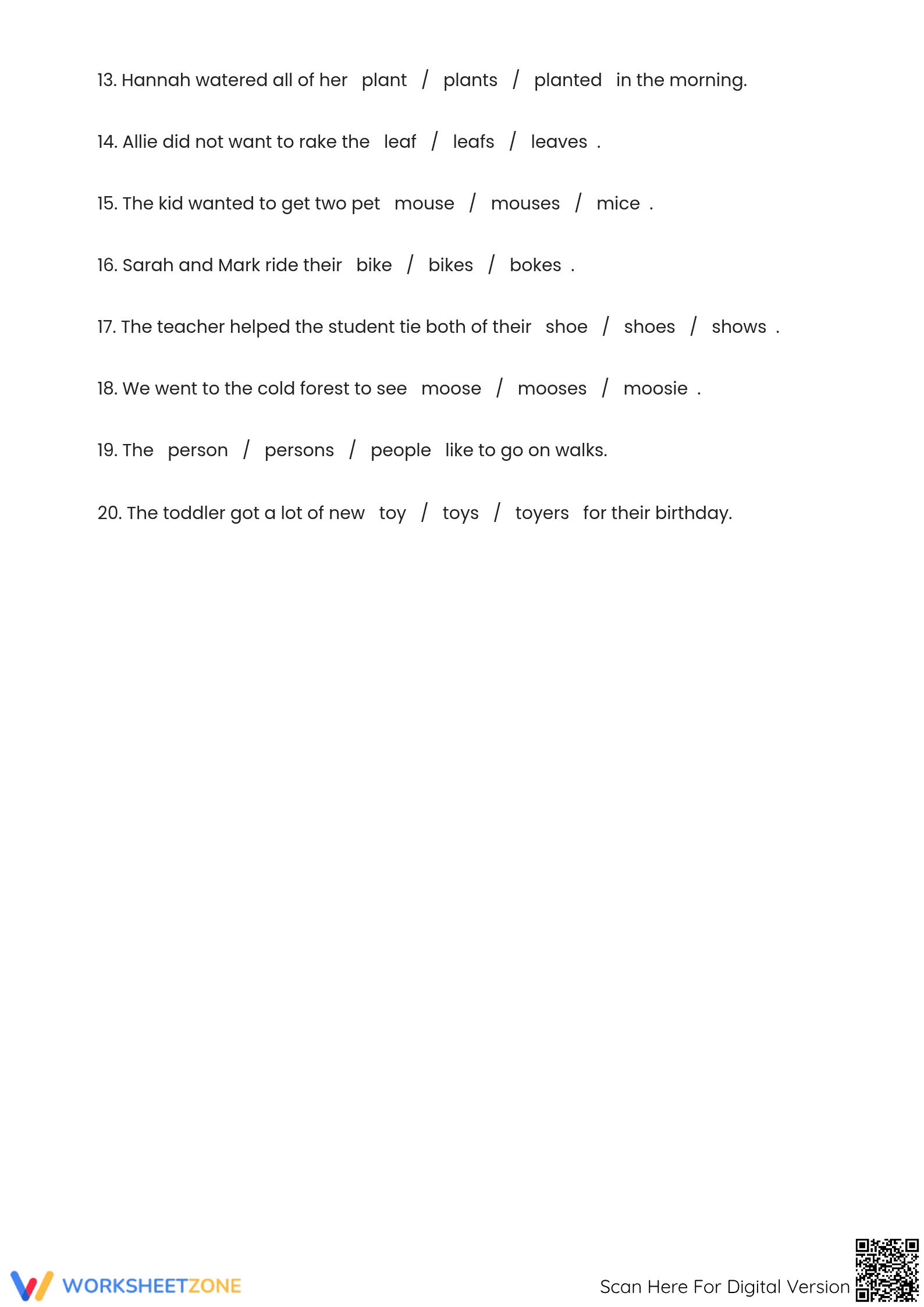
Master regular and irregular plural nouns with this comprehensive grammar worksheet designed for upper elementary students. This resource provides direct practice in identifying the correct plural forms within context, ensuring students can differentiate between standard -s/-es endings and complex irregular changes like tooth/teeth or leaf/leaves. By providing 20 sentence-level tasks, it ensures deep linguistic understanding.
At a Glance
- Grade: 4–6 · Subject: English
- Standard:
CCSS.ELA-LITERACY.L.3.1.B— Form and use regular and irregular plural nouns- Skill Focus: Regular and Irregular Plural Nouns
- Format: 2 pages · 20 problems · Answer key included · PDF
- Best For: Grammar warm-ups and formative assessments
- Time: 15–20 minutes
This two-page PDF contains 20 carefully crafted sentences, each presenting three options for the plural noun. Students must analyze the sentence structure and select the grammatically correct form. The set includes a balanced mix of regular nouns such as "dogs" and "slices" alongside challenging irregulars like "knives," "children," "mice," and "moose." A full answer key is included for effortless grading.
Educators can implement this resource in under two minutes with a simple three-step workflow. First, print the two-page PDF for your class (30 seconds). Second, distribute the worksheets for students to complete independently or in pairs (1 minute). Finally, use the included answer key to review correct pluralization rules as a whole-class activity (10 minutes). This streamlined process makes it perfect for sub plans.
The primary focus of this worksheet is `CCSS.ELA-LITERACY.L.3.1.B`, which requires students to form and use regular and irregular plural nouns accurately. It also supports general grammar proficiency and sentence editing skills. Both standard codes can be copied directly into lesson plans, IEP goals, or district curriculum mapping tools to ensure instructional alignment with state and national requirements.
This worksheet serves as an excellent warm-up activity to begin a grammar block or as a quick formative assessment after a direct instruction lesson on pluralization. Teachers should observe if students struggle more with vowel-shifting irregulars (man/men) compared to ending-changing irregulars (knife/knives). Completion typically takes 15 to 20 minutes, making it ideal for standard classroom rotations or bell-ringer tasks.
This resource is designed for students in grades 4, 5, and 6 who are refining their mechanics. It is particularly effective for English Language Learners (ELLs) who may find irregular English plurals counterintuitive. It pairs naturally with a short passage or an anchor chart displaying common irregular plural noun patterns for additional support during the independent practice phase of the lesson.
This Grade 4-6 grammar resource leverages standard CCSS.ELA-LITERACY.L.3.1.B to build foundational proficiency in pluralization. By focusing on regular and irregular plural nouns, the worksheet addresses a critical component of language mechanics. According to EdReports 2024, high-quality grammar materials must provide students with varied opportunities to apply rules in sentence-level contexts to move beyond rote memorization. This worksheet facilitates that transition by presenting 20 unique scenarios that require active linguistic analysis. The selection of irregular forms such as 'moose,' 'knives,' and 'children' aligns with research suggesting that early exposure to morphological outliers prevents the overgeneralization of plural suffixes. Educators can utilize this standalone tool as a printable assessment or a no-prep classroom activity to gauge mastery of irregular forms. The inclusion of an answer key ensures immediate feedback, which is essential for correcting misconceptions in real-time during the guided or independent practice phases of grammar instruction.


