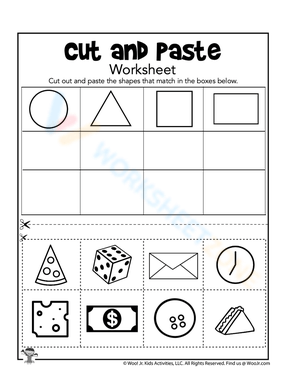
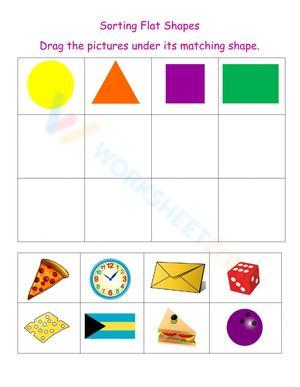
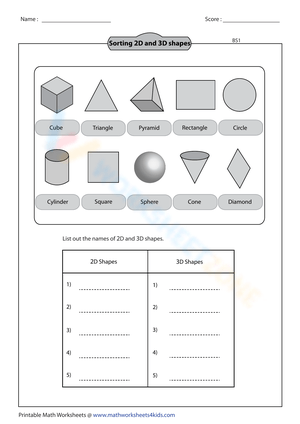
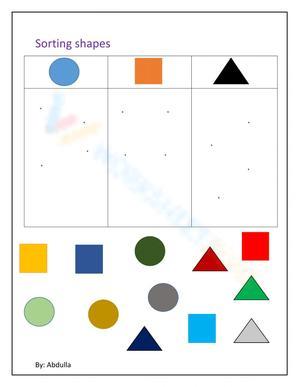
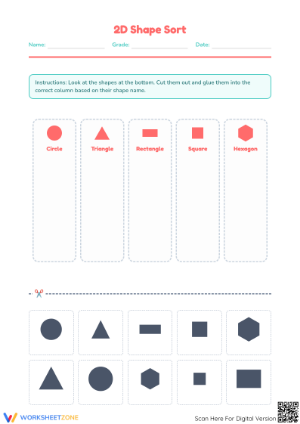
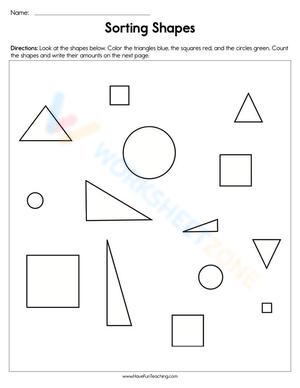
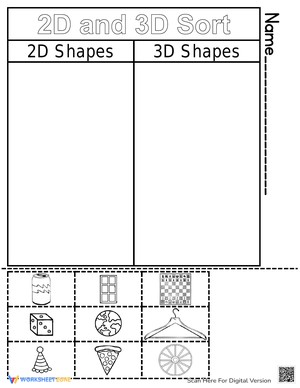
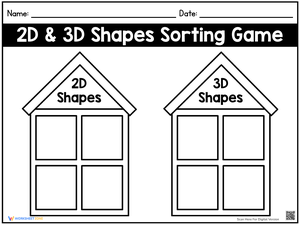
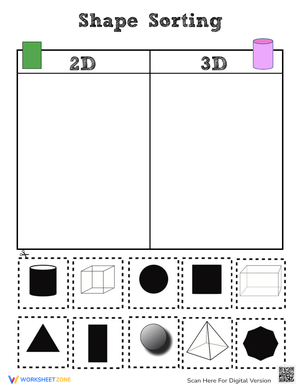
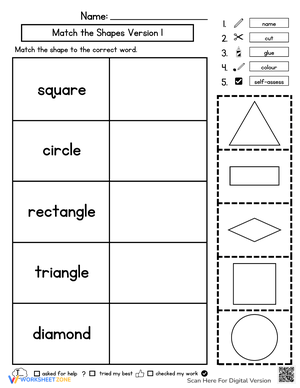
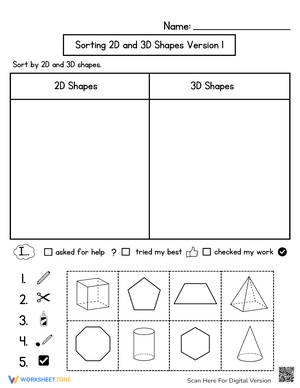
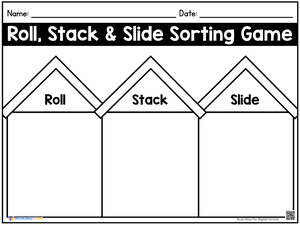
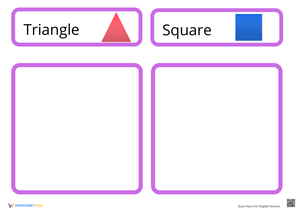
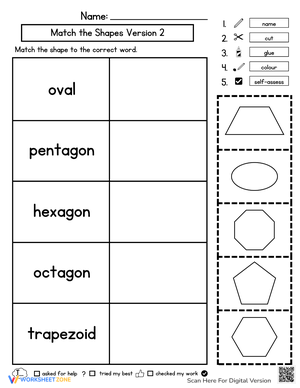
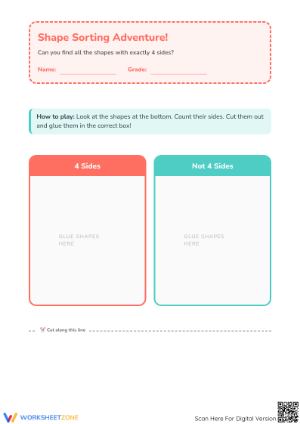
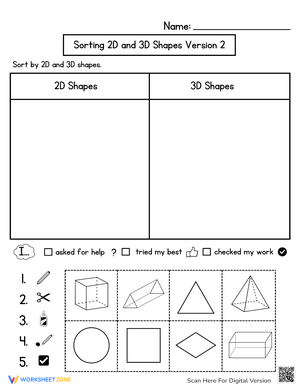
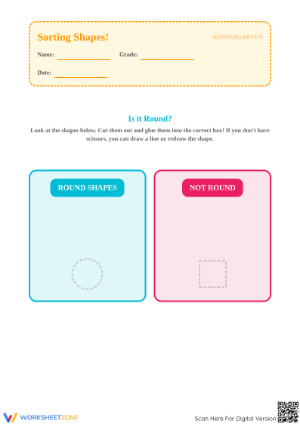
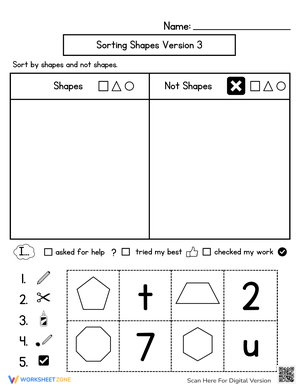
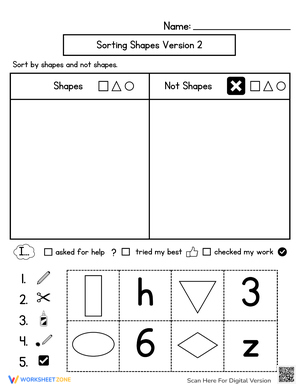
These 1st grade sorting shapes worksheets pdf give first graders structured practice sorting geometric figures by their defining properties — number of sides, number of vertices, and whether a shape is two-dimensional or three-dimensional. Each worksheet isolates a specific sorting task: students cut, paste, mark, or rewrite shapes into categories based on attributes that hold regardless of color, size, or orientation on the page. The set covers both flat shapes and solid figures, building the conceptual vocabulary first graders need before they move into fractions or measurement.
The Specific Skills Each Worksheet Targets
The core of this 1st grade sorting shapes worksheets pdf set is the defining-versus-non-defining attribute distinction — the concept that determines whether a student actually understands shape classification or is just pattern-matching by appearance. Individual worksheets address:
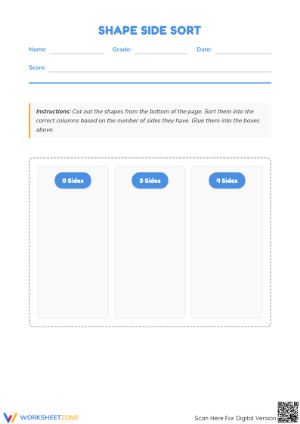
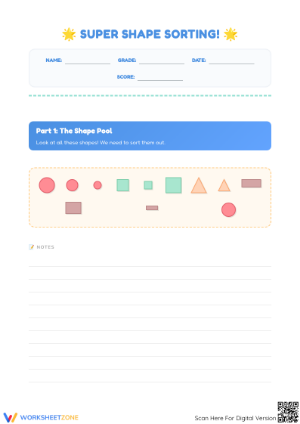
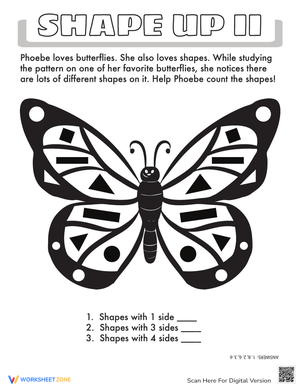
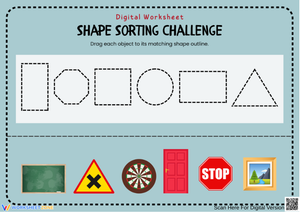
- Sorting 2D shapes (circles, triangles, squares, rectangles, hexagons) by number of sides and vertices
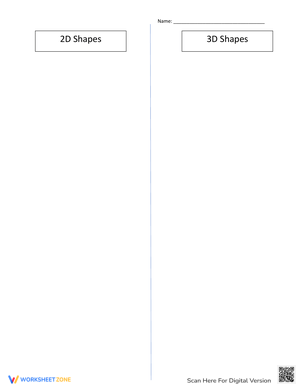
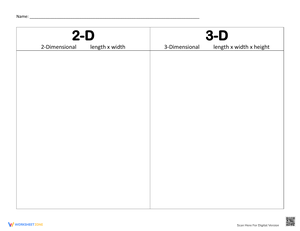
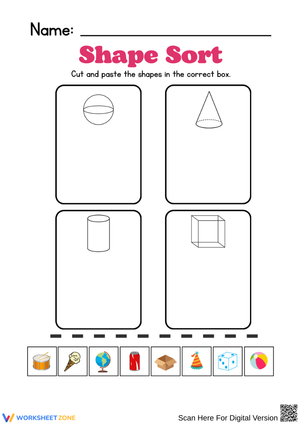
- Distinguishing flat figures from solid figures — placing cylinders, cones, cubes, and spheres into the correct column
- Identifying shapes across varied sizes and orientations, including triangles that point downward and rectangles that are nearly square in proportion
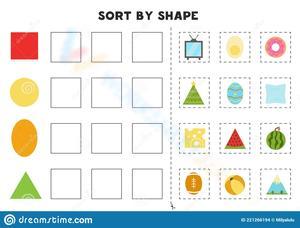
- Cut-and-paste sorting tasks that require students to physically organize shape cards into labeled categories
- Written explanation prompts where students complete a sentence identifying why a shape belongs in its group
That last type matters more than it looks. When a first grader writes "It is a triangle because it has 3 sides and 3 corners," they are demonstrating comprehension that coloring or cutting alone cannot reveal.
Mistakes Students Make That These Worksheets Help You Catch
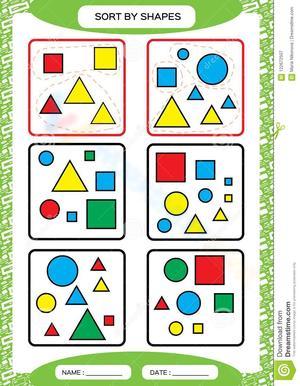
The most persistent error in first-grade shape sorting is color-sorting: a student who puts all the red shapes together and all the blue shapes together, regardless of geometry. This is not carelessness — it is the natural default for children who have spent their early years sorting objects by color in toys and games. A worksheet that presents the same triangle in red, green, and purple forces that conflict into the open. Watching where a student places those three cards tells you immediately whether the instruction about defining attributes has actually landed.
A second, less obvious error involves elongated rectangles. Students who have only seen rectangles in one proportion — roughly twice as long as they are wide — frequently refuse to classify a nearly-square rectangle as a rectangle. They insist it "looks like a square." This is a developmental misreading worth addressing directly. Worksheets that include edge-case shapes (a very wide triangle, a very narrow rectangle, a tilted square) expose this gap before it becomes a unit-assessment surprise.
The 2D/3D boundary creates its own confusion. Many first graders sort a picture of a cube alongside the squares rather than the solids because they see "a square shape" on the page. That misconception needs explicit attention — the worksheet surfaces it, and the teacher closes it in whole-class discussion.
Why Sorting Is the Right Format for This Skill at This Grade
First graders are at the stage where the move from concrete objects to representational images is still in progress. When the task is purely abstract — "name all the defining attributes of a rectangle" — many students answer correctly by rote without being able to apply the knowledge. Sorting forces application. A student cannot fake categorization; they either place the shape correctly or they don't. The physical act of cutting and pasting shape cards, or drawing lines to connect shapes to labeled columns, requires a decision — and those decisions are the formative data a teacher actually needs.
This format also keeps cognitive load at a manageable level for six-year-olds. Each worksheet asks one focused question: flat or solid, three sides or four sides, closed or open. That narrowness is a feature. It means a student who struggles is struggling with exactly one concept, and a teacher watching over the child's shoulder can diagnose the confusion in real time rather than after a test.
Building These Worksheets Into Your Weekly Math Lessons
Math centers are the natural home for these worksheets, but they work just as well in other slots. A cut-and-paste sorting page runs cleanly as morning work — it takes seven to ten minutes for most first graders, produces a finished artifact to discuss during whole-class debrief, and requires no verbal instruction to launch. Place the worksheet face-down on desks before students arrive, flip, go.
For small-group geometry lessons, pairing a printed worksheet with wooden geometric solids changes how students interact with the sorting task. Having a child hold a physical cone while looking at a 2D illustration of a cone closes the representational gap — the drawing stops being a mystery and becomes a symbol for something they have actually touched. That bridge from object to representation is worth the two minutes it takes to set up the manipulative tray.
These worksheets also function as quick exit tickets at the end of a geometry lesson. Hand a student a four-shape sorting task and watch where the shapes land. You get classroom-level data in three minutes — specific enough to reorganize the next day's small groups on the spot.
Standard Alignment
These worksheets align directly with CCSS.MATH.CONTENT.1.G.A.1, which requires first graders to distinguish between defining attributes — such as triangles being closed and three-sided — and non-defining attributes such as color, size, and orientation. This standard sits in the Geometry domain and is typically introduced in late fall or early winter, after students have consolidated counting and place-value work. The sorting format on each worksheet directly enacts the standard's language: students are not drawing shapes, they are making attribute-based classification decisions, which is precisely what 1.G.A.1 targets.
The flat-versus-solid sorting worksheets also support CCSS.MATH.CONTENT.1.G.A.2, which asks students to build understanding of two- and three-dimensional shape properties. A student who correctly sorts a cylinder away from a circle — and can explain that a cylinder is a solid with circular faces — has demonstrated the foundational understanding that standard requires, and is better positioned for the partitioning work that comes in 1.G.A.3.
Adjusting the Set for a Range of Learners
For students who need additional support, reduce the field before the task begins: instead of sorting eight shapes into three categories, pull four shapes and two categories. The classifying task is identical; the visual complexity is lower. Pre-sorting one example into each column also helps — a structured starting point that doesn't remove the intellectual work, just reduces the initial disorientation for students who freeze when faced with a completely blank sort.
Students working above grade level benefit from adding a written justification line beneath each sorted group — "These shapes belong together because ___." That extension shifts the task from classification to explanation, which demands a higher level of conceptual control. You can also introduce the 1st grade sorting shapes worksheets pdf pages that include irregular quadrilaterals or obtuse triangles, pushing students to test their attribute definitions against less familiar examples. A student who confidently sorts equilateral triangles may hesitate at a very flat scalene triangle — and that hesitation is one of the most productive moments in first-grade geometry instruction.
Frequently Asked Questions
What attributes should first graders use when sorting shapes?
First graders sort by defining attributes: number of sides, number of corners (vertices), and whether a shape is open or closed. They learn to set aside non-defining attributes — color, size, and the angle at which the shape appears on the page. A triangle rotated 180 degrees is still a triangle; a large blue hexagon and a small red hexagon belong in the same group. Getting students to internalize this distinction is the central instructional work of the unit, and it takes more repetition than most teachers initially expect.
How do these worksheets fit into a math center rotation?
Each worksheet is self-contained, so students work at the geometry center without needing verbal setup from the teacher. Cut-and-paste sorting pages work especially well in centers: students have a clear physical task, a visible endpoint, and a finished product to bring to the debrief. For use across multiple groups, laminate a few copies and supply dry-erase markers — students mark directly on the laminated sheet, wipe it clean, and the next group uses the same page.
Are these worksheets suitable for students who haven't yet been introduced to 3D shapes?
The 2D-only sorting worksheets work independently of the solid-figure set. A teacher can sequence the worksheets to introduce flat shapes first, confirm mastery, and then layer in solid figures. The 2D/3D comparison worksheets are best used after students have had some exposure to both — not as a first introduction, but as a consolidation task once the vocabulary is in place. Using them too early, before students have handled actual solids, tends to produce the cube-as-square confusion described above.
Can these worksheets serve as formative assessment tools?
A single sorting worksheet, collected and reviewed, tells more about geometric understanding than most multiple-choice assessments at this level. When a student's cut-and-paste page shows a cylinder glued in the flat-shapes column, that's diagnostic information — not just a wrong answer. The 1st grade sorting shapes worksheets pdf set includes enough task variety that teachers can designate one worksheet per concept as a formative check — flat versus solid, three-sided versus four-sided, defining versus non-defining — without the sequence feeling repetitive to students working through it across the week.