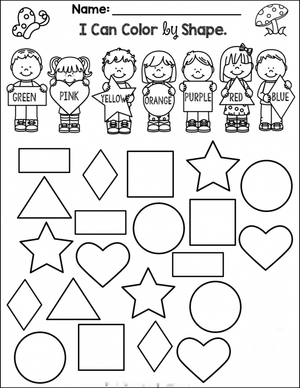
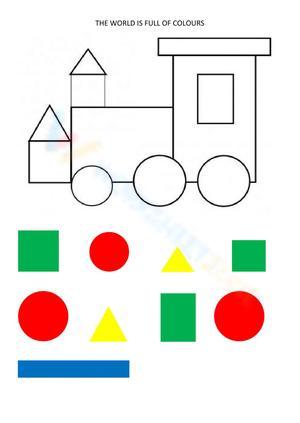
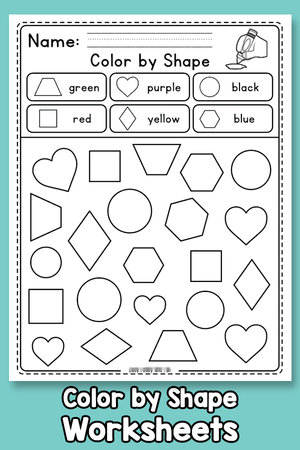
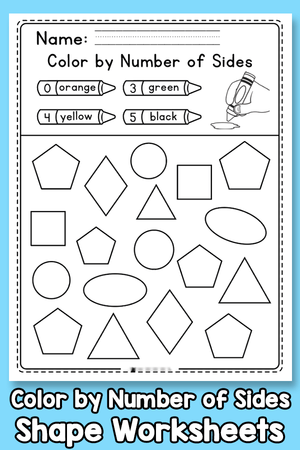
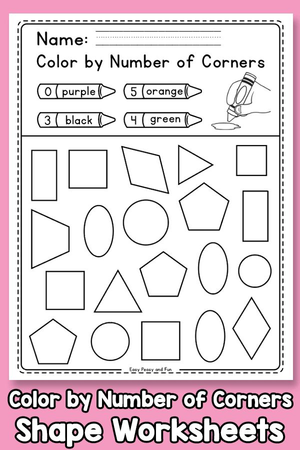
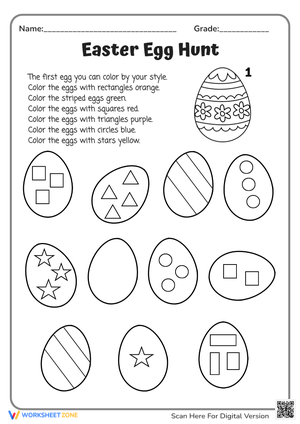
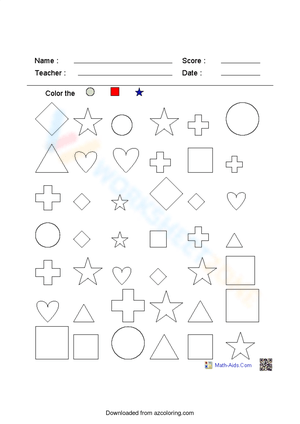
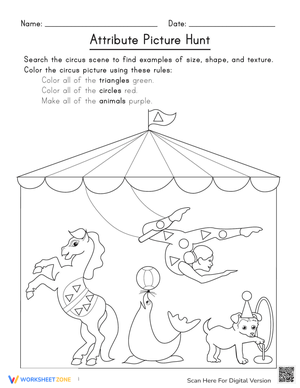
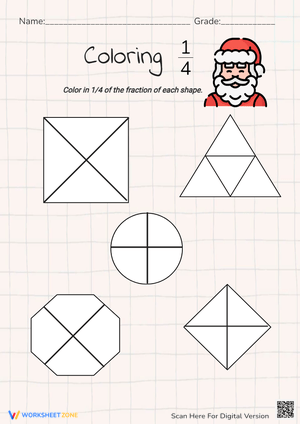
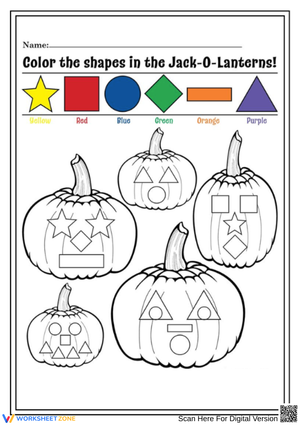
1st grade color by shapes pdf worksheets give teachers a format where geometry practice and fine motor coordination happen simultaneously without either task compromising the other. Each worksheet presents a color-coded legend — circle gets red, hexagon gets blue — and students must identify every matching shape embedded in a larger illustrated scene, then fill it in accordingly. The finished image tells a teacher exactly where a student's shape recognition broke down.
What Students Practice Across the Set
These 1st grade color by shapes pdf worksheets cover the five shapes that anchor Grade 1 geometry — circles, squares, rectangles, triangles, and hexagons — but the emphasis shifts from one worksheet to the next. Some focus heavily on distinguishing squares from rectangles; others embed multiple triangle orientations to test whether students recognize a shape regardless of which direction it points. Students also read color words from the legend, adding a low-stakes literacy demand to a math activity without requiring teacher explanation after the first session.
Beyond shape identification, students practice following multi-step directions: read the shape name, read the color word, locate every instance of that shape, then color it correctly before moving to the next legend entry. That sequence sounds simple until you watch a first grader color all the triangles correctly and then accidentally re-color several of them while working through the rectangles. That error isn't a geometry mistake — it's a working memory and attention signal, and it shows up in the finished worksheet in a way that a verbal response never would.
Student Mistakes Worth Catching Before They Calcify
The square-rectangle confusion is the most persistent error in this format, and it plays out in a specific way: students who correctly identify a standalone square will still color a long, narrow rectangle using the square's color because they see "four sides" and stop processing. The defining attribute — all four sides equal — hasn't become automatic yet. When a student's completed worksheet shows every four-sided shape in one color regardless of proportions, that's the moment to pull out a ruler and hold it against both shapes side by side.
Hexagons produce a different error: students skip them rather than misidentify them, leaving those regions blank because nothing in their mental shape library flagged a six-sided figure as something worth looking for. Triangles create a third pattern — students who correctly mark every upright triangle will miss the same shape rotated onto a side or pointing downward. This is the non-defining attribute work that CCSS.MATH.CONTENT.1.G.A.1 targets directly, and seeing it play out in actual completed work makes the standard feel less abstract when planning re-teaching.
Building These Worksheets Into Your Weekly Lesson Flow
These work best when they follow direct instruction rather than precede it. Drop one on desks the morning after a whole-group lesson on hexagons, and students arrive with fresh vocabulary and a clear reason to hunt for that six-sided shape on purpose. Used as morning work in the roughly 10-to-12-minute window between arrival and the formal start of instruction, they produce meaningful practice with near-zero redirection — once the format is familiar, students read the legend and self-direct completely.
In a math workshop model, 1st grade color by shapes pdf worksheets slot cleanly into an independent station while the teacher pulls small groups for guided work. Because the directions are visual and self-contained, students rarely stall mid-task, which protects small-group time from interruption. Reserve a few worksheets specifically for the Friday geometry block — after a week of attribute-focused lessons, a color-by-shape activity serves as both review and a low-stakes check on whether the week's vocabulary and concepts actually stuck.
Adjusting the Work for a Range of Learners
For students who are still building shape vocabulary, pre-label the legend with small hand-drawn examples next to each word — a tiny drawn square beside "square," a tiny drawn hexagon beside "hexagon." This removes the vocabulary retrieval barrier so students can focus on visual discrimination, which isolates the skill you actually want to assess that day. Students using this version participate in the same activity as their peers rather than working on something entirely separate.
Students who move through the coloring quickly benefit from a follow-up tally: after finishing, they count each shape and record the totals at the bottom. This adds a counting and data layer that connects geometry to number sense without requiring a second activity entirely. A harder extension asks students to identify which shape appears most frequently and write one sentence explaining how they know — pushing them to produce the attribute-based language ("the hexagons all have six sides and I counted...") that the standard calls for.
Standard Alignment
CCSS.MATH.CONTENT.1.G.A.1 asks students to distinguish defining attributes of shapes — number of sides, number of angles — from non-defining attributes like color, size, and orientation. These worksheets address that standard directly: the color a shape receives in the legend has nothing to do with how the shape looks on the page, so students must identify each shape by structure alone. Orientation varies by design — triangles appear in at least three rotations, rectangles appear in both landscape and portrait positions — so students cannot use position as a recognition shortcut. That's the standard doing real work, not just appearing at the top of a page.
The NCTM's early geometry guidelines also emphasize spatial visualization as a skill distinct from shape naming. When a student scans a busy illustrated scene to locate every hexagon, they are performing figure-ground discrimination and mental comparison at the same time. That cognitive work is worth naming when talking to parents or instructional coaches about why a coloring activity earns time in the math block.
Frequently Asked Questions
Can completed worksheets function as formative assessment data?
Yes, and they're efficient for it. A quick scan of the finished work reveals systematic errors — if a student consistently colors rectangles with the square's designated color across multiple worksheets, that's a pattern worth documenting. Teachers can use that information to plan a targeted re-teaching conversation, a small-group lesson, or a side-by-side comparison activity during the next geometry session.
How should I support students with color vision deficiencies?
Add a symbol to each legend entry — a dot inside all circles, a small X inside all squares — so students can match by pattern rather than by hue alone. Most 1st grade color by shapes pdf worksheets use a standard legend format that makes this modification straightforward to apply before printing. Students using the adapted version participate in the full shape-identification task without the accommodation drawing attention from peers.
When in the geometry unit should these worksheets be introduced?
After at least one direct-instruction lesson on the shapes included in that particular worksheet. Introducing a worksheet before students have heard the vocabulary — hexagon especially — produces guessing rather than practice, and students fill in color by elimination rather than recognition. Once shapes have been named and discussed, these worksheets convert that initial exposure into automaticity through repeated, low-pressure retrieval.













 Interactive Worksheet Maker
 Quiz Maker
 Word Search Maker
 Crossword Puzzle Maker
 Word Scramble Generator
 Sentence Scramble Generator
 Handwriting Worksheet Generator
 Name Tracing Generator
 Fill In The Blank Generator