


























Views
Downloads

Sorting Round and Not Round Shapes | Kindergarten Ready
Paste this activity's link or code into your existing LMS (Google Classroom, Canvas, Teams, Schoology, Moodle, etc.).
Students can open and work on the activity right away, with no student login required.
You'll still be able to track student progress and results from your teacher account.
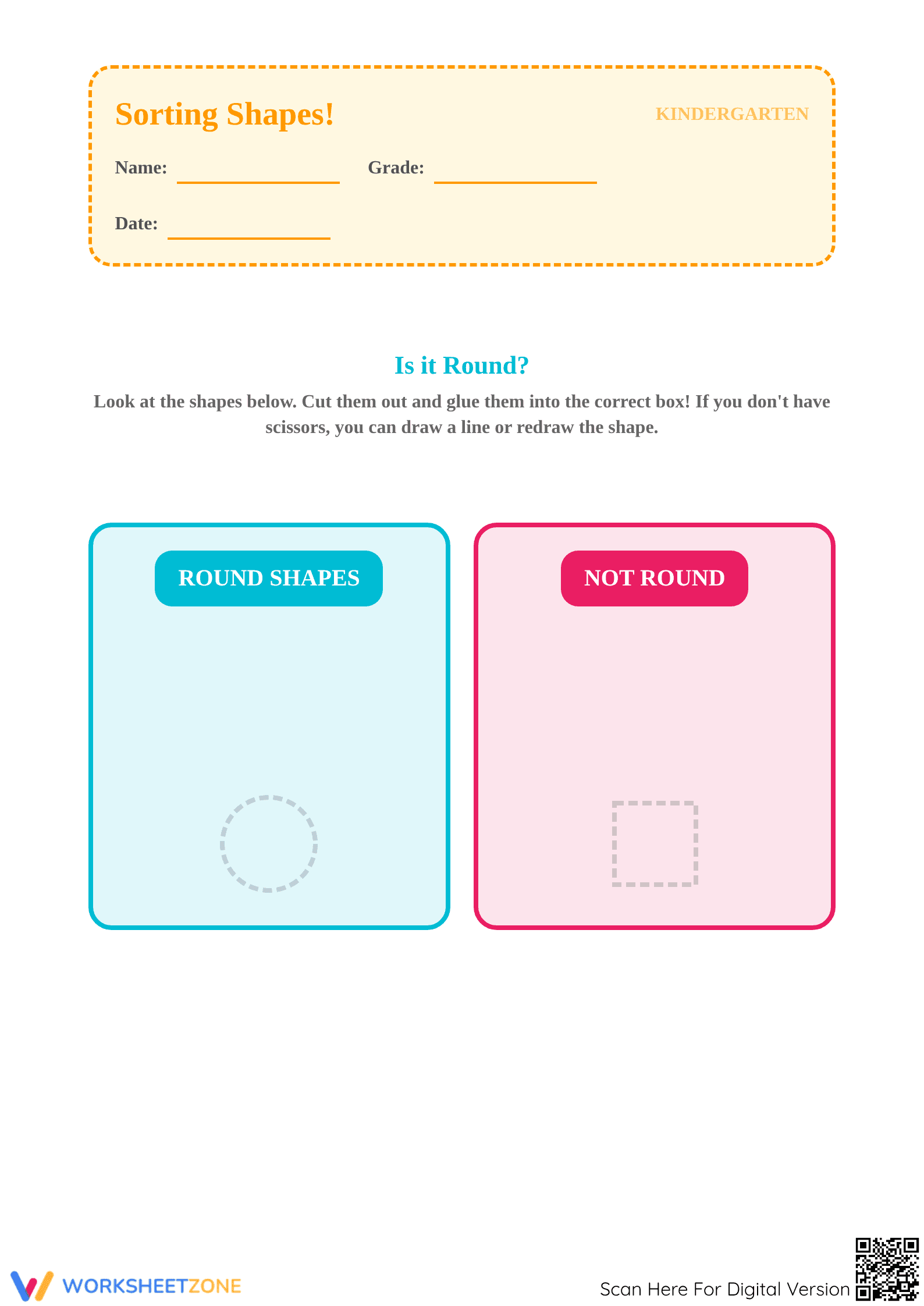
This Kindergarten geometry worksheet helps early learners master shape recognition by classifying objects as round or not round. Through interactive cut-and-glue, drawing, and coloring activities, students develop the foundational spatial reasoning skills necessary for advanced math. This comprehensive three-page packet ensures students can identify geometric attributes across multiple modes of learning.
At a Glance
- Grade: Kindergarten · Subject: Math
- Standard:
CCSS.MATH.CONTENT.K.MD.B.3— Classify objects into given categories and count the number of objects in each category.- Skill Focus: Geometric attribute classification
- Format: 3 pages · 22 tasks · Answer key included · PDF
- Best For: Independent practice, centers, or sub plans
- Time: 20–30 minutes
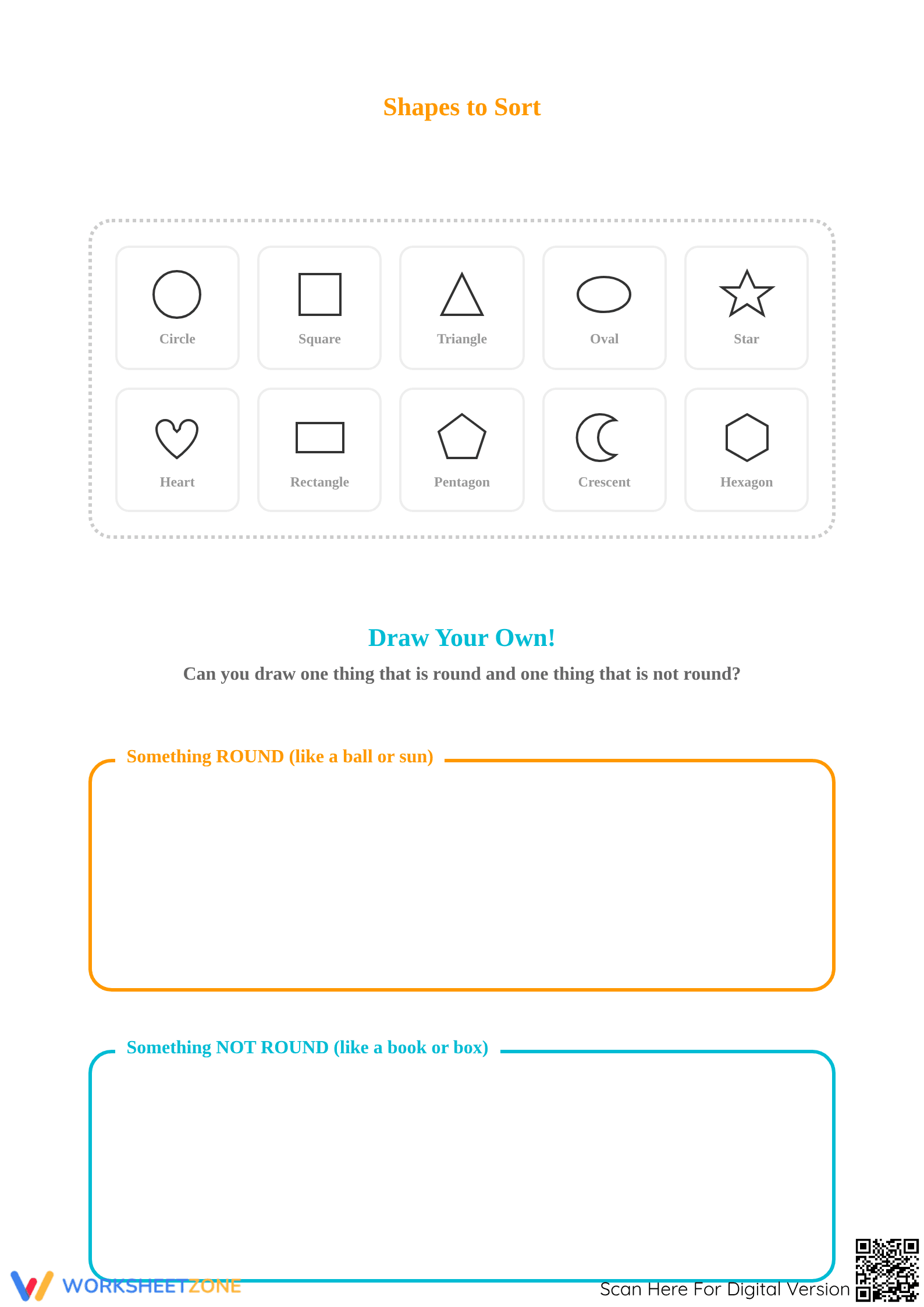
This three-page resource provides a variety of engaging tasks to reinforce shape sorting. Page one features a classic cut-and-glue activity where students sort ten different geometric figures into "Round Shapes" and "Not Round" categories. Page two includes creative drawing prompts that ask students to visualize real-world objects with specific attributes. The final page offers a "Color Challenge," requiring students to discriminate between shapes using a color-coded system.
The zero-prep workflow for this worksheet is designed for maximum teacher efficiency. First, print the three-page PDF (approx. 30 seconds). Second, distribute the materials along with scissors, glue, and crayons (approx. 1 minute). Finally, use the provided answer key for a rapid visual check or whole-class review (approx. 1 minute). With a total preparation time of under three minutes, this packet is ideal for emergency sub plans or last-minute math center additions.
The primary standard for this resource is CCSS.MATH.CONTENT.K.MD.B.3, which requires students to "Classify objects into given categories; count the numbers of objects in each category and sort the categories by count." By distinguishing between round and non-round attributes, students also build toward K.G.B.4, analyzing and comparing two-dimensional shapes in different sizes and orientations. Both standard codes can be copied directly into lesson plans, IEP goals, or district curriculum mapping tools.
Use this worksheet as a formative assessment after introducing circles and polygons. Observe how students handle the "Color Challenge" on page three; if a student colors the heart orange, they may need additional instruction on the definition of "round" versus "curved." This packet also serves as an excellent quiet-time activity during small group rotations, taking most Kindergarteners approximately 25 minutes to complete all three sections thoroughly.
This resource is tailored for Kindergarten students and Grade 1 learners requiring remediation in basic geometry. The heavy reliance on visual cues and physical movement makes it particularly effective for English Language Learners and students with IEPs focused on fine motor skills. Pair this worksheet with a physical set of attribute blocks or a "shape hunt" around the classroom for a complete multi-sensory lesson.
This shape sorting resource is strategically designed to align with the developmental milestones of early childhood mathematics. According to research from the RAND AIRS 2024 report, high-quality manipulatives and sorting tasks are critical for developing the "attribute language" that precedes formal geometric definitions. By explicitly requiring students to sort shapes like circles and ovals away from triangles and squares, the worksheet reinforces CCSS.MATH.CONTENT.K.MD.B.3 while supporting the cognitive shift from holistic perception to analytical observation. Studies in ScienceDirect TpT Analysis suggest that multi-modal tasks—combining kinesthetic cutting with visual coloring—significantly improve retention rates in learners aged five to seven. This printable provides the structured repetition needed for students to confidently classify two-dimensional figures based on observable geometric properties, ensuring a solid foundation for Grade 1 geometry and measurement standards.


