


























Views
Downloads

Printable 2D Shape Sort Worksheet | Kindergarten Math
Paste this activity's link or code into your existing LMS (Google Classroom, Canvas, Teams, Schoology, Moodle, etc.).
Students can open and work on the activity right away, with no student login required.
You'll still be able to track student progress and results from your teacher account.
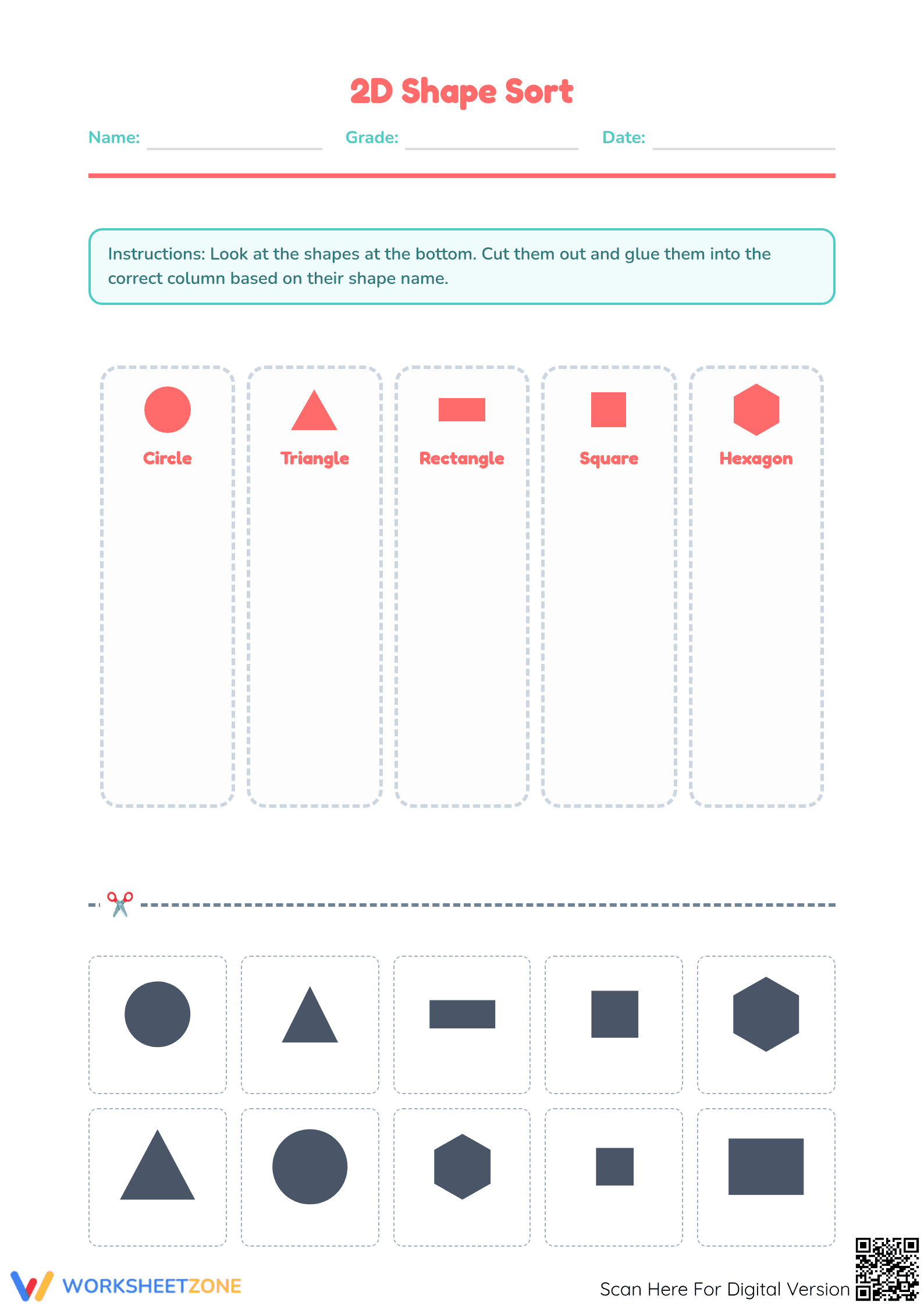
This 2D Shape Sort worksheet provides an interactive way for Kindergarten and Grade 1 students to master basic geometry. Students practice identifying and classifying circles, triangles, rectangles, squares, and hexagons through a tactile cut-and-glue activity. This hands-on approach reinforces shape recognition and fine motor skills while achieving foundational math standards.
At a Glance
- Grade: Kindergarten–2 · Subject: Math
- Standard:
CCSS.MATH.CONTENT.K.G.A.2— Correctly name shapes regardless of their orientations or overall size- Skill Focus: 2D Shape Identification & Sorting
- Format: 1 page · 10 problems · Answer key included · PDF
- Best For: Independent math centers or morning work
- Time: 15–20 minutes
What's Inside
This single-page PDF features a clear sorting grid with five designated columns: Circle, Triangle, Rectangle, Square, and Hexagon. At the bottom of the page, students find ten distinct shapes to cut out and categorize. The design includes diverse orientations and sizes to challenge student perception. A comprehensive answer key is included for quick teacher review or student self-correction.
Zero-Prep Workflow
- Step 1: Print (30 seconds). Simply hit print on this ready-to-use PDF for each student or small group.
- Step 2: Distribute (30 seconds). Hand out the sheets along with scissors and glue sticks; no additional materials or teacher-led setup is required.
- Step 3: Review (1 minute). Use the provided answer key to scan student work instantly, making this an ideal solution for emergency sub plans or busy classroom blocks.
Standards Alignment
The primary alignment is CCSS.MATH.CONTENT.K.G.A.2: "Correctly name shapes regardless of their orientations or overall size." By presenting shapes in various positions, the worksheet prevents students from relying on a single mental prototype. This resource also supports Grade 1 geometry objectives by focusing on defining attributes. Both standard codes can be copied directly into lesson plans, IEP goals, or district curriculum mapping tools.
How to Use It
Use this as a formative assessment after introducing the five basic shapes to gauge individual mastery. Alternatively, place it in a math center to provide tactile reinforcement during independent work time. Observe students as they sort to identify those who may struggle with shape orientation, particularly with triangles or rectangles. Expected completion time is 15 to 20 minutes.
Who It's For
This resource is designed for Kindergarten and Grade 1 students beginning their geometry journey. It offers excellent support for English Language Learners and students with IEPs who benefit from visual and tactile learning. Pair this with a shape-themed read-aloud or a "shape hunt" around the classroom for a complete instructional experience.
Mastering 2D shape identification is a critical milestone in early mathematical development. Research from RAND AIRS 2024 highlights that tactile, "hands-on" activities like sorting significantly improve geometric reasoning in Kindergarteners compared to passive observation alone. By requiring students to physically manipulate shapes and place them into categories, this worksheet leverages kinesthetic learning to solidify the mental connection between visual attributes and shape nomenclature. The use of varied orientations within the 10-task set specifically addresses common misconceptions where students fail to recognize shapes if they are rotated or scaled. This alignment with evidence-based practices ensures that students build a robust foundation for more complex spatial tasks in later grades. Educators can confidently integrate this standard-aligned tool into their curriculum, knowing it meets high-quality instructional requirements for early childhood mathematics and cognitive development.


