These name the shapes worksheets for 1st grade give teachers a targeted set of practice tools for the geometry unit that typically runs mid-spring, when students have enough foundational number sense to focus on attributes and spatial vocabulary. Each worksheet addresses a distinct skill, so the set works as precise practice rather than a general review packet.
What's Inside the Set
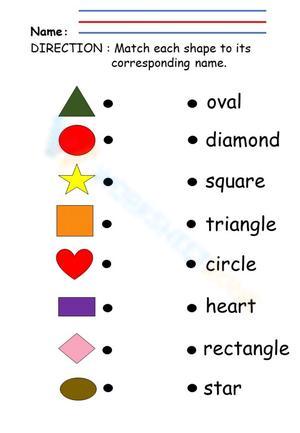
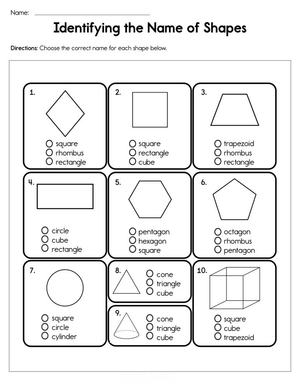
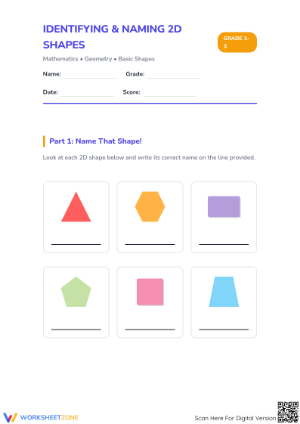
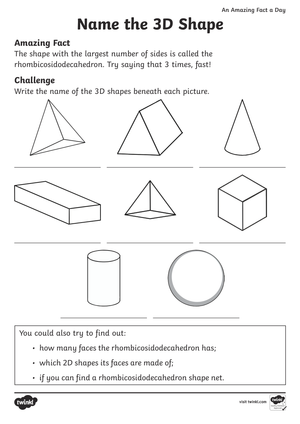
The worksheets cover the two-dimensional shapes first graders are responsible for — circles, triangles, squares, rectangles, hexagons, and trapezoids — as well as the three-dimensional figures introduced at this grade: cubes, cones, cylinders, and spheres. Activities are not uniform across worksheets. Students label diagrams from a word bank, sort shapes by side count, identify which shape in a group does not belong, and match 3D figures to photographs of real objects. The variety matters because different tasks tax different parts of shape knowledge.
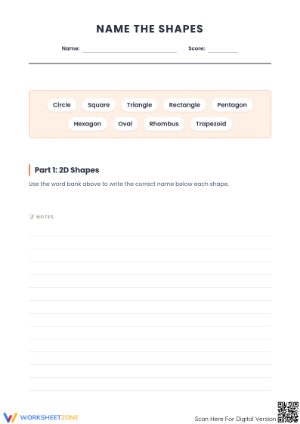
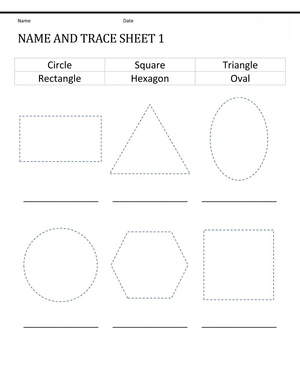
- Labeling shape diagrams using a provided word bank
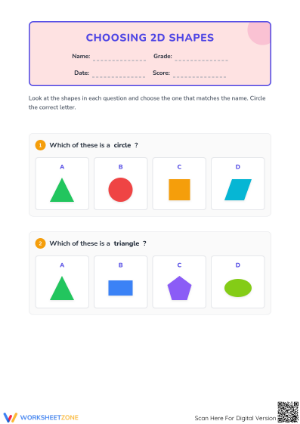
- Sorting shapes into attribute-based groups by side or corner count
- Identifying non-examples in a mixed array
- Matching 3D figures to real-world objects
- Describing shapes using precise terms for sides and corners
Vocabulary is layered intentionally. Earlier worksheets use "corner" and "side." Later ones introduce "vertex" and "vertices." Teachers can move students through this language progression at their own pace since each worksheet stands independently.
Attribute Thinking: Why It Matters at This Grade Level
Most first graders arrive knowing shape names from preschool, but they identify shapes the way they identify animals — by overall appearance. A triangle points up; a square looks like a die face. The shift that 1st grade geometry demands is replacing that visual-gestalt recognition with attribute counting. A student who can say "this is still a triangle because it has three closed sides and three corners, even though it's pointing sideways" has made the conceptual move the standards require.
Working through name the shapes worksheets for 1st grade that deliberately show shapes in uncommon orientations — a rectangle standing on its short end, a triangle aimed left, a hexagon rotated off-axis — is precisely how that gestalt recognition gets disrupted. Students who only ever see "standard" shapes on practice materials sort correctly in familiar worksheets and fail when assessments use rotated figures. The orientation variation built into these worksheets addresses that gap before it becomes a testing problem.
Student Mistakes to Anticipate in This Unit
The rectangle-square confusion is the most consistent error in first grade geometry. Students typically treat "square" and "rectangle" as distinct and opposite categories, which means when asked to circle all rectangles in a mixed array, they skip the squares entirely. The fix is brief: count the corners together, confirm all four are right angles, then check whether all four sides match in length. That side-length comparison — not a re-teaching lecture — corrects the error in the moment and usually sticks.
Orientation errors come second. A student who correctly names a triangle pointing up will often write "not a triangle" or skip the item when the same shape appears inverted. Redirecting attention to the side count — three sides, all closed — pulls focus away from the overall figure and onto the defining attribute. Hexagons produce a third reliable confusion: students frequently call them octagons because both have "a lot of sides." Having students tap and count each side before writing the name slows the guess-and-move-on habit that produces this error consistently across classrooms.
How to Work These Worksheets Into Your Teaching Week
The most efficient use is as a four-to-five-minute warm-up at the start of a math block — students name and label shapes independently while the teacher takes attendance or circulates to check in. The worksheets also drop naturally into math stations: one station handles geometry practice while others address number fluency. Because each worksheet is standalone, there is no required sequence; pull whichever one matches the current week's focus.
Small group sessions are where name the shapes worksheets for 1st grade pay off most clearly as a diagnostic tool. Sitting with three or four students and a single worksheet, a teacher can observe exactly where attention goes: Does the student count sides? Does she look at color or size first? Does she rotate the paper to reorient a shape that appears "wrong"? Those behaviors reveal whether a student is reasoning from attributes or from appearance — information that shapes the next day's instruction far more than a circled answer ever will.
Getting the Most From This Set With Mixed-Ability Classes
Students still building basic shape recognition benefit most from the word-bank labeling worksheets, where the vocabulary barrier is removed and the task is purely identification. Students who have the names solid can move to attribute-sorting tasks, which require them to explain why a shape belongs in a category — that shift from naming to justifying is where the deeper geometry work happens. For students with fine-motor challenges, pointing to correct answers or sorting physical manipulatives alongside the printed worksheet accomplishes the same cognitive work without the handwriting demand.
Advanced students can be pushed to generate non-examples beyond what the worksheet provides: draw a four-sided figure that is not a rectangle, then explain why. That open-ended extension pairs cleanly with the printed practice and moves students toward the kind of spatial argument that 2nd grade geometry will expect from them.
Standard Alignment
The worksheets address CCSS.MATH.CONTENT.1.G.A.1, which requires students to distinguish shapes using defining attributes — number of sides, number of vertices, presence of curves — and to understand that color, size, and orientation are irrelevant to naming. In classroom terms, this standard is the conceptual anchor of the entire 1st grade geometry unit; everything else in the 1.G domain depends on students understanding what actually defines a shape rather than what it looks like from a familiar angle. The 3D shape tasks also support 1.G.A.2, which asks students to compose shapes from solid figures and recognize those figures in real-world contexts.
Frequently Asked Questions
Which shapes do first graders need to be able to name?
First graders are responsible for six 2D shapes — circle, triangle, square, rectangle, hexagon, and trapezoid — and four 3D figures: cube, cone, cylinder, and sphere. The standard expects students to name these shapes and describe the defining attributes that make each one what it is, not just recognize familiar-looking examples.
How do you explain the square-rectangle relationship to a six-year-old?
The clearest approach is to measure together. Tell students that a rectangle has four right-angle corners and opposite sides that match in length — then count the corners of a square on the worksheet and compare all four sides. A square passes both tests, which means it qualifies as a rectangle. The distinguishing fact is that a square's all four sides are equal, making it a special case rather than a separate shape entirely.
Are three-dimensional shapes covered in this set?
Yes. Several worksheets focus specifically on cubes, spheres, cones, and cylinders, asking students to name each figure and connect it to a real-world object. The 3D work is intentionally linked to the 2D work — students observe that a cylinder has two circular faces, tying solid figures back to the flat shapes they already know and reinforcing that connection across the unit.
Can these be used for homework or morning work?
The name the shapes worksheets for 1st grade format is straightforward for both purposes. Directions are printed clearly on each worksheet, and the tasks — labeling, circling, writing a name — are self-explanatory enough that caregivers can support at home without needing teacher context. For morning work, the labeling and sorting tasks finish comfortably in the eight minutes before the school day formally begins, which is one of the few windows in a 1st grade morning that reliably stays consistent.













 Interactive Worksheet Maker
 Quiz Maker
 Word Search Maker
 Crossword Puzzle Maker
 Word Scramble Generator
 Sentence Scramble Generator
 Handwriting Worksheet Generator
 Name Tracing Generator
 Fill In The Blank Generator