


























Views
Downloads

Printable 4-Sided Shape Sorting Worksheet | Grade K-2
Paste this activity's link or code into your existing LMS (Google Classroom, Canvas, Teams, Schoology, Moodle, etc.).
Students can open and work on the activity right away, with no student login required.
You'll still be able to track student progress and results from your teacher account.
Help your Kindergarten and Grade 1 students master basic geometry with this interactive shape sorting worksheet. By identifying and classifying polygons based on the number of sides, learners develop the foundational visual discrimination skills necessary for advanced math. This activity transforms abstract geometry concepts into a hands-on adventure that reinforces shape properties and vocabulary through active participation and tactile engagement.
At a Glance
- Grade: K–2 · Subject: Math / Geometry
- Standard:
CCSS.MATH.CONTENT.K.G.B.4— Analyze and compare 2D shapes by describing their sides and vertices- Skill Focus: Identifying and sorting 4-sided shapes
- Format: 3 pages · 13 tasks · Answer key included · PDF
- Best For: Interactive math centers and geometry introduction
- Time: 15–20 minutes
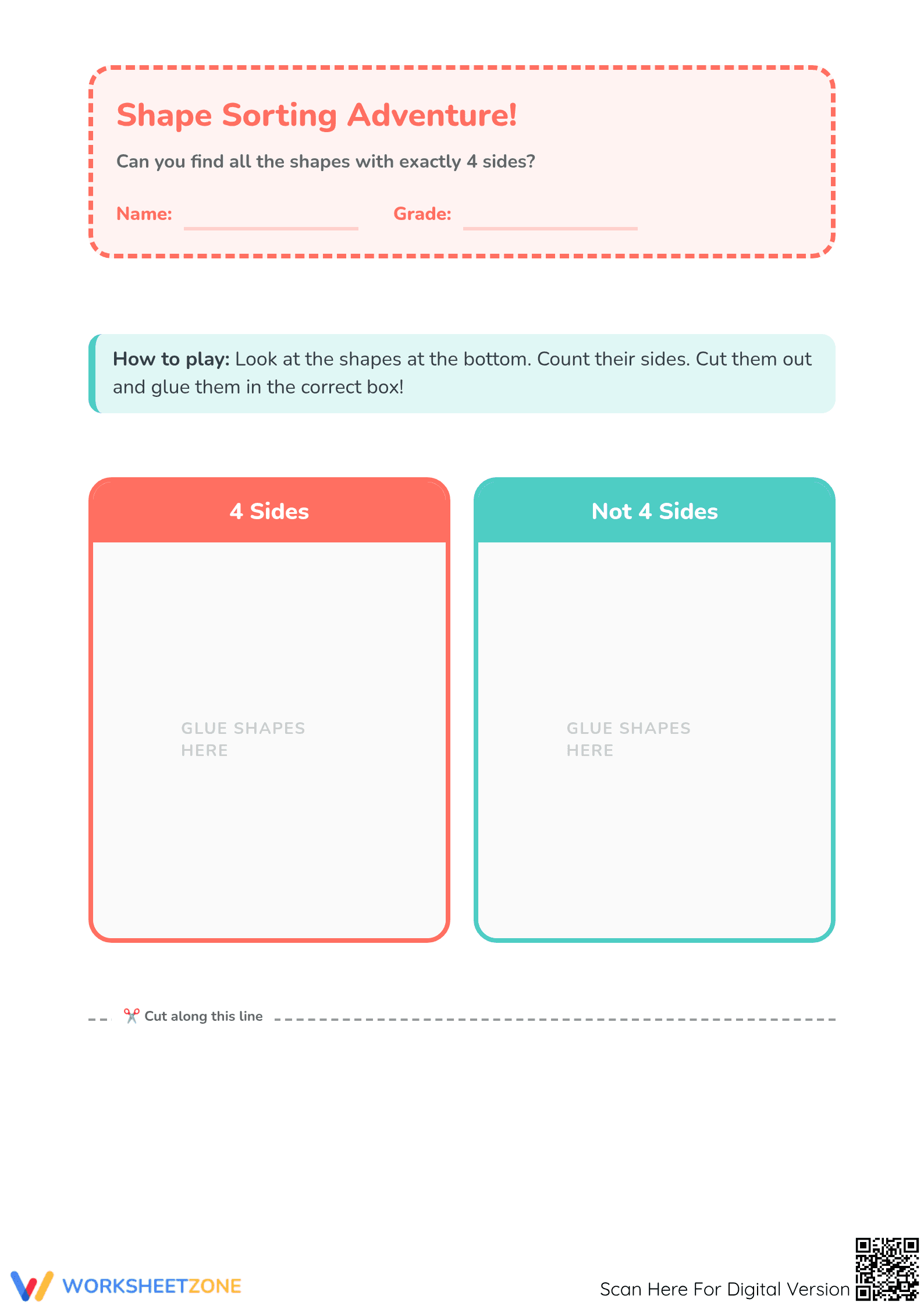
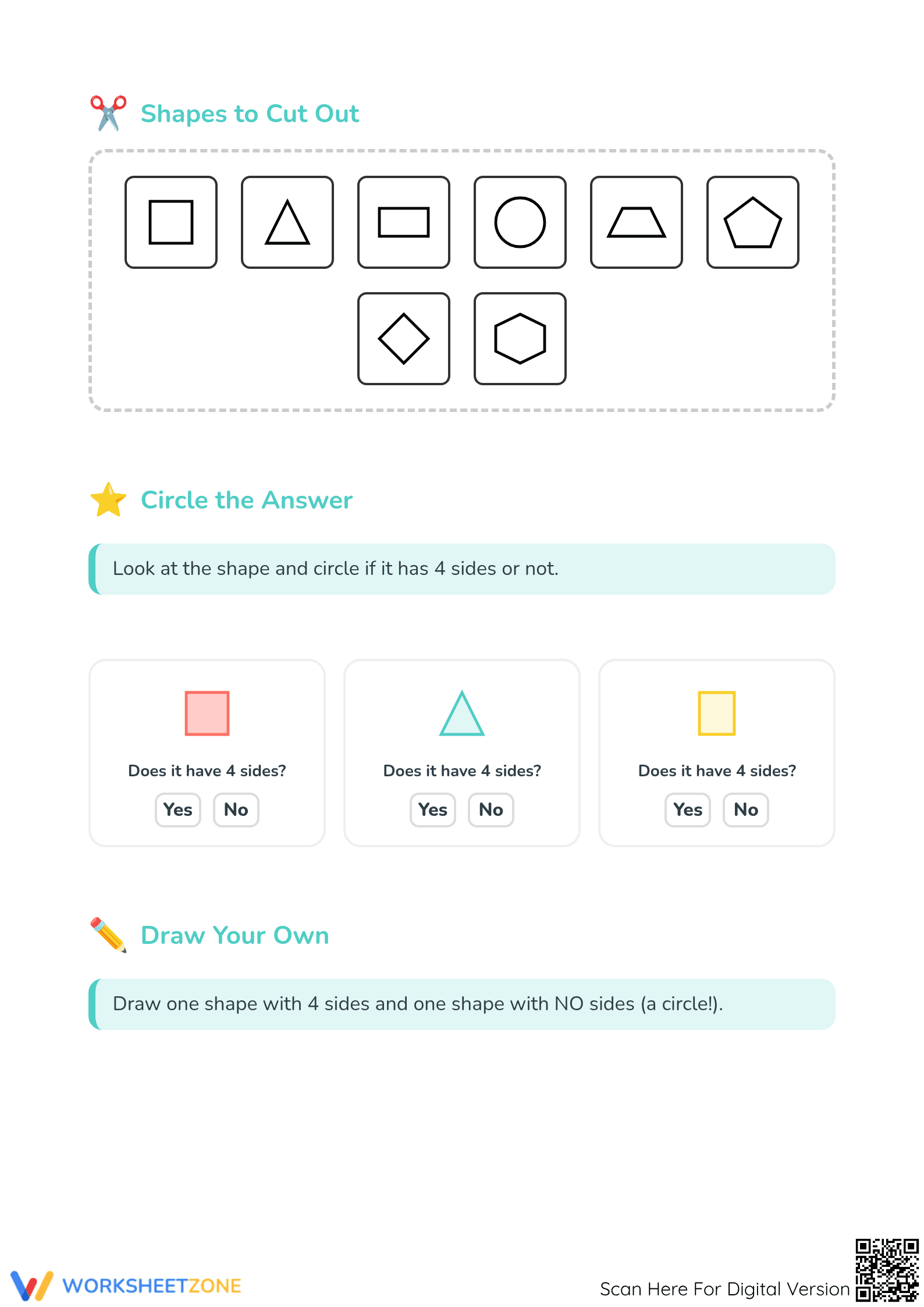
This comprehensive 3-page PDF includes a primary sorting mat where students glue shapes into "4 Sides" or "Not 4 Sides" columns. It features a dedicated page of 8 varied shapes to cut out, including squares, triangles, circles, and hexagons. Additionally, the packet provides circling exercises for quick assessment and a creative drawing prompt to encourage student agency while reinforcing side-counting skills through different modalities.
Implementing this activity is incredibly efficient for busy educators. First, Print the required copies for your class, which takes seconds for a standard group. Second, Distribute the materials alongside scissors and glue; students can begin immediately with the clear "How to Play" instructions provided on the page. Finally, Review the completed sorting mats using the included answer key for instant formative feedback in under 2 minutes total teacher prep time.
This worksheet is strictly aligned to `CCSS.MATH.CONTENT.K.G.B.4`, which requires students to analyze and compare two-dimensional shapes using informal language to describe their parts, such as the number of sides. Focusing on the distinction between quadrilateral and non-quadrilateral figures builds a bridge toward later Grade 1 standards like `1.G.A.1`. Both standard codes can be copied directly into lesson plans, IEP goals, or district curriculum mapping tools for seamless documentation.
Use this worksheet as a concluding activity during your direct instruction on shape attributes. After identifying sides on an anchor chart, transition students to the "Shape Sorting Adventure" for independent practice. For a formative assessment tip, observe students as they sort the trapezoid and pentagon; their ability to distinguish these often-confusing shapes provides high-signal data on their conceptual understanding of side counting and geometric classification before moving to three-dimensional figures.
This resource is designed for Kindergarten and Grade 1 students beginning their geometry journey. It offers natural differentiation for English Language Learners (ELLs) through heavy visual cues and simplified instructional vocabulary. Pair this worksheet with a read-aloud of "The Greedy Triangle" or a set of physical pattern blocks to provide a multi-sensory learning experience that appeals to varied learner profiles and ensures all students can access the core curriculum.
Effective geometry instruction in early childhood relies on the physical manipulation of shapes as highlighted by research in the RAND AIRS 2024 report. This worksheet operationalizes these findings by requiring students to cut and glue shape assets, which promotes deeper cognitive processing of geometric properties compared to passive identification. By focusing on `CCSS.MATH.CONTENT.K.G.B.4`, the activity addresses the critical need for students to move beyond prototypical shape recognition toward attribute-based classification. ScienceDirect TpT Analysis indicates that hands-on activities significantly increase student engagement and retention of vocabulary in early elementary math settings. Integrating such evidence-based practices ensures that classroom time is spent on high-impact learning tasks that align with national standards for mathematical proficiency and spatial reasoning development. The inclusion of a drawing task further solidifies the connection between identifying and producing geometric forms, a key milestone in early math development.


