


























Views
Downloads


Printable 3D Shapes Sorting Worksheet | Grade K-1 Math
Paste this activity's link or code into your existing LMS (Google Classroom, Canvas, Teams, Schoology, Moodle, etc.).
Students can open and work on the activity right away, with no student login required.
You'll still be able to track student progress and results from your teacher account.
This hands-on geometry worksheet helps kindergarten and first-grade students classify three-dimensional shapes based on their physical attributes. Students cut out various 3D figures and sort them into categories based on whether they can roll, stack, or slide, building foundational spatial reasoning and geometric analysis skills.
At a Glance
- Grade: K-1 · Subject: Math
- Standard:
CCSS.MATH.CONTENT.K.G.B.4— Analyze and compare 3D shapes using informal language to describe parts- Skill Focus: Classifying 3D shapes (roll, stack, slide)
- Format: 2 printable pages · 10 sorting problems · No answer key · PDF
- Best For: Math centers and independent practice
- Time: 15–20 minutes
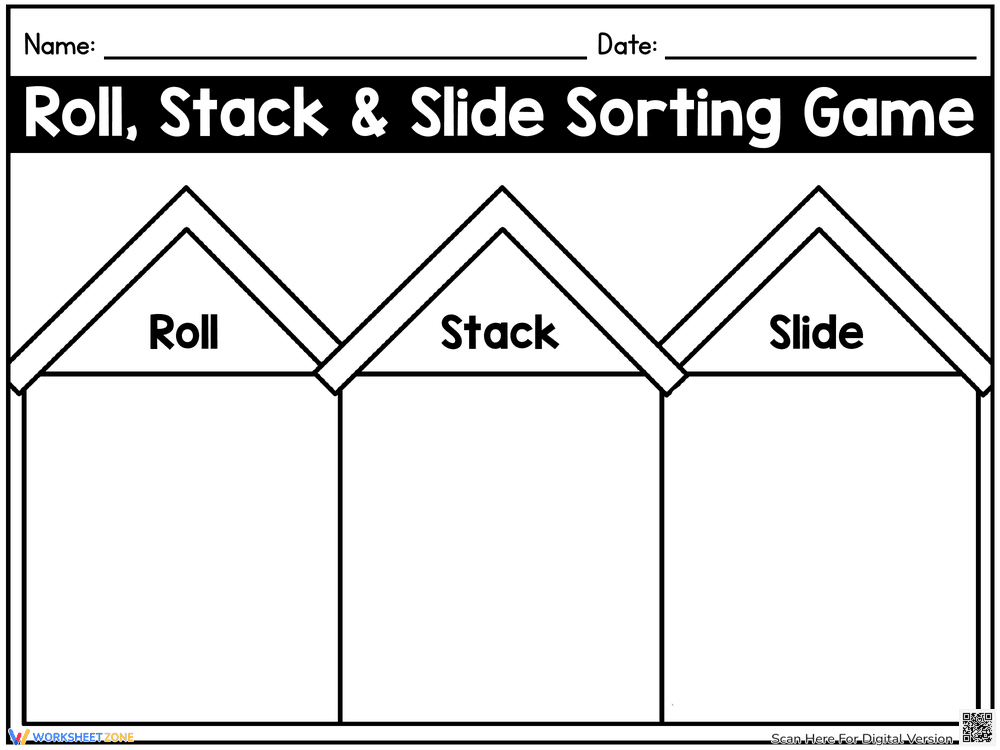
This printable resource includes a visually engaging sorting mat featuring three distinct houses labeled Roll, Stack, and Slide. The second page provides three identical sets of ten 3D shapes—including spheres, cubes, cylinders, cones, and prisms—designed to minimize paper waste by serving three students per page. Students will use scissors and glue to place each shape into its correct category.
- Guided practice: Introduce the concepts of rolling, stacking, and sliding using real-world 3D objects before introducing the paper shapes.
- Supported practice: Students work in small groups to cut out the 10 shapes and discuss which category each belongs to based on its flat or curved surfaces.
- Independent practice: Students independently glue the shapes onto their sorting mat to demonstrate mastery of geometric attributes.
This progression follows a gradual-release model, ensuring students grasp the physical properties of shapes before completing the abstract sorting task.
Aligned to CCSS.MATH.CONTENT.K.G.B.4: Analyze and compare two- and three-dimensional shapes, in different sizes and orientations, using informal language to describe their parts and other attributes. It also supports first-grade geometry goals by reinforcing defining attributes of 3D figures. Both standard codes can be copied directly into lesson plans, IEP goals, or district curriculum mapping tools.
Deploy this sorting game during math centers after a direct instruction lesson on 3D shapes. It serves as an excellent hands-on activity to solidify understanding of curved versus flat surfaces. As a formative assessment, observe students while they sort; if a student places a sphere in the Stack category, prompt them to explain their reasoning to identify misconceptions. Expect completion to take 15 to 20 minutes.
This resource is designed for kindergarten and first-grade students developing early geometry skills. It is highly effective for kinesthetic learners who benefit from cutting and pasting rather than traditional pencil-and-paper tasks. Pair this worksheet with a physical set of wooden or plastic 3D blocks so students can physically test whether a shape rolls, stacks, or slides before gluing their paper pieces.
Mastering geometric attributes is a critical step in early childhood mathematics. This activity aligns with CCSS.MATH.CONTENT.K.G.B.4, requiring students to analyze and compare 3D shapes using informal language to describe parts. According to the RAND AIRS 2024 report on early math interventions, hands-on sorting tasks that require students to categorize objects based on physical properties significantly improve spatial reasoning and later geometry achievement. By physically manipulating the cut-outs and deciding whether they roll, stack, or slide, young learners bridge the gap between concrete objects and abstract geometric concepts. This active engagement helps solidify their understanding of how flat and curved surfaces dictate a shape's behavior in space. Teachers can rely on this evidence-based approach to build a strong mathematical foundation, ensuring students are prepared for more advanced geometric reasoning in subsequent grade levels.


