Matching Shapes Printable Worksheets for 1st Grade
These matching shapes printable worksheets for 1st grade give teachers a ready-to-use geometry practice set built around the visual discrimination work that Grade 1 students actually need — not naming shapes from memory, but learning to see what makes a triangle a triangle even when it appears rotated or drawn in an unexpected size. Each worksheet targets a specific skill in the shape recognition sequence, so teachers can assign them in any order based on where their class is in the unit.
The Specific Skills These Worksheets Target
The set covers the core 2D shapes that anchor early geometry: circle, square, rectangle, triangle, and hexagon. Several worksheets also introduce simple solids — cube, cone, cylinder, sphere — for teachers whose pacing guides bring 3D figures into the same unit. Across the set, students practice four distinct skill types rather than cycling through the same line-matching format on every worksheet.
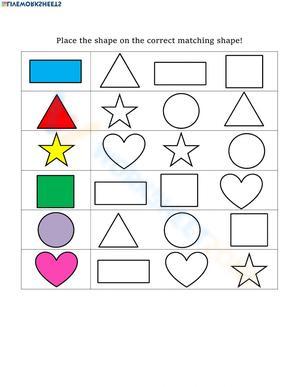
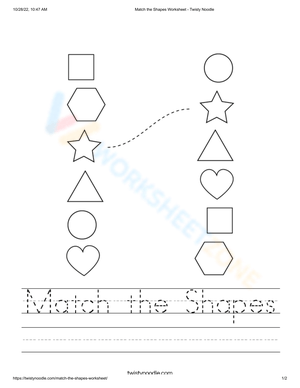
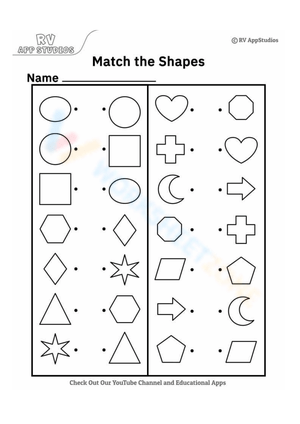
- Drawing a line from one shape to its identical match across different sizes and orientations
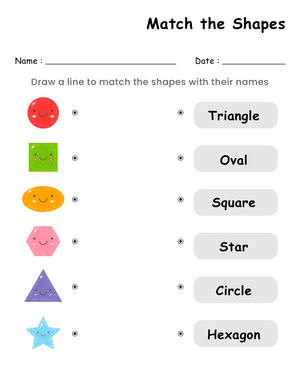
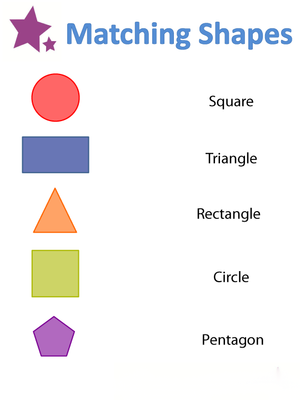
- Connecting a shape to its written name
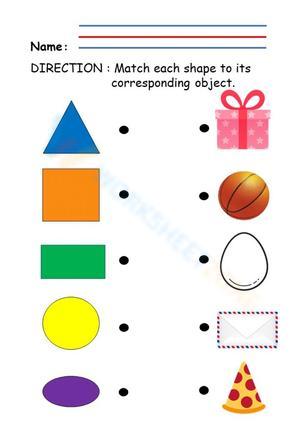
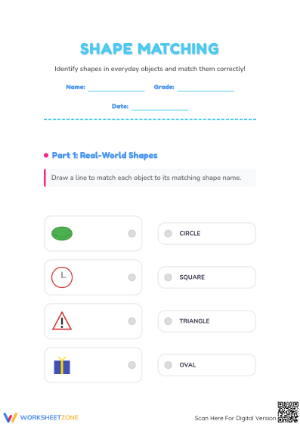
- Matching real-world objects and photographs to a geometric shape
- Sorting by attributes: number of sides, presence of corners, straight versus curved edges
- Identifying simple 3D shapes from two-dimensional picture representations
That last category — attribute sorting — deserves a note. It is more cognitively demanding than the others because students must set aside the overall look of a shape and focus on one specific feature. A first grader who can match a hexagon by sight may still struggle to articulate that it has six straight sides. The sorting worksheets push toward that level of description, which is where the real geometric thinking begins.
Frequent Student Errors Worth Watching For
In the matching shapes printable worksheets for 1st grade, the most persistent error pattern surfaces when squares and rectangles appear on the same page. Many first graders carry a prototype image: squares are "small" and rectangles are "long." When a worksheet presents a wide, squat rectangle alongside a large square, students will sometimes match the two together because the proportions look similar. Introducing the phrase "a square is a special rectangle" too early compounds the confusion — students who hear that before their attribute language is firm often become less certain, not more. These worksheets keep square-and-rectangle comparisons explicit so the confusion surfaces during practice rather than hiding until a test.
A second pattern worth watching: on real-world picture-matching worksheets, a student will correctly pair a clock with a circle, then immediately match a wrapped gift box to a square because the ribbon's crossed pattern creates four corner-like angles in the photograph. They are reading visual noise rather than the shape itself. Keeping photographs clean and uncluttered addresses this directly, and several worksheets in the set are designed with that constraint built in.
Why This Format Works the Way It Does in First Grade
Grade 1 geometry lands at a particular developmental moment. Students at this age are still building their ability to hold a mental image and compare it to a new example — what researchers in cognitive development describe as analogical reasoning at the perceptual level. A line-matching worksheet externalizes that comparison process: instead of working through it mentally, a student can track back and forth with a finger before committing. That physical scanning is not a shortcut; it is how the comparison gets practiced until it moves inward.
Short, frequent practice also outperforms a single long exposure for this kind of visual learning. Three ten-minute geometry warm-ups across a week build shape recognition more reliably than one forty-minute block. The worksheet format supports that rhythm because the setup cost is zero — no materials beyond crayons, no procedures to re-explain, no technology to troubleshoot before students can begin.
How to Build These Worksheets Into Your Lesson Plans
Matching shapes printable worksheets for 1st grade work across more parts of the school day than teachers typically expect. The line-matching format runs smoothly as morning work — students who arrive before the bell can start without any instruction, which smooths the transition after morning meeting without requiring the teacher to facilitate. Attribute-sorting pages, which demand more focused analysis, belong after direct instruction rather than before it.
For math centers, place the cut-and-paste version in a tub with scissors and a glue stick, and set a completed example face-up at the top of the stack. First graders can self-check against the example without asking for help, which keeps the center running independently through the rotation. For small-group intervention, use the same worksheet the rest of the class completed but reduce the answer field — crossing off two of the five options before the student begins lowers cognitive load without altering the geometric content of the task.
These worksheets also function as informal assessment in motion. Walking the room while students work, clipboard in hand, and noting who reverses shape names, who matches by color or overall size, and who ignores orientation yields more actionable data than collecting a scored page at the end of math. Those real-time observations shape the next day's mini-lesson in ways a stack of corrected papers cannot.
Differentiating These Worksheets Across Ability Levels
For students who need additional support, limit each session to four shapes maximum, keep all figures upright in standard orientation, and stay with 2D figures until those are secure. A line-matching page with a circle, a triangle, and a square — no distractors that look proportionally similar — lets a student build a reliable recognition base before encountering edge cases. Pairing the worksheet with a brief hands-on moment first, such as tracing the corners of a physical square before sitting down to work, means the paper reinforces a concrete experience rather than introducing an abstraction cold.
For students ready for more challenge, modify the task at the point of use rather than swapping worksheets. Ask those students to complete the matching first, then whisper or write one reason why two shapes belong together. Orientation is the strongest lever here: presenting triangles with the point facing left or the flat base at the top exposes whether a student understands the shape or only recognizes its most common picture. A student who can match a rotated hexagon is demonstrating geometric understanding, not visual memory.
Standard Alignment
These worksheets address CCSS.MATH.CONTENT.1.G.A.1, which asks students to distinguish between defining attributes — number of sides, number of corners — and non-defining attributes such as color, overall size, and orientation, and to build and draw shapes that match a given attribute description. The line-matching and name-matching tasks cover the recognition side of that standard; the attribute-sorting worksheets address the defining-versus-non-defining distinction the standard explicitly calls out. Matching shapes printable worksheets for 1st grade that include both task types give teachers direct coverage of the full standard rather than only its surface-level naming component, which is what single-format sets often miss.
Frequently Asked Questions
Which shapes should come first in Grade 1 matching practice?
Circle and triangle are the cleanest starting points because their visual profiles are the most distinct from everything else on the page. Square and rectangle should follow together, with explicit attention to the attribute overlap — that pairing produces the most consistent confusion in student work. Hexagon typically comes last among the core 2D shapes. Solid shapes work best once 2D recognition is stable.
Do these worksheets travel home well, or are they better kept in school?
Line-matching and color-and-match formats go home successfully because families can support the task without geometry vocabulary. Attribute-sorting pages are better kept in school — the thinking conversation that belongs alongside that task is worth having in the classroom, not across a kitchen table without the teacher present to redirect common errors.
How long should a shape-matching worksheet take a first grader to complete?
A focused student finishes a line-matching worksheet in six to ten minutes. Attribute-sorting tasks run closer to twelve to fifteen minutes when students are working carefully. A student who finishes in under three minutes is likely matching by sight memory and skipping the attribute-checking step the worksheet is built to reinforce — worth a quick conversation before they move on.
Are there any limitations teachers should know about before using these?
The cut-and-paste format frustrates students who struggle with fine motor control — the task becomes about scissors management rather than geometry. For those students, a line-matching or color-and-match version covers the same content without the physical demand. Also, students who have had no prior exposure to shape names at all may need a brief whole-group introduction before independent work; the worksheets reinforce shape recognition, they do not introduce it from zero.
Clear All