


























Views
Downloads
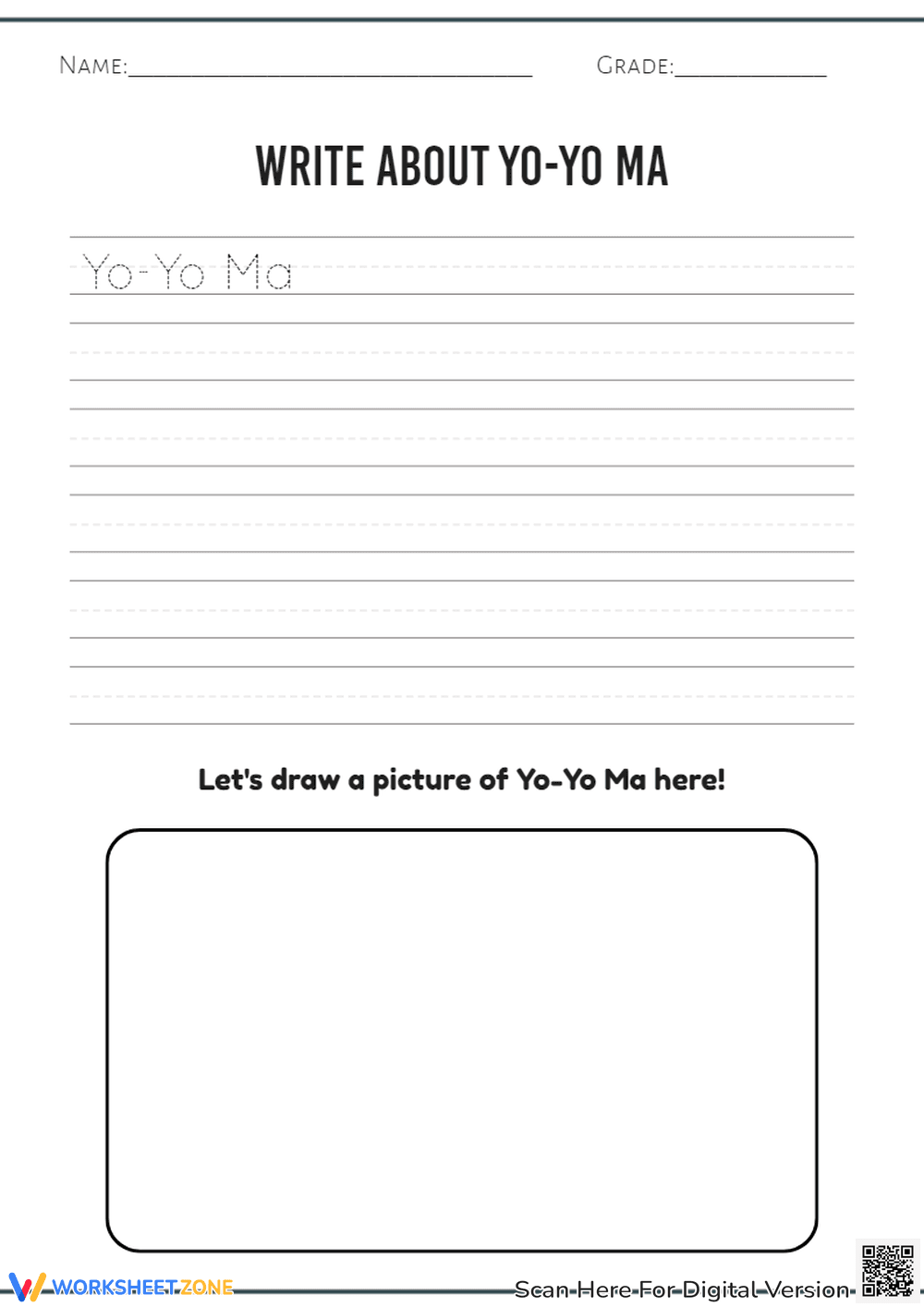

Yo-Yo Ma Writing Worksheet | Grade 2 Printable
Paste this activity's link or code into your existing LMS (Google Classroom, Canvas, Teams, Schoology, Moodle, etc.).
Students can open and work on the activity right away, with no student login required.
You'll still be able to track student progress and results from your teacher account.
This printable informative writing worksheet helps second and third-grade students practice handwriting and composition while learning about renowned cellist Yo-Yo Ma. Students trace the musician's name, write original facts on primary dashed lines, and create a matching illustration to support their text.
At a Glance
- Grade: 2 · Subject: ELA
- Standard:
CCSS.ELA-LITERACY.W.2.2— Write informative texts introducing a topic with facts.- Skill Focus: Informative Writing & Handwriting
- Format: 1 page · 2 tasks · No answer key · PDF
- Best For: Independent practice
- Time: 15–20 minutes
This single-page resource features a clear, structured layout designed for early elementary writers. It includes a tracing section for Yo-Yo Ma's name to reinforce proper letter formation, followed by several blank primary writing lines with dashed midlines for drafting an informative paragraph. The bottom half of the page provides a dedicated blank frame where students can draw a picture of the cellist, integrating visual arts with their written composition.
This worksheet is designed for immediate classroom implementation with a streamlined workflow:
- Print (1 minute): Generate copies of the single-page PDF for the entire class.
- Distribute (1 minute): Hand out the worksheets along with pencils and coloring materials.
- Review (3 minutes): Briefly introduce Yo-Yo Ma and explain the writing and drawing expectations.
With under five minutes of total teacher prep time, this resource is highly suitable for emergency sub plans, morning work, or spontaneous writing blocks during Asian Pacific American Heritage Month.
This activity aligns with CCSS.ELA-LITERACY.W.2.2: "Write informative/explanatory texts in which they introduce a topic, use facts and definitions to develop points, and provide a concluding statement or section." It also supports foundational handwriting and fine motor skill development. Both standard codes can be copied directly into lesson plans, IEP goals, or district curriculum mapping tools.
Deploy this worksheet during an independent writing center after reading a biography or watching a video clip about Yo-Yo Ma. Alternatively, use it as a cross-curricular social studies and ELA activity during Asian Pacific American Heritage Month. While students work, teachers can conduct formative assessments by observing pencil grip, letter sizing on the dashed lines, and the ability to recall and write accurate facts. Expected completion time ranges from 15 to 20 minutes depending on the student's writing fluency and drawing detail.
This resource is primarily designed for second and third-grade students developing their informative writing and handwriting skills. The primary dashed lines provide built-in scaffolding for students who still need spatial guidance for letter formation. It pairs perfectly with a read-aloud biography of Yo-Yo Ma or a broader unit on famous musicians and artists.
Integrating handwriting practice with content-area writing, such as biographical profiles, significantly enhances early literacy development. This worksheet aligns with CCSS.ELA-LITERACY.W.2.2, requiring students to write informative texts introducing a topic with facts. According to a Fisher & Frey (2014) analysis on instructional scaffolding, providing structured writing spaces alongside creative drawing tasks lowers the affective filter, allowing young learners to process new information more effectively. By combining name tracing, guided primary lines, and an illustration box, this resource supports cognitive retention of historical figures while reinforcing essential fine motor skills. The dual-modality approach ensures that students not only practice their penmanship but also engage deeply with the subject matter, making it a highly effective tool for comprehensive literacy instruction in the early elementary grades.


