These asian pacific american heritage month worksheets give teachers a ready set of reading passages, biographical profiles, map activities, and historical timeline exercises built around AAPI history — material that belongs in the curriculum year-round but receives deliberate focus in May. The set spans content from the Chinese immigrant laborers who completed the Transcontinental Railroad on May 10, 1869, to the legislative milestones and civil rights organizing that shaped the following century.
What Each Worksheet Covers
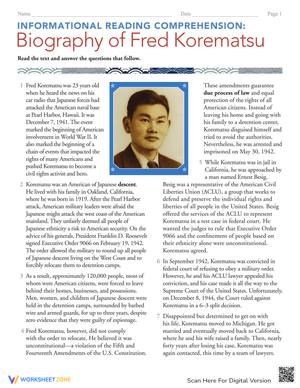
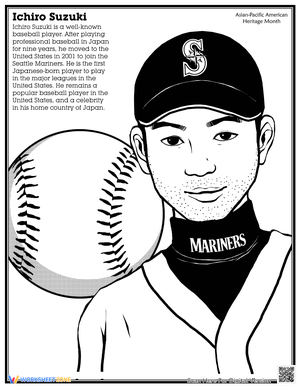
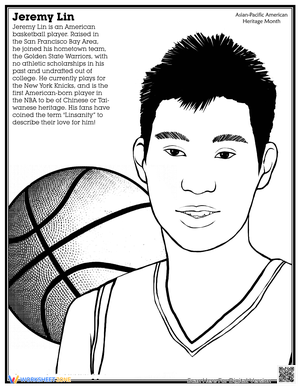
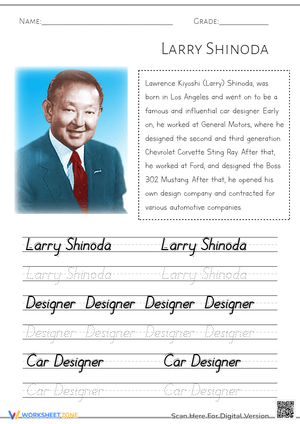
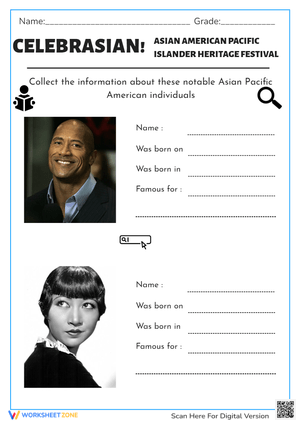
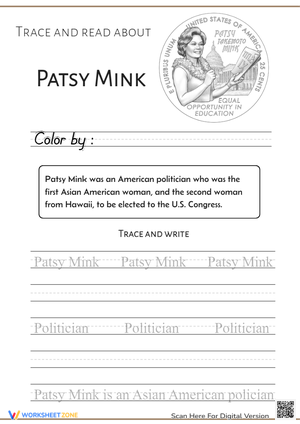
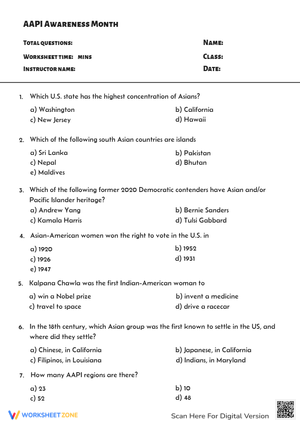
Biographical profiles introduce figures who tend to disappear from standard textbook chapters: Dalip Singh Saund, the first Asian American elected to the U.S. House of Representatives; Patsy Takemoto Mink, the first woman of color in Congress; and Filipino labor organizer Larry Itliong, whose pivotal role in the Delano grape strike is routinely overshadowed in classroom materials by coverage of César Chávez. Each profile pairs a reading passage with comprehension questions that move from literal recall toward inference.
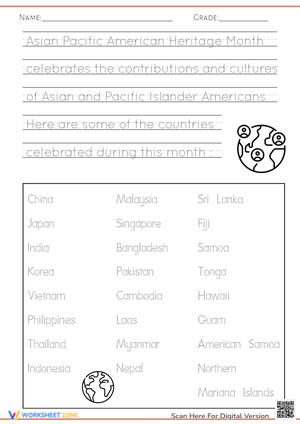
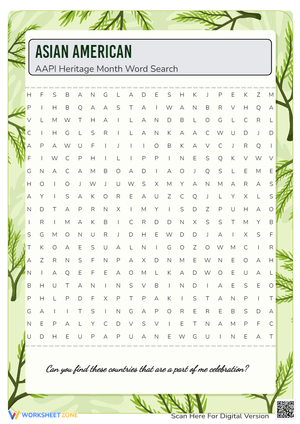
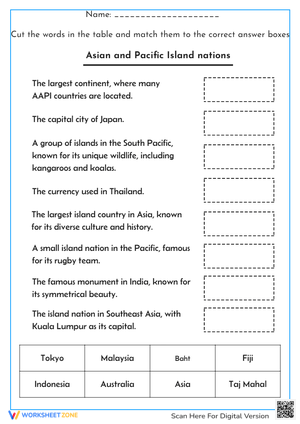
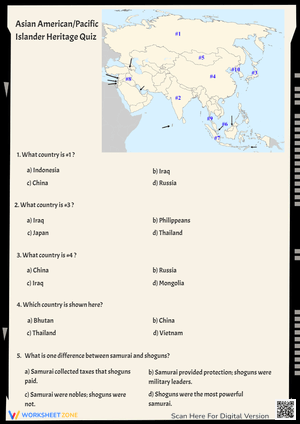
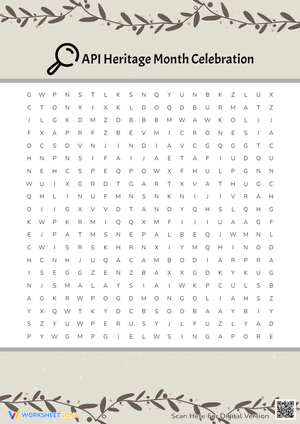
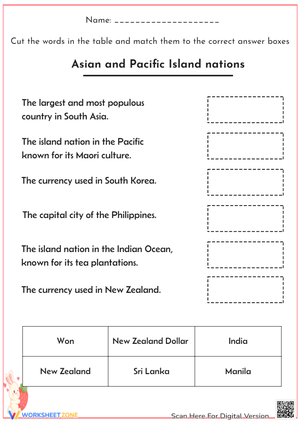
- Geography and map work: Students label and distinguish the subregions within the AAPI umbrella — East, Southeast, and South Asia, plus the Pacific Island groupings of Melanesia, Micronesia, and Polynesia. Most students arrive with no mental map of the Pacific, which makes this activity harder — and more valuable — than it first appears.
- Historical timelines: Sequencing exercises run from the 1840s through the 1990s, placing the Japanese American incarceration of the 1940s alongside the Immigration Act of 1965 and congressional recognition of AAPI heritage in 1992.
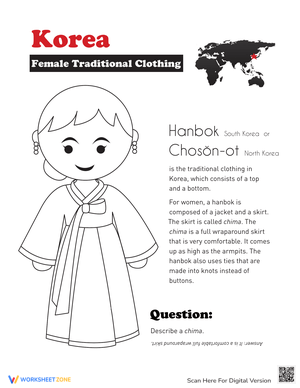
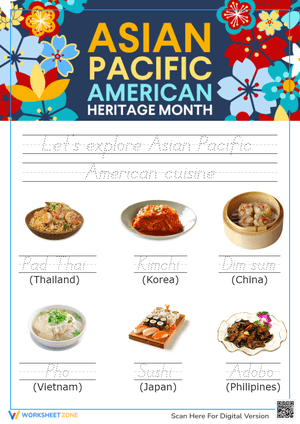
- Cultural literacy activities: These focus on the function and meaning of traditions rather than surface-level identification of foods or costumes. Students consider why a tradition exists, not just what it looks like from the outside.
Misconceptions Students Bring In — and What the Worksheets Surface
The most predictable error is treating AAPI as a unified culture. Students who correctly identify Japan and Vietnam as separate nations will still write "Asian culture values education" as though fifty-plus nationalities share a worldview. That is the model minority myth operating at the level of assumption rather than argument, and it surfaces early in any unit on AAPI history. A biographical worksheet on Grace Lee Boggs — a Chinese American philosopher who spent decades organizing in Black Detroit — disrupts that framing in a way classroom discussion rarely achieves on its own, because students have to work through her ideas on paper before the teacher ever names the misconception.
A second consistent pattern: students conflate Pacific Islander heritage with East or Southeast Asian heritage. On the geography worksheet, many place Samoa, Tonga, and Guam along the Asian coast rather than scattered across the central and south Pacific. That spatial error is worth correcting directly, because it distorts how students interpret everything else in the unit.
Fitting These Worksheets Into Your Lesson-Planning Rotation
The biographical reading passages in asian pacific american heritage month worksheets work well as a Monday morning warm-up — five to eight minutes before the day's main lesson — because they build familiarity with figures students encounter again in timeline and geography activities later in the week. A jigsaw structure is particularly effective here: assign small groups different biographical worksheets, have each group complete the reading and comprehension questions, then reconfigure so each new group contains one expert on each figure. Students teach one another, and the class covers five or six historical figures in a single forty-minute period without the cognitive overload of reading all five passages in sequence.
Teachers who treat the timeline worksheet as an anchor document — returning to it briefly at the start of each new topic to place new content in sequence — find that students hold the chronology far better by the end of May. The map worksheet works the same way: a quick reorientation before any new region comes up reinforces geography without requiring dedicated instructional time.
Adapting the Work for Different Learners
For students who need more support with dense historical text, the biographical passages pair well with a three-column note-taking frame: what I read, what surprised me, questions I still have. That structure keeps the reading active without altering the content. Students who move through material quickly can extend any biographical worksheet into a comparative essay — contrasting the immigrant experience documented at Angel Island with the one at Ellis Island, drawing on evidence from the passage alongside outside sources.
One practical note: the passages are written at a single Lexile level, which puts the differentiation work on the teacher rather than distributing it through the material itself. Students reading significantly below grade level will need a partner read or read-aloud support; the content holds even when independent reading doesn't. At the lower elementary level, the geography and map activities are accessible starting in first grade for basic labeling and scale upward with the addition of population, climate, or trade-route questions for middle grades.
Standard Alignment
These worksheets address CCSS.ELA-LITERACY.RI.4.3 and RI.5.3, which require students to explain historical events and concepts using specific textual detail — exactly what the biographical reading and timeline comprehension tasks demand. CCSS.ELA-LITERACY.RI.4.6 and RI.5.6, covering point of view and author's purpose in informational texts, apply to the primary source excerpts included in several worksheets. Social studies alignment varies by state, but the content maps to NCSS Thematic Standards 1 (Culture), 2 (Time, Continuity, and Change), and 9 (Global Connections). For states using the C3 Framework, the timeline and geography work supports D2.Geo.4 and D2.His.2 at the grades 3–5 band.
Frequently Asked Questions
Why is Asian Pacific American Heritage Month observed in May?
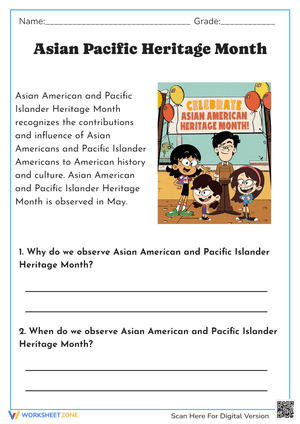
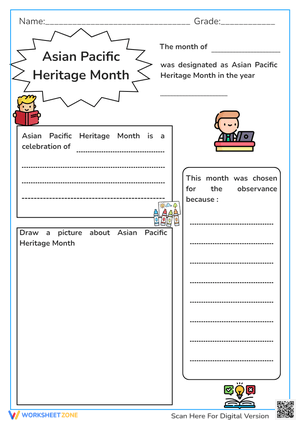
Two specific dates anchor the choice. May 7 marks the recorded arrival of the first Japanese immigrants to the United States, and May 10, 1869, is when the Transcontinental Railroad was completed — built in large part by Chinese immigrant laborers on the western route. Congress designated a Heritage Week in 1978 and expanded the observance to a full month in 1992. These asian pacific american heritage month worksheets use both dates as reference points in the timeline activities, so students connect the calendar choice to actual historical events rather than treating May as an arbitrary designation.
How do these worksheets avoid reducing AAPI history to holidays and food?
The historical and biographical content is front-loaded. Cultural traditions appear alongside the political and labor history that shaped those communities in the United States — Lunar New Year is not taught in isolation from the Chinese Exclusion Act, and Diwali does not appear without context about South Asian immigration patterns after 1965. The cultural literacy worksheets explicitly ask students to consider why traditions take the forms they do, not simply what they look like. Students encounter AAPI figures in STEM, law, labor organizing, literature, and civil rights — not just as representatives of a culture, but as people who acted in history.
Are these worksheets suited to a single grade level or a broader range?
Reading passages are written at approximately a 4th–5th grade Lexile range, which makes each worksheet directly usable in grades 3–5 and workable with moderate adjustment through grade 7. The map and timeline activities span a wider range without modification. Teachers in multi-grade settings report assigning the same asian pacific american heritage month worksheets to students across two or three grade levels, differentiating through the follow-up tasks rather than the source material — a practical solution when multiple preps share the same planning period.












 Interactive Worksheet Maker
 Quiz Maker
 Word Search Maker
 Crossword Puzzle Maker
 Word Scramble Generator
 Sentence Scramble Generator
 Handwriting Worksheet Generator
 Name Tracing Generator
 Fill In The Blank Generator