What Water Cycle Worksheets Teach in Grades 3-8
Water cycle worksheets give upper-elementary and middle school science teachers a printable way to move students from naming the stages of the water cycle to explaining how water actually moves through Earth's systems. Instead of asking students to memorize four vocabulary words, a well-built worksheet asks them to label a diagram, trace the path of a single water molecule, and describe what energy source drives each step. That shift from recall to reasoning is exactly what grade 3-8 science standards expect.
On Worksheetzone, water cycle worksheets typically pair a labeled diagram with short-answer and vocabulary tasks, so you can use one page for direct instruction and another for independent practice. Because the stages stay consistent across grade levels, the same core diagram can anchor a third-grade introduction and a seventh-grade modeling task with only the questions changing.
The Four Stages Students Label and Explain
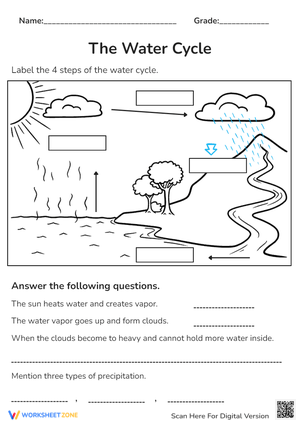
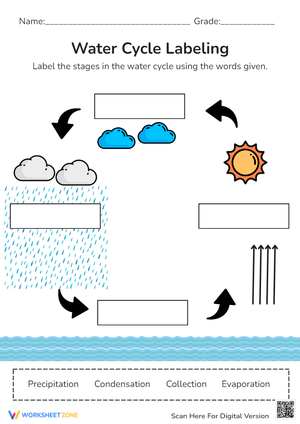
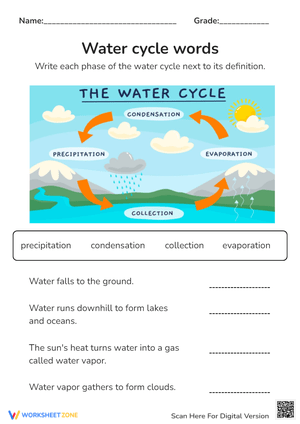
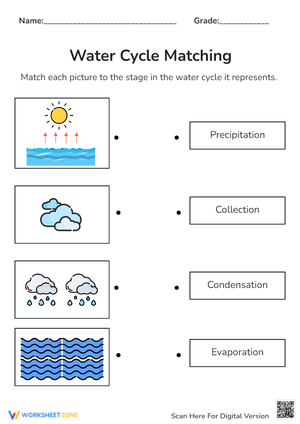
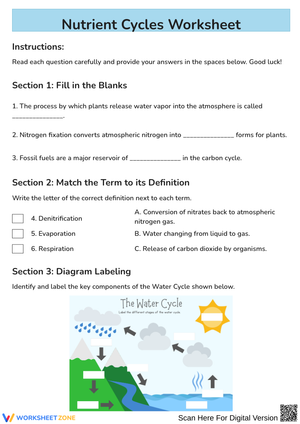
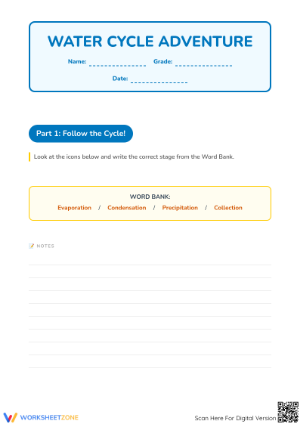
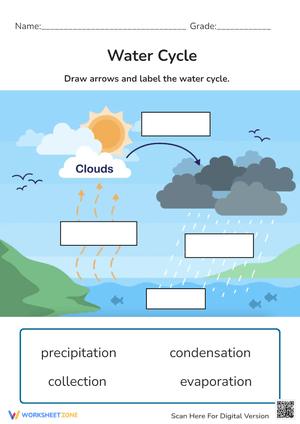
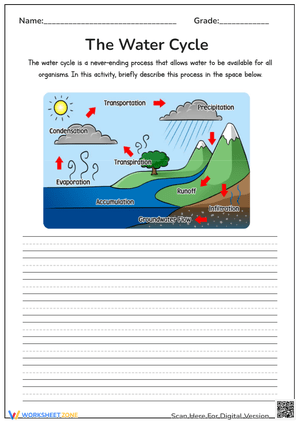
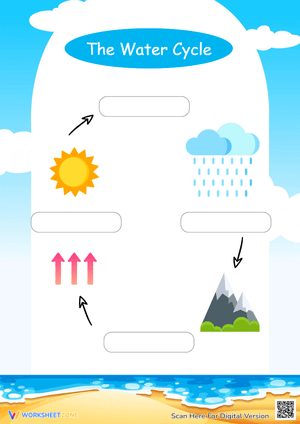
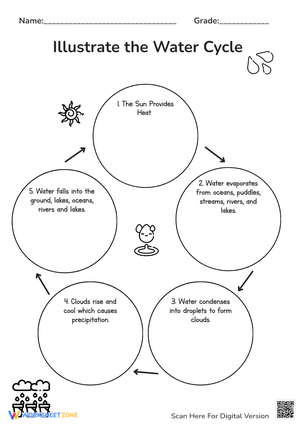
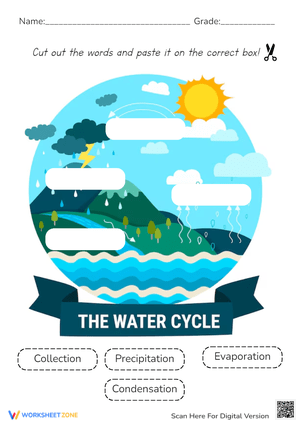
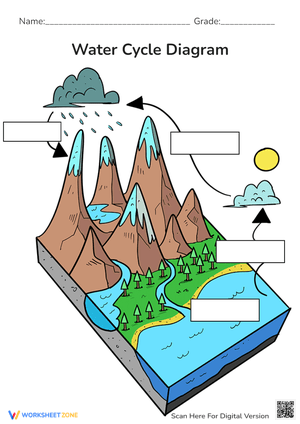
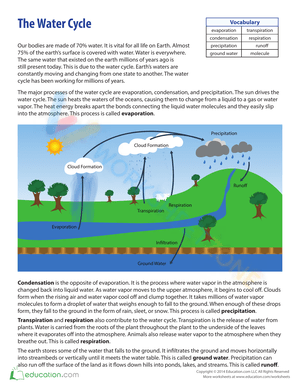
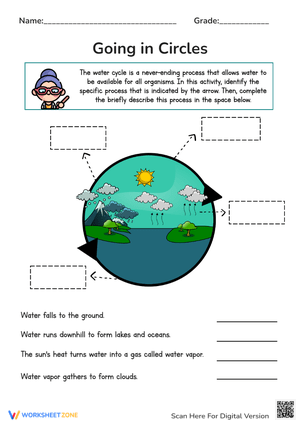
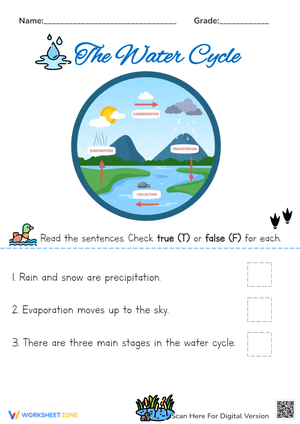
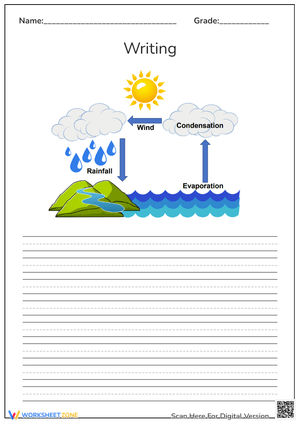
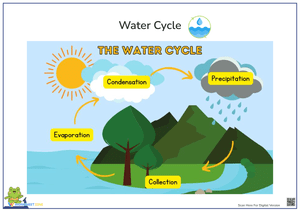
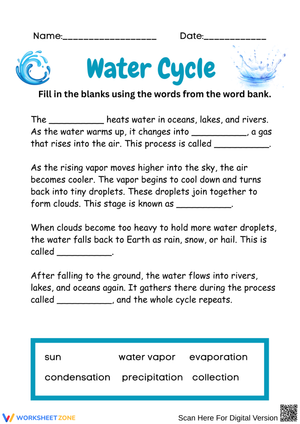
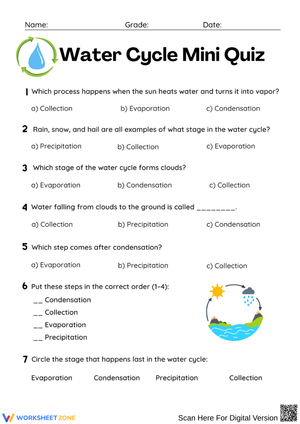
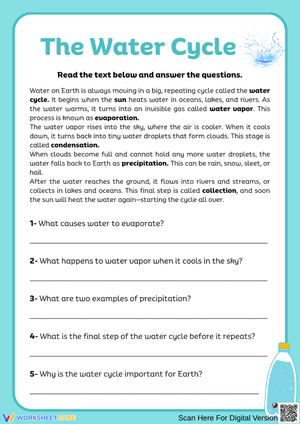
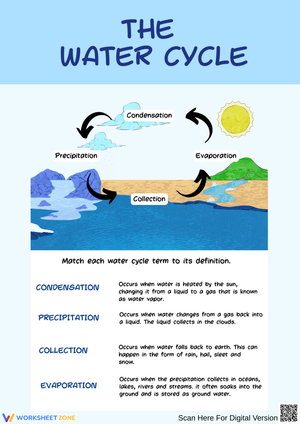
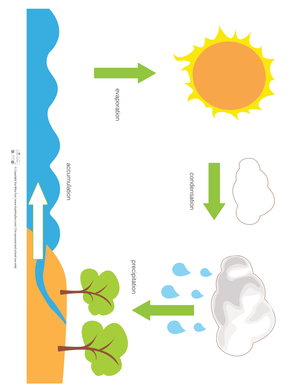
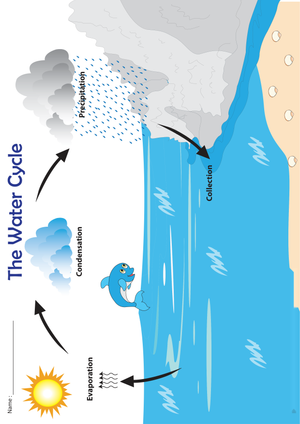
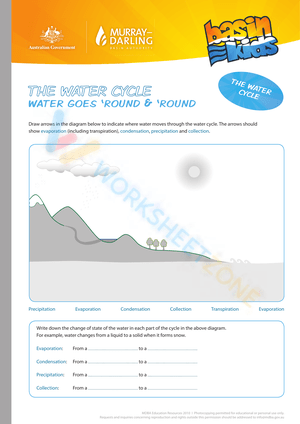
Most water cycle worksheets center on four core stages: evaporation, condensation, precipitation, and collection. Students need to do more than match each term to a picture. They should be able to say that the sun heats water in oceans, lakes, and rivers until it evaporates into water vapor, that vapor cools and condenses into clouds, that precipitation falls as rain or snow, and that water collects in bodies of water and groundwater before the process repeats.
A strong worksheet builds this understanding in layers:
- Evaporation: students identify the sun as the energy source and connect heat to water changing from liquid to gas.
- Condensation: students explain how cooling water vapor forms clouds.
- Precipitation: students name the forms rain, snow, sleet, and hail take.
- Collection: students trace water back to oceans, lakes, rivers, and groundwater.
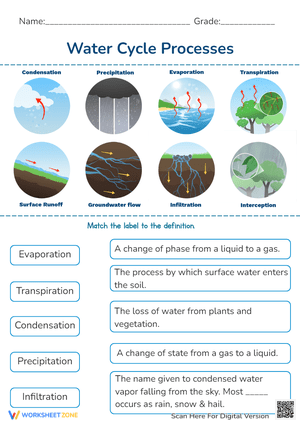
Middle school worksheets add transpiration and runoff, which lets students describe a more complete system rather than a simple four-arrow loop.
Standards Alignment for Water Cycle Worksheets
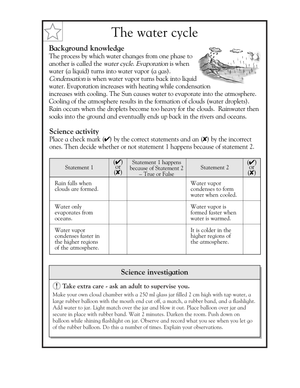
Water cycle worksheets support earth systems modeling at both elementary and middle school levels. For middle school students in grades 6–8, the MS-ESS2-4 Earth's Systems standard calls for developing a model describing how water cycles through Earth's systems, driven by solar energy and gravity, including transpiration, evaporation, condensation, and precipitation.
The practical takeaway is that a labeling worksheet alone won't fully meet standards, because both elementary and middle grade expectations call for a student-built model. Use worksheets as the scaffold: students first master the vocabulary and stages on the page, then transfer that structure into their own diagram or written model. The worksheet becomes the bridge between definitions and the modeling task standards actually ask for.
Differentiating for Elementary and Middle School
The same topic serves very different learners, so the worksheet you choose should match the grade band. For grades 3–5, keep the emphasis on vocabulary, picture-label matching, and short sentences that describe each stage. Sentence frames such as "The sun causes water to ___" help emerging writers explain the process without stalling on spelling.
For grades 6–8, raise the cognitive demand. Ask students to add arrows and labels for transpiration and runoff, to explain the role of gravity in moving water downhill, and to predict how the cycle changes in a drought or a rainforest. A single Worksheetzone diagram can support both groups when you swap the question set rather than the image.
Classroom Implementation
A pattern worth planning around: students routinely master the four stage names yet still describe the water cycle as a one-way trip from ocean to cloud to ground, missing that it is a closed loop with no start or end. On Worksheetzone diagrams, the fastest fix is to remove the numbered arrows for one activity and ask students to enter the cycle at any point and return to it, which forces them to treat evaporation and collection as continuous rather than sequential.
Build a short instructional arc around the worksheet. Open with a five-minute diagram label as a warm-up, teach or review the stages, then move students into a model-building task that mirrors standards expectations. Close the lesson with a few short-answer questions from the same worksheet as an exit check. Keeping one diagram across all three phases lowers cognitive load and lets students focus on the science rather than a new format each time.
Frequently Asked Questions
1. What grade level are water cycle worksheets appropriate for?
They fit best in grades 3–8. Elementary versions lean on labeling and vocabulary, while grades 6–8 worksheets add transpiration, runoff, and system modeling. The same diagram often works across grades when you adjust the questions.
2. How do water cycle worksheets align with standards?
Middle school worksheets support the MS-ESS2-4 Earth's Systems standard, which asks students in grades 6–8 to develop a model describing how water cycles through Earth's systems driven by solar energy and gravity.
3. What are the main stages of the water cycle covered in worksheets?
Most worksheets cover evaporation, condensation, precipitation, and collection. Middle school versions extend the set with transpiration and runoff so students can describe a fuller, connected system instead of a simple loop.
4. How can teachers use water cycle worksheets for review versus assessment?
For review, use labeled diagrams and vocabulary matching. For assessment, use a blank-diagram version before and after instruction, then score a few consistent items so you can compare student growth directly.
5. What real-world data can teachers pair with water cycle worksheets?
USGS figures work well: only about 2.5% of Earth's water is freshwater, more than 96% is in the oceans, and roughly 68% of freshwater is locked in ice and glaciers. Have students graph these numbers alongside the diagram.












 Interactive Worksheet Maker
 Quiz Maker
 Word Search Maker
 Crossword Puzzle Maker
 Word Scramble Generator
 Sentence Scramble Generator
 Handwriting Worksheet Generator
 Name Tracing Generator
 Fill In The Blank Generator