




























Views
Downloads
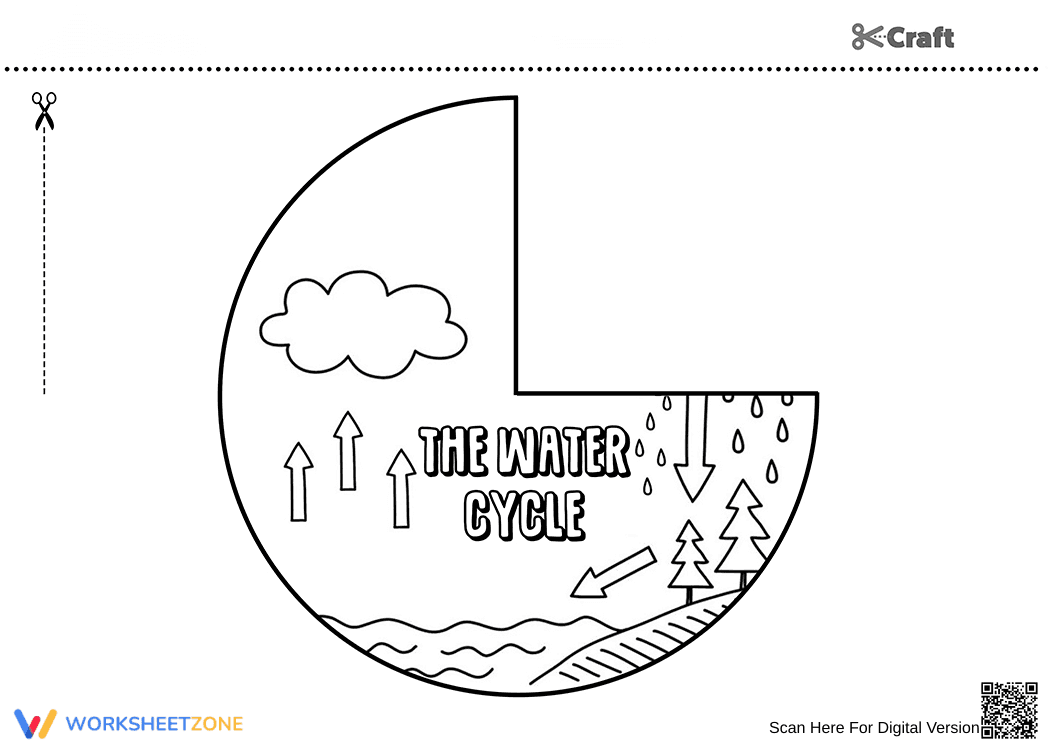

Grade 3 Water Cycle Craft — Printable No-Prep Worksheet

Paste this activity's link or code into your existing LMS (Google Classroom, Canvas, Teams, Schoology, Moodle, etc.).
Students can open and work on the activity right away, with no student login required.
You'll still be able to track student progress and results from your teacher account.
This hands-on Grade 3 science worksheet helps students visualize the continuous movement of water through the environment. By constructing a simple paper model, learners actively engage with key concepts like evaporation, condensation, and precipitation, transforming abstract earth science principles into a tangible, interactive learning experience.
At a Glance
- Grade: 3 · Subject: Science
- Standard:
3-ESS2-1— Model and describe typical weather and water patterns- Skill Focus: Water cycle modeling
- Format: 1 page · 1 craft activity · No answer key · PDF
- Best For: Independent science centers
- Time: 15–20 minutes
This single-page resource features a clear, easy-to-cut circular template designed for young learners. The visual model includes distinct sections illustrating evaporation with upward arrows, condensation within a cloud, and precipitation falling over a landscape. Students simply cut along the dotted lines to create an interactive wheel or foldable craft that reinforces essential earth science vocabulary without requiring complex assembly.
- Print (1 minute): Generate enough copies of the single-page PDF for the entire class.
- Distribute (1 minute): Hand out the templates along with scissors and coloring materials.
- Review (3 minutes): Briefly explain the cutting instructions and the four stages depicted on the wheel.
With under two minutes of total teacher prep time, this activity is highly suitable for emergency sub plans or quick transitions between core subjects.
Aligned to primary standard 3-ESS2-1, this activity supports students as they represent data and graphical displays to describe typical weather conditions. Additionally, it supports CCSS.ELA-LITERACY.RI.3.7 by requiring students to use information gained from illustrations to demonstrate understanding of the water cycle. Both standard codes can be copied directly into lesson plans, IEP goals, or district curriculum mapping tools.
This craft works exceptionally well as a culminating activity after direct instruction on weather patterns and the water cycle. Alternatively, use it as an interactive notebook insert where students can write definitions under each flap. As a formative assessment observation tip, listen to students' peer conversations while they color and cut to ensure they are correctly identifying evaporation and precipitation. Expected completion time ranges from 15 to 20 minutes.
This resource is designed for primary elementary students, particularly third graders developing their foundational science vocabulary. The highly visual, low-text format provides excellent differentiation for English Language Learners and students requiring fine motor practice. It pairs perfectly with a read-aloud book about rain or a classroom anchor chart detailing the stages of the water cycle.
Integrating hands-on modeling into elementary science instruction significantly enhances vocabulary retention and conceptual understanding. According to a ScienceDirect TpT Analysis, interactive crafts and visual models bridge the gap between abstract atmospheric processes and concrete student comprehension. By aligning with 3-ESS2-1 to model and describe typical weather and water patterns, this activity ensures that young learners are not merely memorizing isolated terms, but actively constructing meaningful representations of natural phenomena. Engaging multiple senses through cutting, coloring, and assembling helps solidify the cyclical nature of evaporation, condensation, and precipitation in a memorable way. This multimodal approach supports diverse learning profiles, allowing students to physically manipulate the scientific concepts they are studying in real time. Ultimately, providing accessible, low-prep modeling opportunities fosters deeper scientific inquiry and builds a much stronger foundation for future earth science curriculum.


