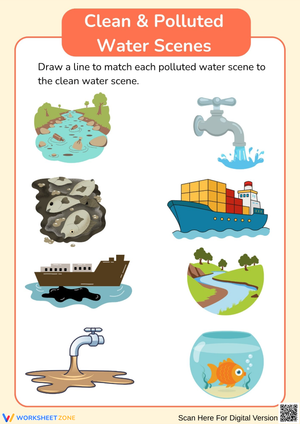
Water Pollution worksheets
These water pollution worksheets give grades 5–8 science teachers a structured set of materials that moves students from core vocabulary through data analysis and into applied solution design — without requiring teachers to build every activity from scratch. Each worksheet targets a distinct concept in the water quality unit, so the set works as standalone practice or as a sequenced instructional block.
What's Inside the Set
The worksheets address the foundational concepts teachers spend the most instructional time on in a water quality unit. Each worksheet focuses on one of the following skill areas:
- Point-source versus non-point-source pollution classification, using real-world scenarios that students sort and label
- Cause-and-effect analysis of eutrophication — specifically how excess nitrogen and phosphorus from agricultural runoff triggers algal blooms, which deplete dissolved oxygen and produce hypoxic dead zones
- Vocabulary work with terms students consistently conflate: contaminant, pollutant, runoff, aquifer, and effluent
- Reading and interpreting water quality data graphs, including dissolved oxygen curves and pH trend lines from monitoring stations
- A solution-design planning worksheet where students apply engineering reasoning to a locally framed watershed problem
Frequent Student Errors Worth Watching For
The point-source versus non-point-source distinction trips up more students than most teachers anticipate. A typical seventh grader will correctly label a factory discharge pipe as point-source, then mark fertilizer runoff from a farm as point-source as well — because the farm is a single, identifiable location on a map. The error reveals a deeper misconception: students conflate the origin of the pollutant with the character of the pollution pathway. Until they understand that non-point-source is defined by diffuse, unconfined movement through the environment rather than by the geographic origin of the substance, the classification keeps breaking down in the same predictable way.
Eutrophication produces a different but equally consistent error. Students grasp that algae grows faster when excess nutrients enter a waterway, but they struggle to explain why more plant life would reduce dissolved oxygen. The causal chain — algal mats block sunlight, submerged vegetation dies, bacteria decompose the dead organic matter, decomposition consumes dissolved oxygen — requires holding four sequential steps in working memory simultaneously. A cause-and-effect chain worksheet that makes each step an explicit, labeled box, rather than a blank students fill from recall alone, gives students a structure to trace the logic before they are asked to reproduce it on an assessment.
Standard Alignment
NGSS MS-ESS3-3 asks students to apply scientific principles to design a method for monitoring or minimizing a human impact on the environment. This standard lands squarely in the water quality unit for most sixth and seventh grade teachers — it is the performance expectation that turns descriptive pollution knowledge into applied problem-solving. The worksheets support both halves of that expectation: earlier activities in the set build the scientific principles students need (pollution pathways, ecosystem effects, measurement methods), while later worksheets provide a structured planning format for the design task. Using a water pollution worksheets as the research-and-analysis phase before a hands-on filtration lab keeps cognitive load manageable — students arrive at the performance task with organized notes rather than a stack of scattered observations.
How to Build These Worksheets Into Your Lesson Plans
The most effective placement depends on where students are in the unit. For the opening lesson, the vocabulary and source-identification worksheets work best following an anchor phenomenon — a photograph of a hypoxic dead zone in the Gulf of Mexico, a beach closure notice from your state's environmental agency, or a local water quality report. Students who have something concrete to react to before they encounter formal vocabulary retain the terms significantly better than students who meet the definitions cold on day one.
Mid-unit, the data analysis and cause-and-effect worksheets fit naturally into a three-station rotation. One station runs the worksheet as independent practice; a second has students testing water samples from the school garden or a nearby drainage ditch with basic pH and turbidity kits; the third station is a short annotated case study read. The rotation keeps energy up during the long middle stretch of a unit, when engagement tends to flatten out. A water pollution worksheets designed for station use should have printed directions at the top of each page — when students have to ask what to do, the rotation stalls and the whole structure loses momentum.
For the final days of the unit, the solution-design worksheet functions as a bridge between research and a culminating project. Students use it to define a specific local problem, evaluate two or three potential interventions, and draft the opening paragraph of a letter to a city council member or school board. That last step — writing an actual letter — raises the stakes enough that students edit their scientific reasoning more carefully than they would on a worksheet with no real audience.
Adjusting the Worksheets for a Range of Learners
For students who need additional support, the cause-and-effect chain worksheets become more accessible when teachers pre-fill every other box in the sequence. This removes the retrieval burden while preserving the analytical work of reading the completed chain and explaining it in a written sentence. Pairing those students with a six-term glossary printed on an index card — kept at the desk throughout the unit — eliminates vocabulary lookup as a recurring bottleneck and lets them direct their attention toward content reasoning instead.
Advanced students tend to move through the classification and vocabulary worksheets quickly. The most productive extension is not more classification work — it is a shift in the direction of analysis. Give these students the same scenario cards from the sorting activity, then ask them to write a brief argument: which of these pollution sources would be hardest to regulate, and why? That question pulls in civic and policy reasoning and forces students to apply their scientific understanding in a context that has no clean answer, which is where deeper thinking actually develops.
Frequently Asked Questions
What grade range do these worksheets cover?
The set works across grades 5–8. Fifth graders handle the vocabulary and source-identification worksheets well with modest teacher support; the data analysis and solution-design worksheets are better suited for grades 6–8, where students have more experience reading graphs and constructing evidence-based written arguments.
Do the worksheets require lab materials or equipment?
No. Each worksheet functions as a standalone paper activity. The solution-design and cause-and-effect worksheets reference real-world scenarios but do not require water samples, test kits, or consumable materials. Teachers who want to pair the activities with a hands-on lab can do so, but no worksheet in the set depends on it.
Are answer keys included with each worksheet?
Yes. Each worksheet includes a corresponding key that addresses short-answer, classification, and open-response items. For open-ended questions, the keys provide a sample strong response along with a list of the reasoning elements a complete answer should include — which is far more useful for grading than a single model answer that does not communicate what partial credit looks like.
When do most teachers use this set during the school year?
Most teachers reach the human impact on Earth's systems unit in late fall or early spring, when NGSS ESS3 standards come into focus in the curriculum sequence. A water pollution worksheets also works well as Earth Day content in April without pulling students away from their current unit — the vocabulary and classification activities stand on their own without requiring the full instructional sequence.
Clear All