


























1 / 2
0
Views
0
Downloads

Save
0 Likes
Share
Specific Heat Capacity Practice Worksheet
0 Views
0 Downloads
Paste this activity's link or code into your existing LMS (Google Classroom, Canvas, Teams, Schoology, Moodle, etc.).
Students can open and work on the activity right away, with no student login required.
You'll still be able to track student progress and results from your teacher account.
Information
Description
What It Is:
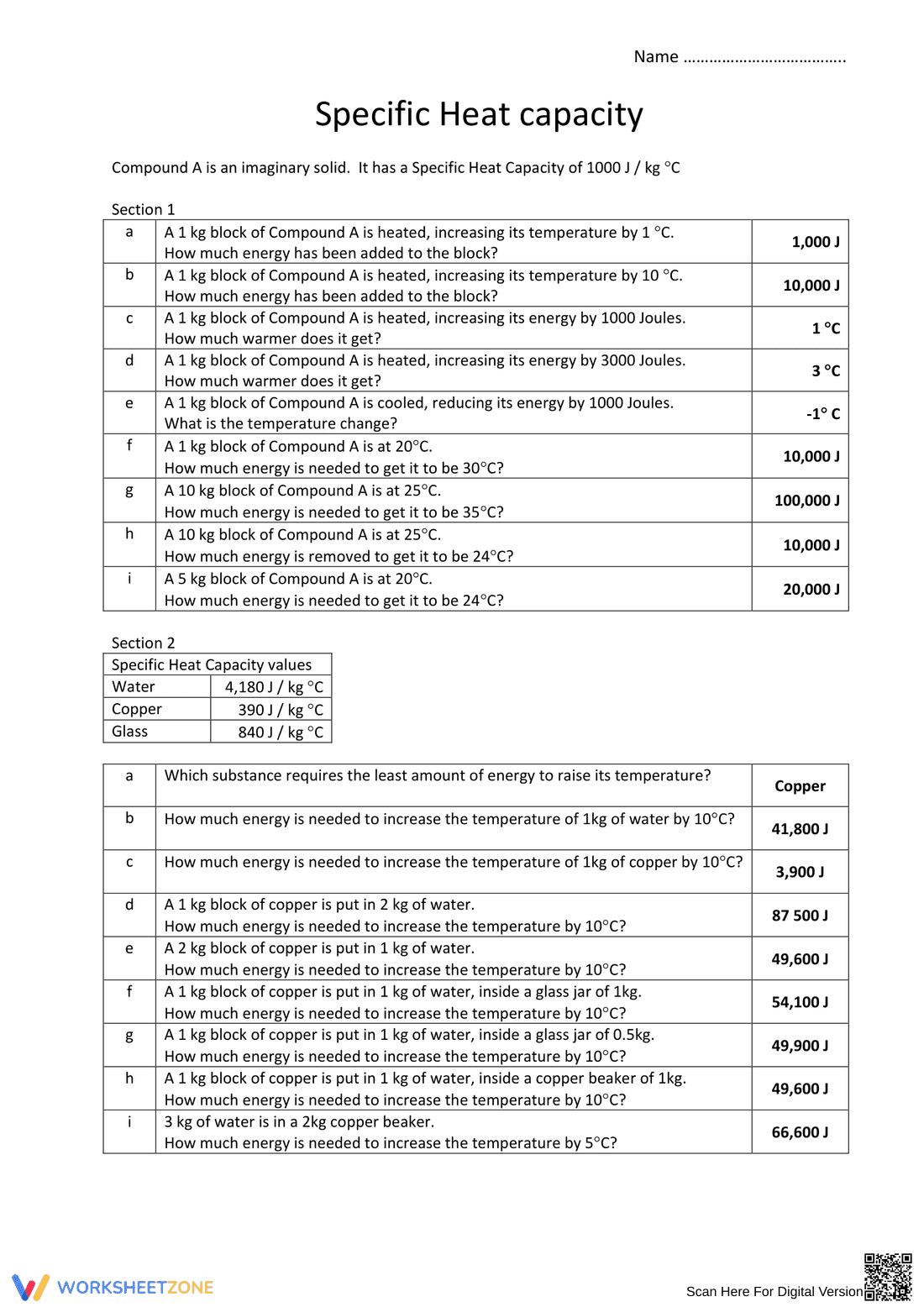
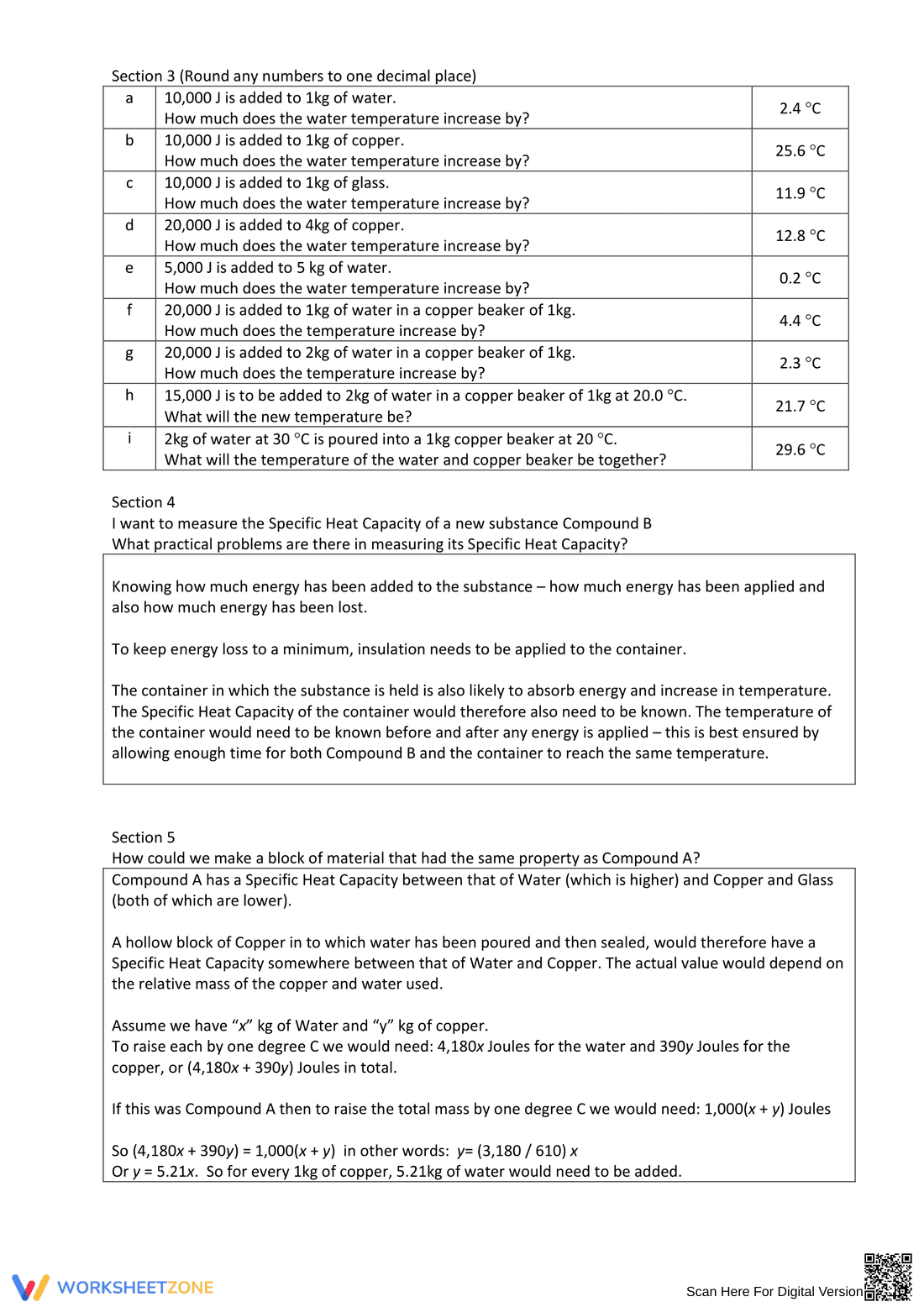
This is an educational worksheet focused on specific heat capacity. It includes two sections. Section 1 presents problems involving an imaginary solid 'Compound A' with a specific heat capacity of 1000 J/kg°C, asking students to calculate energy changes and temperature changes. Section 2 provides specific heat capacity values for water, copper, and glass and then presents problems involving calculating energy needed to heat different substances, including combinations of copper and water in various containers.
Grade Level Suitability:
This worksheet is suitable for grades 9-12, specifically for high school physics or chemistry students. The concepts of specific heat capacity, energy transfer, and temperature change require a foundational understanding of physics principles typically taught at the high school level. The calculations also require algebra skills.
Why Use It:
This worksheet reinforces the understanding of specific heat capacity and its application in calculating energy transfer during heating and cooling processes. It allows students to practice quantitative problem-solving skills related to heat transfer and calorimetry. The variety of scenarios, including mixing different substances, promotes critical thinking and a deeper understanding of the concept.
How to Use It:
Students should first review the concept of specific heat capacity and the relevant formulas. They should then work through each problem in Section 1 and Section 2, showing their calculations and units. Encourage students to pay close attention to the units and to use the given specific heat capacity values accurately. They should use the formula Q = mcΔT to solve for the unknown variables.
Target Users:
The target users are high school students taking physics or chemistry courses. It is also suitable for students preparing for standardized tests that cover heat transfer and thermodynamics. Teachers can use it as a practice assignment, homework, or as part of a lesson on calorimetry.
This is an educational worksheet focused on specific heat capacity. It includes two sections. Section 1 presents problems involving an imaginary solid 'Compound A' with a specific heat capacity of 1000 J/kg°C, asking students to calculate energy changes and temperature changes. Section 2 provides specific heat capacity values for water, copper, and glass and then presents problems involving calculating energy needed to heat different substances, including combinations of copper and water in various containers.
Grade Level Suitability:
This worksheet is suitable for grades 9-12, specifically for high school physics or chemistry students. The concepts of specific heat capacity, energy transfer, and temperature change require a foundational understanding of physics principles typically taught at the high school level. The calculations also require algebra skills.
Why Use It:
This worksheet reinforces the understanding of specific heat capacity and its application in calculating energy transfer during heating and cooling processes. It allows students to practice quantitative problem-solving skills related to heat transfer and calorimetry. The variety of scenarios, including mixing different substances, promotes critical thinking and a deeper understanding of the concept.
How to Use It:
Students should first review the concept of specific heat capacity and the relevant formulas. They should then work through each problem in Section 1 and Section 2, showing their calculations and units. Encourage students to pay close attention to the units and to use the given specific heat capacity values accurately. They should use the formula Q = mcΔT to solve for the unknown variables.
Target Users:
The target users are high school students taking physics or chemistry courses. It is also suitable for students preparing for standardized tests that cover heat transfer and thermodynamics. Teachers can use it as a practice assignment, homework, or as part of a lesson on calorimetry.


