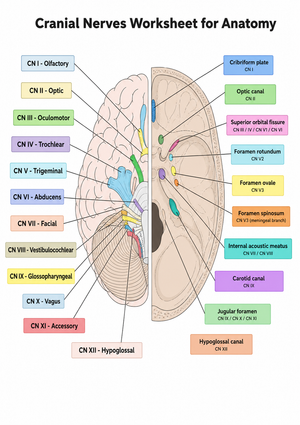
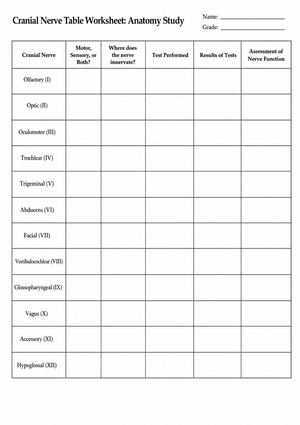
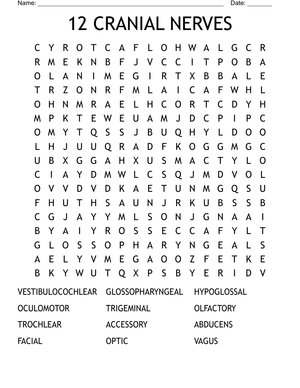
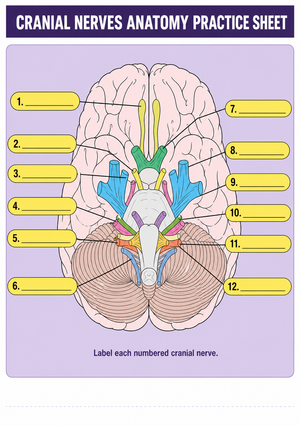
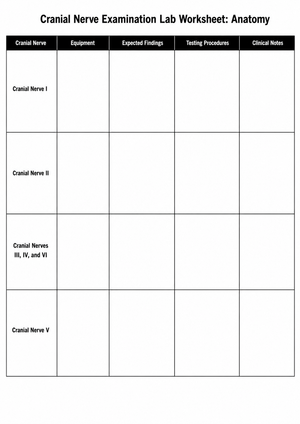
Moving from broad anatomy lectures to quantifiable student understanding requires structured assessment tools, and cranial nerves worksheets serve exactly that function. Each printable resource transforms abstract neuroanatomy into measurable benchmarks, allowing teachers to track which of the twelve pairs students can identify, label, and describe with accuracy. The format produces clear data points teachers can analyze immediately after each lesson.
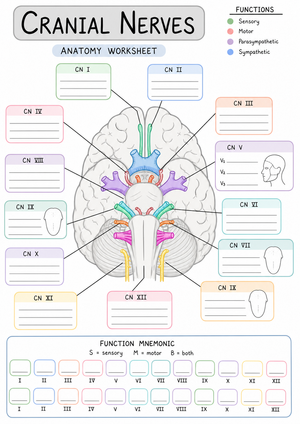
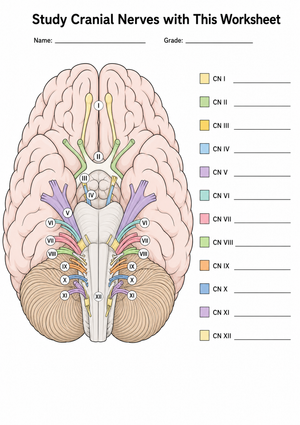
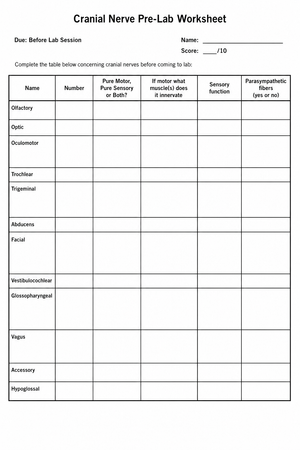
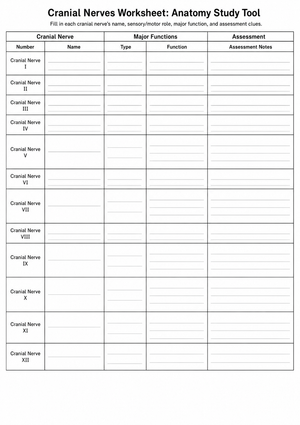
The structured progression of these cranial nerves worksheets reveals learning gaps in a way classroom discussion rarely achieves. Early exercises focus on basic labeling of the olfactory, optic, and oculomotor nerves on a printable diagram. Subsequent tasks introduce functional pairing, asking students to match each nerve with its sensory or motor role. By the final section, students must reason through clinical scenarios, demonstrating applied knowledge.
Built-in answer keys accompany many worksheets, supporting rapid grading and immediate feedback for students. Teachers can review a full classroom set in minutes, identifying which nerves consistently produce errors across the cohort. Parents supporting home study benefit from the same answer references, allowing them to verify accuracy without prior anatomy training. For a wider toolkit, see our curated anatomy activities collection on Worksheetzone.
Tracking performance across multiple exercises gives teachers a longitudinal view of student mastery rather than a single snapshot. Educators using Worksheetzone can map weekly worksheet results against lesson plan objectives, then assign targeted review sheets for any student scoring below benchmark. Pairing the cranial nerves resources with our brain anatomy worksheets creates a complete neuroanatomy unit aligned to high school and pre-medical pathways.
For data-driven instruction that produces measurable progress, integrate these cranial nerves worksheets into every assessment cycle. Worksheetzone provides classroom-ready printable and digital formats, structured difficulty levels, and printable answer keys that turn each lesson into trackable evidence of student growth in cranial nerves anatomy mastery.
Frequently Asked Questions
Question 1: What grade level are cranial nerves worksheets designed for?
These worksheets target high school biology and anatomy students, advanced middle school science classes, and introductory college or pre-medical learners. The structured difficulty progression allows teachers to assign foundational labeling tasks to younger students and reserve clinical reasoning sections for older cohorts. Worksheetzone offers tiered versions so educators can match content precisely to the cognitive level of each classroom group.
Question 2: How many cranial nerves do students need to memorize?
Students must learn all twelve pairs of cranial nerves, including their Roman numeral designations, anatomical names, and primary functions. The worksheets present these systematically, beginning with the olfactory nerve and progressing through to the hypoglossal nerve. Repetition across multiple exercise types reinforces memorization, while functional categorization tasks help students distinguish sensory, motor, and mixed nerves with confidence.
Question 3: Are these cranial nerves worksheets aligned with anatomy curriculum standards?
Yes, the worksheet content reflects standard anatomy and physiology curriculum frameworks used in high schools and introductory college programs. Topics include nerve identification, functional classification, pathway tracing, and clinical correlation. Teachers report strong alignment with textbook chapters covering the peripheral nervous system, making these resources suitable for direct integration into existing lesson plans without significant adaptation work.
Question 4: How can parents support cranial nerves study at home?
Parents can use these printable worksheets alongside the included answer keys to quiz students, even without medical background. The worksheets offer self-contained labeling diagrams, function tables, and reasoning questions that guide home study sessions effectively. Setting a consistent weekly review using these resources helps students build long-term retention before classroom assessments and standardized anatomy examinations.












 Interactive Worksheet Maker
 Quiz Maker
 Word Search Maker
 Crossword Puzzle Maker
 Word Scramble Generator
 Sentence Scramble Generator
 Handwriting Worksheet Generator
 Name Tracing Generator
 Fill In The Blank Generator