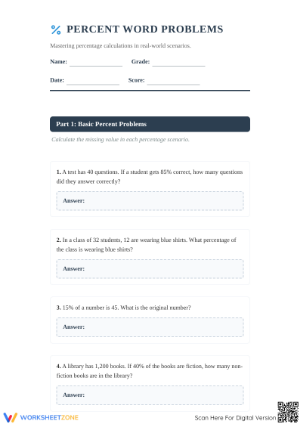
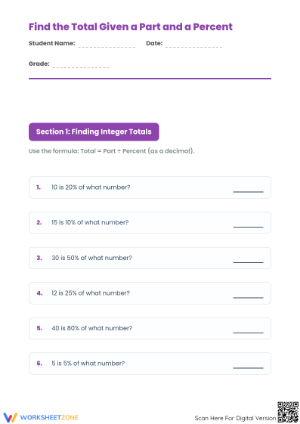
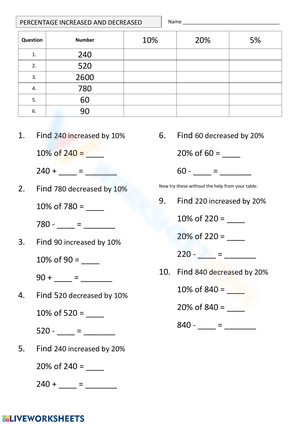
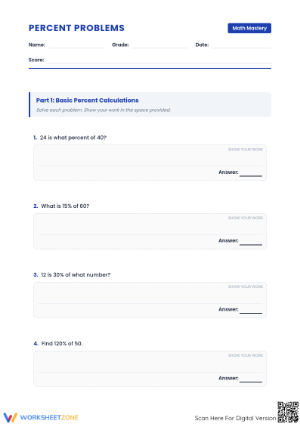
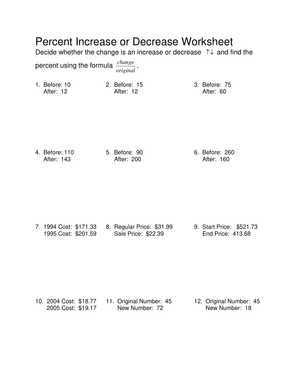
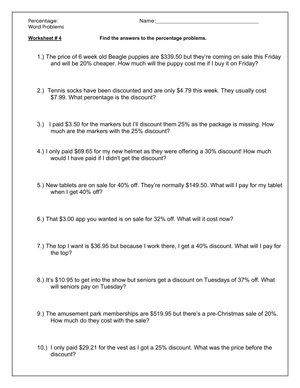
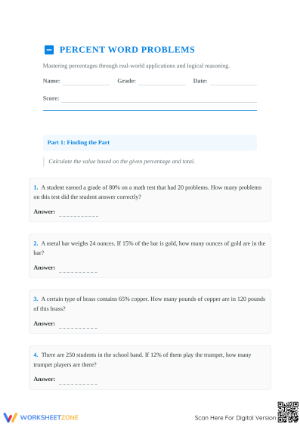
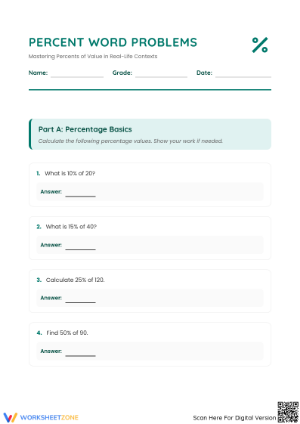
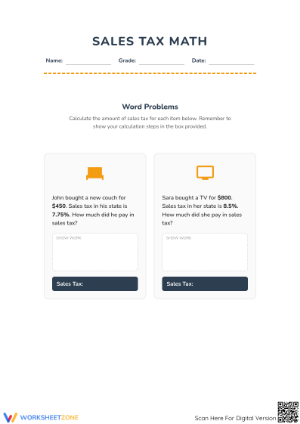
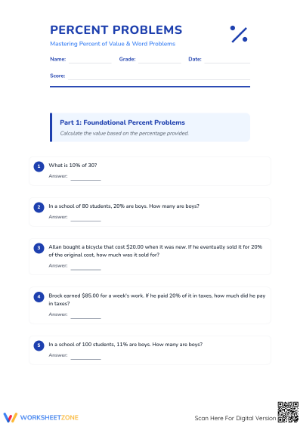
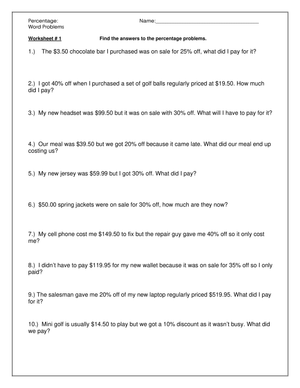
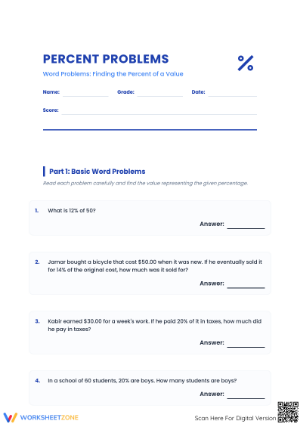
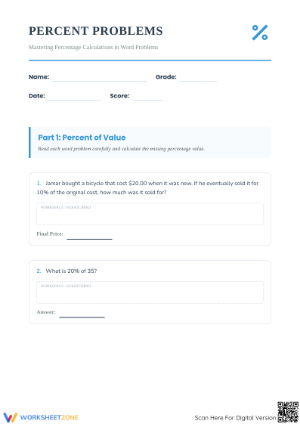
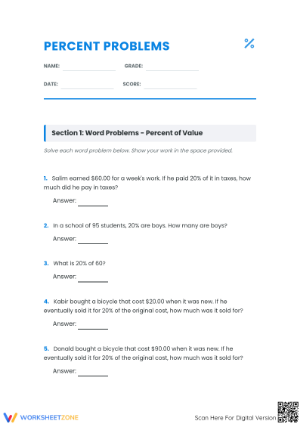
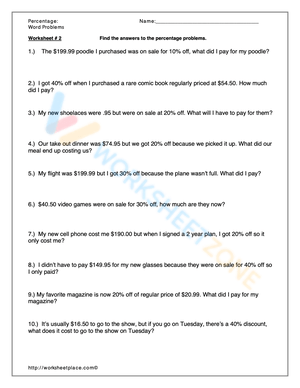
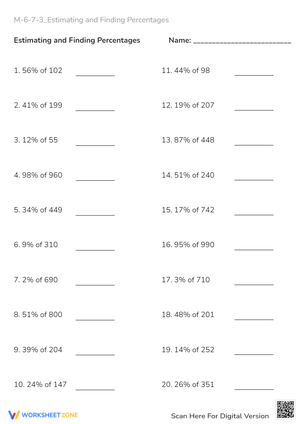
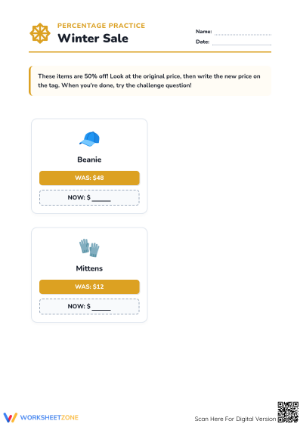
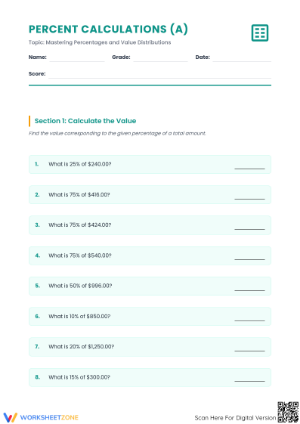
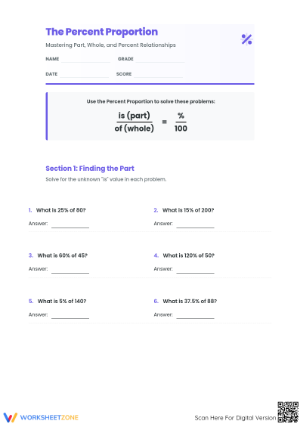
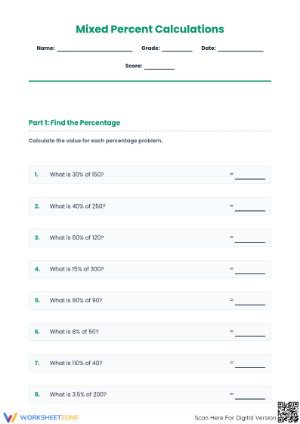
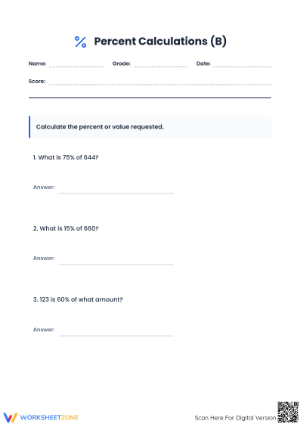
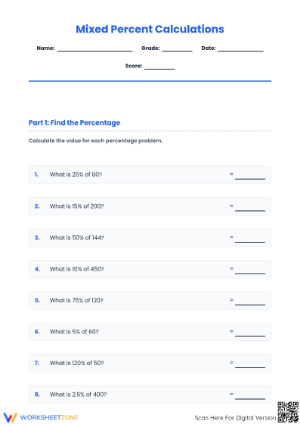
These percent problems pdf worksheets give grades 6–8 teachers a ready-to-print set of standalone practice resources covering all three core percent question types — finding the part, finding the whole, and finding the percent — across both bare computation and real-world problem contexts. Each worksheet arrives with a complete answer key and prints in black and white without layout problems.
The Core Percent Skills Covered Across the Set
Percent problems divide into three structurally distinct types, and students need targeted practice with each one before they can move between them without confusion.
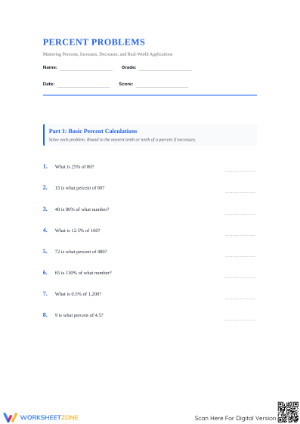
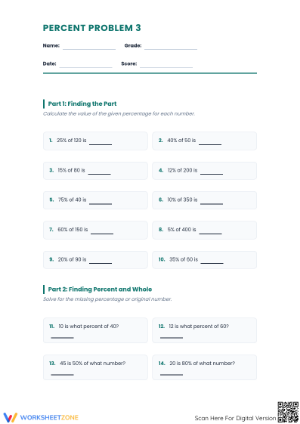
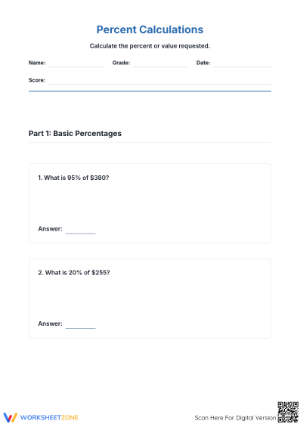
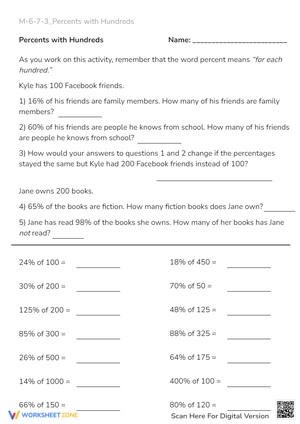
- Finding the part: Given a whole and a percent, students calculate the portion — for example, what is 35% of 140?
- Finding the percent: Given a part and a whole, students name the rate — for example, 27 is what percent of 90?
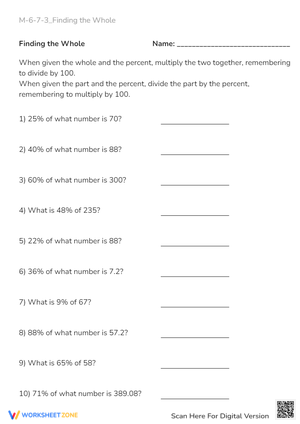
- Finding the whole: Given a part and a percent, students solve backward to the total — for example, 15 is 30% of what number?
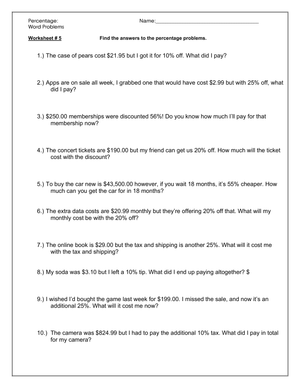
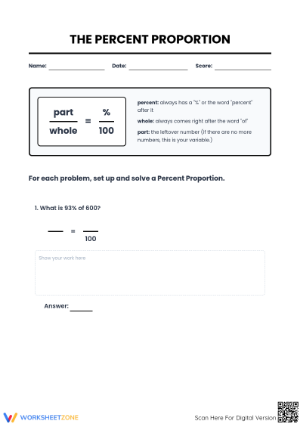
Students can learn the proportion method (part/whole = percent/100) and still fall apart on "finding the whole" problems, because the unknown sits in the denominator — a structural shift that demands different algebraic reasoning than the other two types. Each worksheet in the set first presents one type in isolation to build targeted accuracy, then moves to mixed exercises where students must identify what is unknown before selecting any strategy. Real-world contexts run throughout: calculating a final price after a percentage markdown, applying sales tax, finding percent increase in population data, and working backward from a discounted price to the original amount. A handful of worksheets introduce simple interest at the level expected in 7th-grade finance units.
Frequent Student Errors Worth Catching Before They Harden Into Habits
The most persistent proportion error is a ratio flip. When students read "27 is what percent of 90?" a notable share will write 90/27 = x/100 — placing the larger number in the numerator by default rather than reading carefully for what is the part and what is the whole. They calculate a result, check that it falls below 100, and move on without evaluating whether it is plausible. A correct setup yields roughly 30%; the flipped version produces 333%, which should flag the error immediately — but students who do not pause to estimate miss it entirely.
A second, quieter mistake surfaces on multi-step percent change problems. Students who correctly compute a 20% increase on $50 will sometimes apply the same percent a second time to the original $50 rather than to the new value — skipping the intermediate step in a way that looks plausible in their written work but compounds the error in context. The later worksheets in this set include successive percent change problems specifically because that is where this mistake becomes visible and correctable, rather than hidden inside a single-step exercise.
Building These Worksheets Into Your Weekly Lesson Sequence
A useful weekly structure: open with a single-type worksheet where every problem involves the same question format — finding the part, for instance. Students build speed and accuracy without having to make strategic decisions about setup. The next session, shift to a mixed format where all three question types appear unlabeled, so students must identify what is unknown before writing anything. The third session uses the real-world application worksheets, where context itself obscures which value is the part and which is the whole. By Friday, students who started the week solving clearly labeled exercises are parsing a restaurant bill scenario for the relevant quantities. That transfer is the goal, and the sequence gets there in three sittings without requiring supplemental materials.
The five minutes before the lesson's main activity are the right moment for a quick mental estimate — ask students to approximate 19% of 60 before distributing the percent problems pdf worksheets. Mental benchmarking activates the number sense students need to catch unreasonable answers during independent work. After the worksheet, a two-minute peer-check where partners compare final answers and walk through one disagreement aloud reinforces both accuracy and mathematical communication without cutting into the next period.
Adjusting the Work for a Range of Student Readiness Levels
Students who struggle with the underlying proportion structure benefit from starting with benchmark percents — 10%, 25%, 50%, 75% — where the arithmetic is transparent enough that they can focus on setup rather than calculation. Ask them to label the part, whole, and percent in each problem statement before writing any equation. That single labeling step eliminates most setup errors without reducing the cognitive demand of solving. The percent problems pdf worksheets in this set include versions with built-in labeling fields for this purpose, so struggling students use the same resource as the rest of the class without a visibly different worksheet on their desk.
On-level students work the standard mixed-practice sheets, which include whole numbers, decimals, and a range of real-world contexts. For students ready for greater challenge, the set includes worksheets with successive percent changes, percent error calculations framed in a science-data context, and open-ended tasks that ask students to write their own word problems given a percent and a scenario — an exercise that reveals quickly whether understanding is genuinely flexible or just procedural.
Standard Alignment
These worksheets address 6.RP.A.3c, which asks students to find a percent of a quantity and solve problems involving finding the whole when the part and percent are known, and 7.RP.A.3, which covers multi-step ratio and percent problems including percent increase, percent decrease, tax, tips, discount, and simple interest. In classroom sequencing, 6.RP.A.3c lands near the end of the grade-6 ratios unit — percent is its capstone application, not its opening concept, so students arrive at these worksheets having already worked through equivalent ratios and unit rates. The 7.RP.A.3 worksheets are marked separately and treat percent change as new material rather than review, which matters for lesson planning.
Frequently Asked Questions
What grade levels do these worksheets cover?
The set spans grades 6 through 8. Grade 6 worksheets center on finding the part, percent, and whole using proportions and equations with whole numbers. Grade 7 worksheets extend into percent change, tax, tip, discount, and introductory simple interest. Grade 8 teachers use the percent change and multi-step application worksheets for cumulative review and standardized test preparation units.
How do I help students who can execute the procedure but don't understand why it works?
Remove the proportion template and ask students to reconstruct the setup from a verbal description — "out of every 100, how many?" — before writing any equation. Students who only memorized cross-multiplication collapse at that step; students who understand proportional reasoning can rebuild the setup from the context. The real-world application worksheets in this set require students to extract part and whole from narrative data rather than from clearly labeled numbers, which surfaces this gap quickly and gives teachers a clear starting point for re-teaching.
Can these worksheets support standardized test preparation?
Percent problems appear on every major middle school assessment — SBAC, PARCC, and most state-developed tests include both single-step percent calculations and multi-step real-world applications. For concentrated test prep, the percent problems pdf worksheets that present multiple problem types in a single sitting are the most useful, because they require the same rapid identification of problem type that timed assessments demand. Students who have only practiced blocked sets — one type at a time — consistently underperform on mixed-format tests relative to their actual skill level.
Do the worksheets include worked examples?
Each worksheet opens with one fully worked model problem showing the proportion setup, the cross-multiplication step, and the labeled answer. The model stays on the page throughout — which reduces procedural questions during independent work without removing the cognitive demand of each new problem. Students who finish early have the model available for self-checking their setup, not just their final answer.













 Interactive Worksheet Maker
 Quiz Maker
 Word Search Maker
 Crossword Puzzle Maker
 Word Scramble Generator
 Sentence Scramble Generator
 Handwriting Worksheet Generator
 Name Tracing Generator
 Fill In The Blank Generator