Why percent word problems worksheets matter in grades 6-7
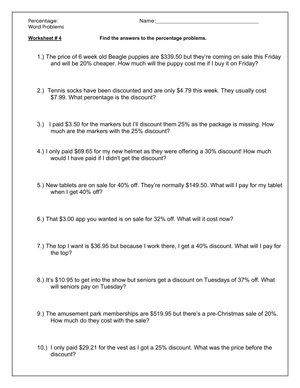
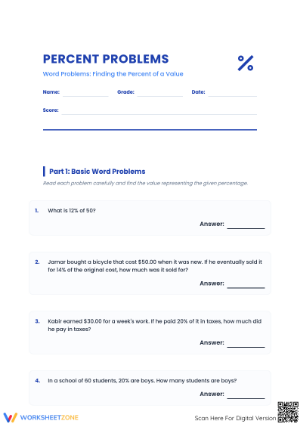
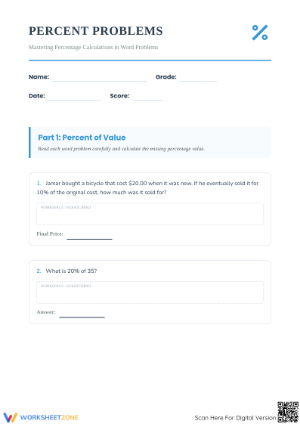
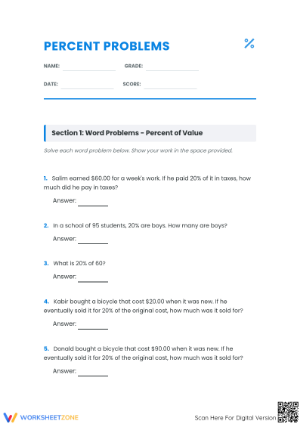
Percent word problems worksheets give teachers a practical way to connect ratio reasoning to the situations students actually recognize. In most upper elementary and middle school classrooms, percent shows up as more than an isolated skill. Students need to move between fractions, decimals, and percents while making sense of discounts, sales tax, restaurant tips, markup, commission, and classroom survey data. A focused worksheet set helps them practice that translation step by step instead of meeting every format for the first time during a quiz.
For teachers planning review, intervention, or homework, percent word problems worksheets are especially useful because they reveal whether students understand the structure of the problem or are only following a memorized procedure. A student may know how to find 25% of 80, for example, but still struggle when the unknown is the whole or when the question asks for percent increase after comparing two values. That makes percent word problem practice a strong checkpoint before moving into more complex proportional reasoning.
Which percent skills a strong worksheet set should include
The best percent word problems worksheets do not stay in one narrow format. They usually build across four related skills so teachers can assign the right level of challenge.
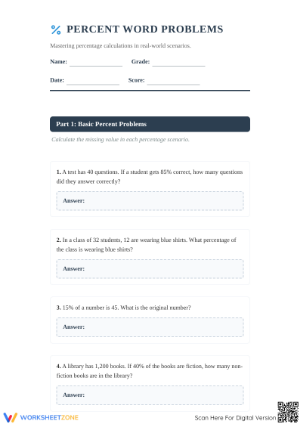
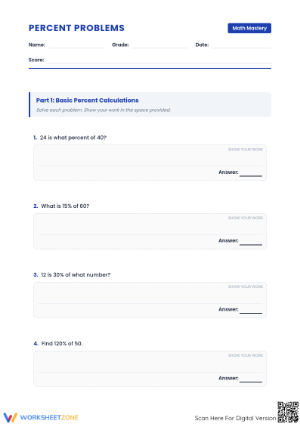
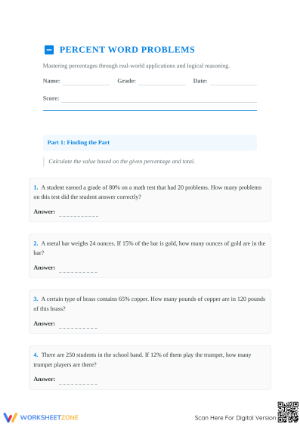
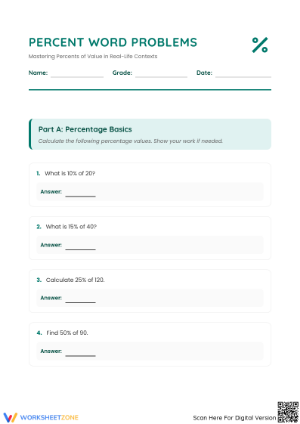
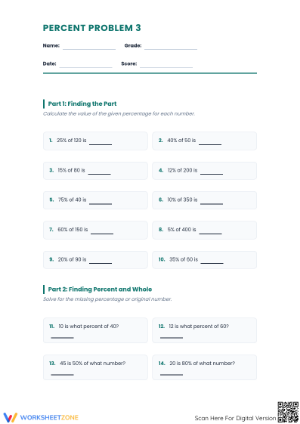
- Percent of a number: Students find the part when the whole and percent are known.
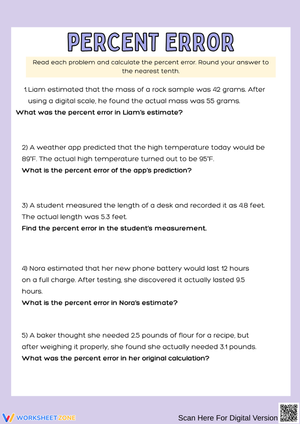
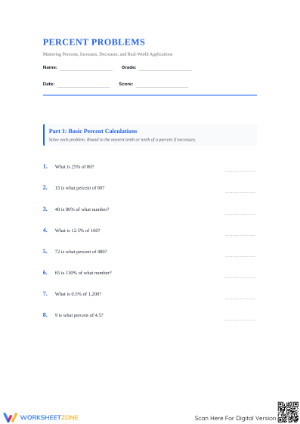
- What percent: Students compare two values and express the relationship as a percent.
- Finding the whole: Students work backward when the part and percent are given.
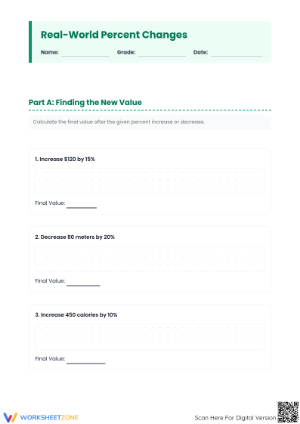
- Percent change: Students analyze increase or decrease in realistic before-and-after scenarios.
That progression matters in class. One-step problems help students establish the meaning of percent as a rate per 100, while later sets can ask them to combine operations in contexts such as sale price plus tax or original price after a markdown. Teachers can also use mixed sets to check whether students choose an efficient strategy rather than assuming every problem starts the same way.
If you are selecting materials for stations or independent practice, look for worksheets that balance direct computation with reading comprehension. Percent tasks often become difficult because students miss the quantity being described, not because the arithmetic itself is advanced. Clear wording, varied unknowns, and realistic numbers usually lead to better evidence of student understanding.
Real-world contexts make percent practice easier to teach
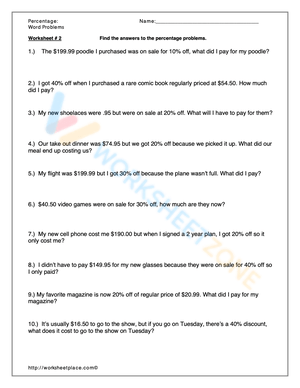
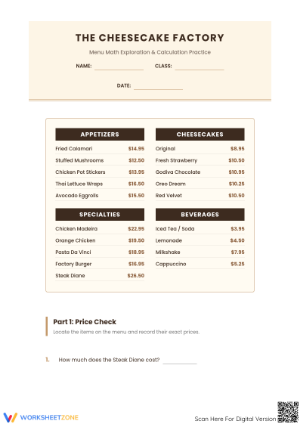
Students tend to engage more with percent when the worksheet context feels familiar. Shopping scenarios are a reliable entry point because they make percent visible: a 20% discount, an 8% sales tax, or a markdown followed by a final total. Restaurant tip problems work for similar reasons. Students can picture the bill, the percent, and the reason for calculating it. That makes the math less abstract without lowering the level of thinking.
Other useful contexts include commission, classroom attendance, sports statistics, and survey results. These situations let teachers vary the language of percent without changing the underlying structure. A student who hesitates on a sale problem may make faster sense of a survey question that asks what percent of the class chose a certain option. Using several contexts across a worksheet set keeps students from attaching one rigid method to one familiar story.
Classroom Implementation
Teachers can get more mileage from percent word problems worksheets by assigning them with a clear purpose instead of using every page the same way. For first exposure, a short set with one problem type works well in guided practice. For independent work, mixed-problem pages are better because they show whether students can identify the needed operation. For homework, a balanced set of routine and real-world items helps families see the topic without turning the assignment into a long reteach session.
In small groups, percent worksheets work best when students explain the role of each number before they calculate. Ask them to name the whole, the part, and the percent out loud. That short routine slows down guessing and gives you a fast listen-in for misconceptions. It also makes it easier to decide whether a student needs more support with proportional reasoning, decimal operations, or reading the scenario accurately.
One useful diagnostic move is to sort percent problems by which quantity is missing. Students who can solve 15% of 60 often stall on questions like 18 is 15% of what number because the structure reverses even though the topic stays the same. Grouping worksheets this way turns error analysis into instruction: you can see whether the issue is equation setup, the meaning of the whole, or confusion between percent and part.
What standards alignment looks like in percent problem practice
When teachers want percent work that aligns to grade-level expectations, the key is not just the answer type but the reasoning students use. The Common Core State Standards for Mathematics - 6.RP.A.3 specifically includes finding a percent of a quantity as a rate per 100 and solving percent problems with strategies such as equivalent ratios, tape diagrams, double number lines, or equations. That means a strong worksheet set can support both conceptual models and efficient calculation.
According to the Common Core State Standards for Mathematics - 6.RP.A.3, students should find a percent of a quantity as a rate per 100 and solve percent problems using diagrams, ratio reasoning, or equations. The notable data point is built into the concept itself: percent is interpreted per 100, which anchors every method.
Worksheetzone's Percent word problems and Multi-step ratio and percent problems also reinforce a useful classroom progression: students first solve straightforward percent-of-a-quantity questions, then move into multi-step applications that blend ratio reasoning with context. That sequence mirrors what many teachers need during a unit because it supports intervention at the start and richer application work later on.
How to differentiate percent word problems worksheets for mixed readiness
Differentiation does not require entirely different topics. Percent word problems worksheets are easy to adjust because the same concept can be changed through numbers, wording, or the unknown quantity. For students needing support, start with benchmark percents such as 10%, 25%, 50%, and 75% and keep the whole number friendly. For students ready for more challenge, use awkward values, multi-step totals, or comparison tasks that ask for percent increase and decrease.
- For intervention: Use one problem type per page and include repeated language structures.
- For on-level review: Mix percent of a number, finding the whole, and what percent questions.
- For enrichment: Add tax after discount, markup, or commission scenarios with more than one step.
Teachers can also differentiate by response format. Some students benefit from writing an equation for every problem, while others may be ready to justify a mental-math shortcut. If you are building stations, consider assigning one worksheet for solving and another for error correction. Correcting a worked example often exposes misconceptions that standard answer-only practice can hide.
Choosing worksheets that stay useful beyond one lesson
The most effective percent word problems worksheets are reusable across the unit, not locked to a single day. A good set can serve as warm-up material, exit ticket practice, homework, reteach work, or sub plans with very little adjustment. That flexibility matters for teachers because percent is rarely mastered after one lesson. Students usually need spaced practice, varied contexts, and a return to the concept when ratios and proportions come back later in the year.
Look for sets that let you control cognitive demand. Some days you may want straightforward percent-of-a-whole review; other days you may need consumer math applications that feel more authentic. When one worksheet collection includes both, it becomes easier to support mixed-ability classes without changing the topic. That is one reason percent word problem pages continue to be useful in middle school math stations and review cycles.
On Worksheetzone, percent practice is most valuable when teachers can move from direct skill rehearsal to applied reasoning without leaving the same topic family. That continuity helps students recognize that discount, tip, tax, and survey questions are all versions of the same underlying percent relationships.
Frequently Asked Questions
1. What skills should percent word problems worksheets cover?
They should cover percent of a number, finding the whole, determining what percent one quantity is of another, and percent increase or decrease. The strongest sets also include multi-step consumer math situations such as tax after a purchase or a discount followed by a final total.
2. What grade levels use percent word problems most often?
These worksheets are most common in upper elementary and middle school, especially around grade 6 and grade 7 when students study ratios, rates, and proportional reasoning. Teachers may also use them later as review in intervention groups or pre-algebra support.
3. How can teachers differentiate percent word problem practice?
Differentiate by controlling the numbers, the problem structure, and the missing value. Start some students with benchmark percents and single-step prompts, while giving others mixed unknowns, less friendly numbers, or multi-step percent change situations that require stronger reasoning.
4. What real-world topics make percent worksheets more engaging?
Shopping discounts, sales tax, restaurant tips, commission, and class survey data tend to work well because students can picture the situation quickly. Familiar contexts reduce confusion and let teachers focus discussion on the percent relationship rather than on decoding the story.













 Interactive Worksheet Maker
 Quiz Maker
 Word Search Maker
 Crossword Puzzle Maker
 Word Scramble Generator
 Sentence Scramble Generator
 Handwriting Worksheet Generator
 Name Tracing Generator
 Fill In The Blank Generator