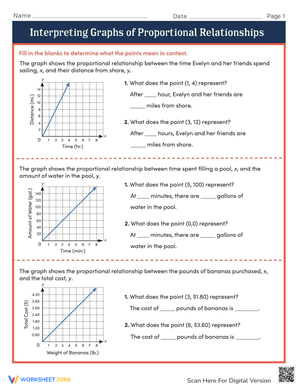
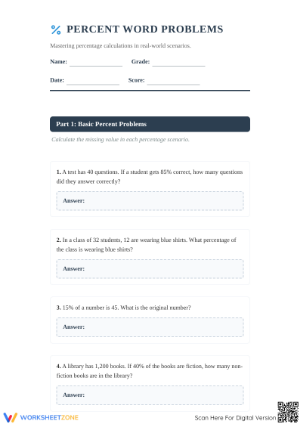
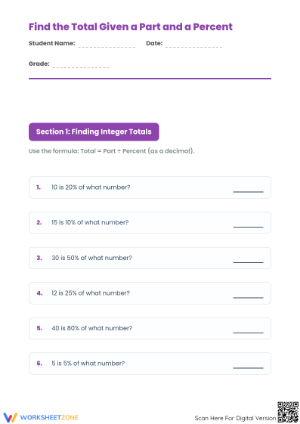
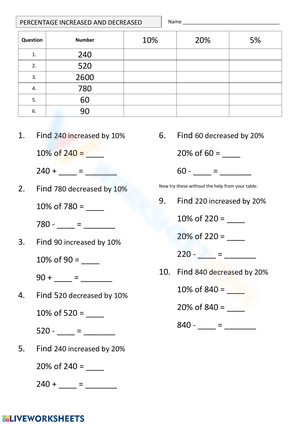
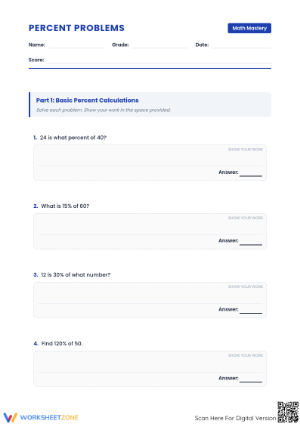
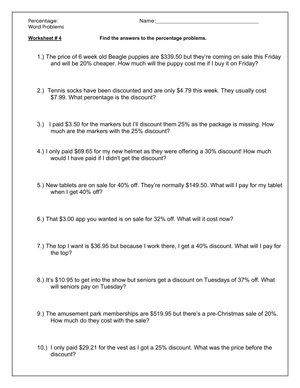
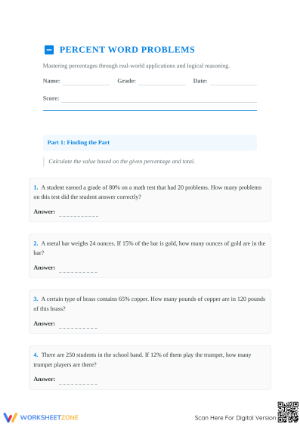
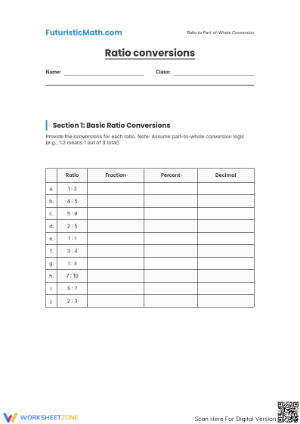
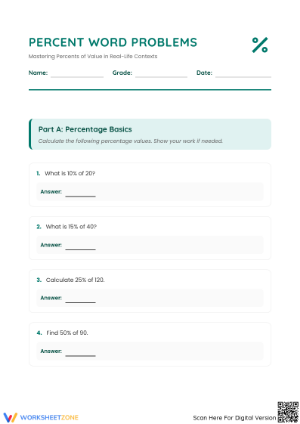
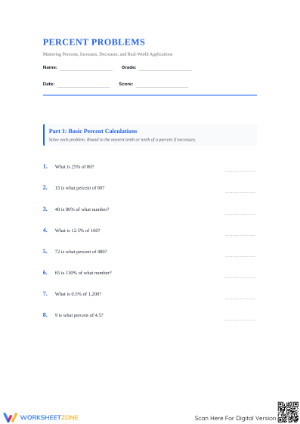
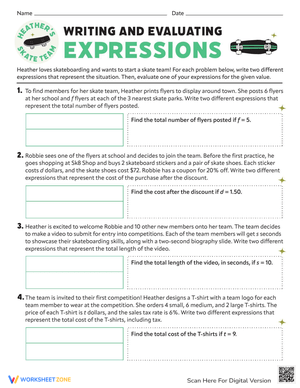
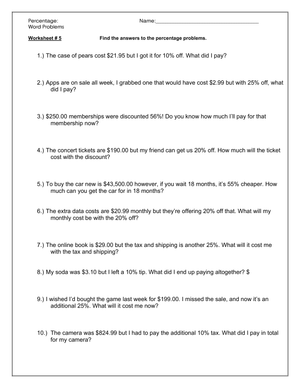
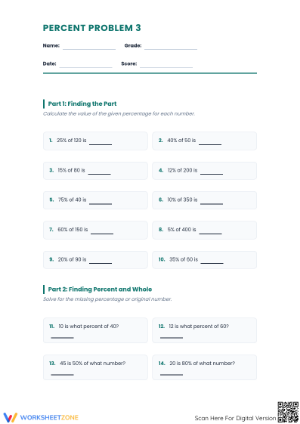
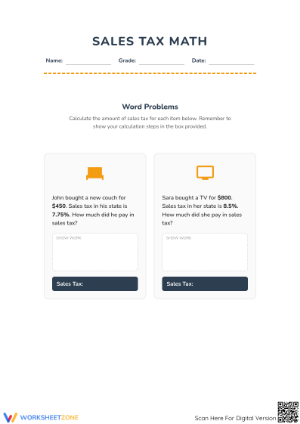
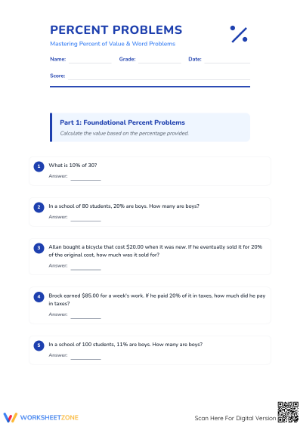
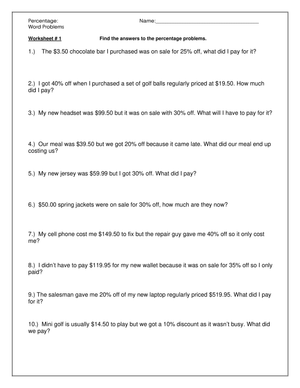
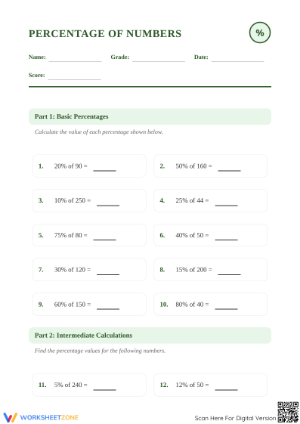
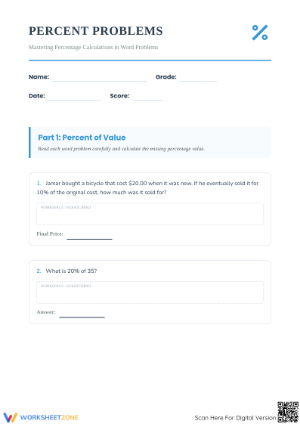
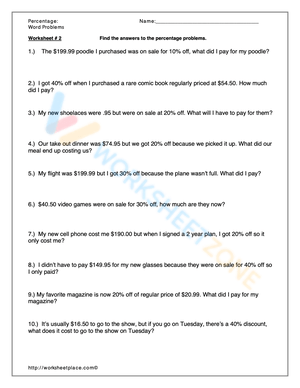
These percents printable worksheets span the full arc of middle school percent instruction — from shading 10×10 grids that make "per hundred" visible to multistep financial problems involving discounts, taxes, and tips — so teachers have targeted practice ready at every point in the unit. Each worksheet stands alone, which means you pull exactly what a group of students needs on a given day without working through a fixed sequence.
Concepts Across the Set
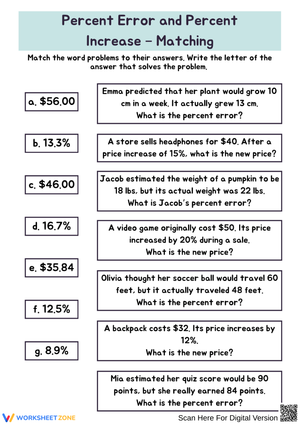
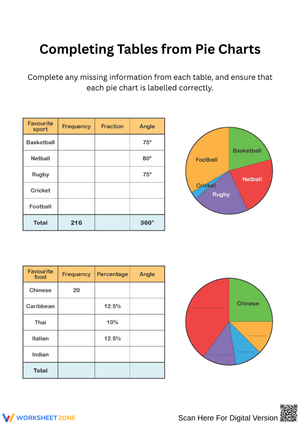
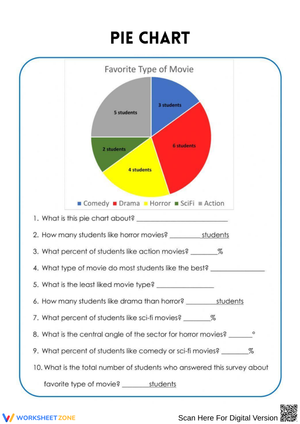
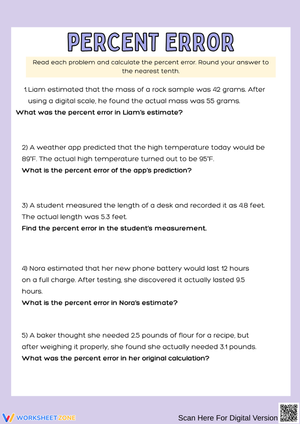
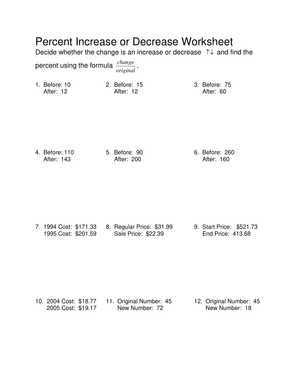
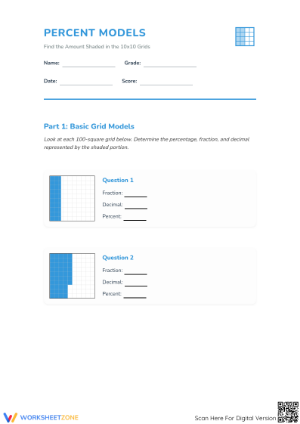
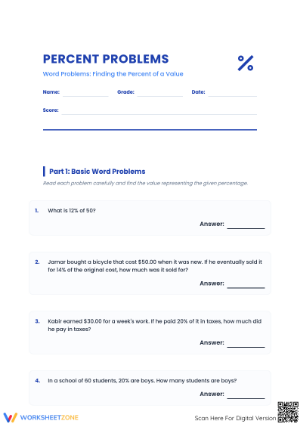
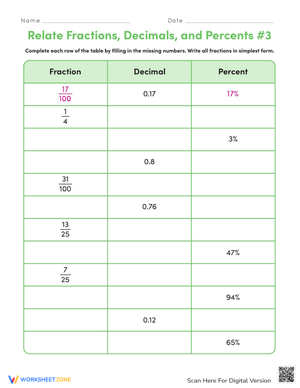
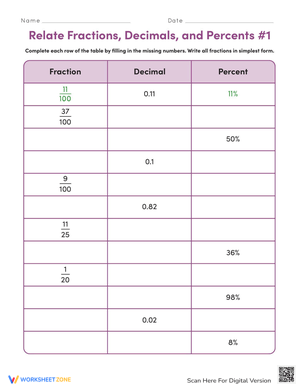
Four skill areas organize the collection, tracking the actual progression teachers build across 6th, 7th, and 8th grade. Grid-shading worksheets anchor the concept by having students shade portions of a 100-square grid to represent a given value — the kind of concrete representation that makes percent something students can see, not just compute. Conversion worksheets provide the repetitive, low-stakes practice students need to move reliably among fractions, decimals, and percents. Financial context worksheets center on sales tax, tip calculations, and retail discounts, tying computation to decisions students will actually make. Percent change worksheets — covering increase, decrease, and percent error — extend into pre-algebra territory for students who have secured foundational skills.
Mixed-review worksheets pull problems from multiple skill areas onto a single sheet. These serve a distinct classroom function: they are the reliable option for unit review blocks, substitute plans, and cumulative checks where teachers want to see which skills are holding and which have slipped.
Mistakes Students Make That These Worksheets Help You Catch
The most persistent percent error in 6th and 7th grade has little to do with computation — it is the failure to recognize that fractions, decimals, and percents are three representations of the same value rather than three separate concepts. A student who correctly converts 3/4 to 0.75 will often freeze when asked to write the equivalent percent, because moving from a decimal to a percent feels like a different procedure from moving from a fraction to a percent. Both are the same idea expressed differently, but purely procedural instruction rarely makes that explicit.
Decimal direction is the second pattern worth anticipating. Converting a percent to a decimal requires dividing by 100 — the decimal shifts left two places. Under time pressure, students frequently shift right instead, converting 45% to 45.0 rather than 0.45. What makes this hard to catch is that 45.0 looks like a plausible number, so students move on without noticing. Grid worksheets address this directly: a student who has shaded 45 out of 100 squares can see the result is less than one whole, making the constraint on the decimal form concrete rather than a rule to recite.
Why This Format Works for This Skill at This Stage
Percent fluency depends on retrieval practice — writing the same conversion moves enough times that the procedure becomes automatic before it appears inside a more complex problem. These percents printable worksheets give students the physical space for exactly that kind of annotated work: circling the percent sign, writing "÷100" above a conversion arrow, underlining the whole quantity. That physical markup of the problem supports working memory and produces a visible record of reasoning that makes it far easier to identify precisely where a process broke down.
There is also a pacing argument for print over digital. Many online percent tools give immediate feedback after each item, which interrupts thinking before a student has committed to a strategy. A printed worksheet lets students work through a set of problems, sit with uncertainty, self-correct, and then check answers — a rhythm that is closer to actual test conditions and builds the tolerance for working through difficulty that percent word problems require.
Lesson-Planning Ideas to Get the Most From These Worksheets
The conversion and grid worksheets work best as warm-up material — five to eight minutes at the start of class, three times per week. Running three conversion problems before the lesson launch on a consistent schedule produces noticeably faster recall by the end of a three-week unit than saving all practice for a single long assignment. Financial word problem worksheets serve a different moment: use them mid-lesson or as paired practice during the lesson close, after students have seen at least one worked example with the teacher.
These percents printable worksheets also function reliably as sub plans. A mixed-review sheet with a posted answer key needs no explanation beyond the printed instructions, and substitutes can collect completed work so the regular teacher returns to a usable snapshot of class progress. That passive data collection during an absence is worth building into the sub folder now rather than scrambling to find something appropriate in the moment.
Standard Alignment
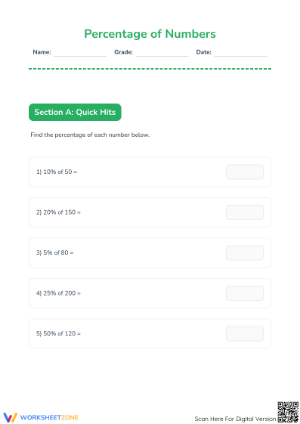
The grid-shading and foundational percent-of-a-number worksheets address CCSS.MATH.CONTENT.6.RP.A.3.C, which asks 6th graders to find a percent of a quantity as a rate per 100. This standard sits within the Ratios and Proportional Relationships domain because the intent is for students to understand percent as a special ratio — not a standalone concept learned in isolation from what came before. The financial reasoning worksheets address CCSS.MATH.CONTENT.7.RP.A.3, which extends percent reasoning into multi-step problems including tax, tips, discounts, simple interest, and percent change. Teachers using these in 7th grade typically introduce the financial context worksheets after students have demonstrated fluency on conversions, so the new complexity comes from the problem context rather than from computation that isn't yet automatic.
Adjusting the Worksheets for Different Student Levels
For students still building conceptual understanding, the grid worksheets come first — shade the grid before writing the fraction and decimal equivalents. Students who skip visual work and go straight to procedural rules tend to produce correct answers they cannot explain, which collapses quickly when they encounter an unfamiliar problem type. The shading step is not optional review for these students; it is the instruction.
Students with strong computation skills but limited exposure to percent change sometimes treat increase and decrease as mirror-image operations — adding 20% and then subtracting 20%, expecting to return to the original number. The percent change worksheet creates a direct entry point to this misconception: have students apply a 25% increase to $80, then apply a 25% decrease to the result, and compare the final value to the starting value. The asymmetry surprises nearly every student who hasn't seen it before, and the printed work gives them something to annotate and explain in their own words.
Frequently Asked Questions
Which grade level should start with the grid-shading worksheets?
Grade 6 is the entry point for formal percent instruction under Common Core, and the grid worksheets belong there. Even students who have encountered percents informally in 5th grade benefit from grounding the concept visually before computation begins. In 7th grade, the same grids can reappear as a re-entry tool when students struggle with the abstract side of percent change.
How many problems should a printed practice worksheet include for a warm-up?
Five to eight problems is the right range for a five-minute warm-up. More than ten items shifts the activity from warm-up to independent practice, which changes the pacing and the cognitive load for the rest of the lesson. The shorter format also makes it practical to post answers immediately and have students self-correct before class moves on.
Do the financial literacy worksheets require background knowledge beyond basic percent computation?
Students need to be able to multiply a decimal by a whole number and add a tax or tip amount to an original price. The Part = Percent × Whole structure handles most of the computation. Having students write that equation at the top of each worksheet before they start — even when they feel they don't need it — reduces setup errors on multi-step problems significantly. These percents printable worksheets include enough variation in the financial scenarios that even students who have seen tip problems before will encounter situations requiring genuine reasoning rather than pattern matching.
Can these worksheets double as formative assessment rather than just practice?
Pull three to five problems from a single worksheet and use them as an exit ticket at the lesson's end. Sorting those responses into three categories — solid understanding, partially there, needs reteaching — takes about four minutes and produces clearer data than a thumbs-up check. The grid worksheets are especially useful in this role: a student's shaded grid reveals the mental model they are working from in a way that a numeric answer alone cannot.













 Interactive Worksheet Maker
 Quiz Maker
 Word Search Maker
 Crossword Puzzle Maker
 Word Scramble Generator
 Sentence Scramble Generator
 Handwriting Worksheet Generator
 Name Tracing Generator
 Fill In The Blank Generator