


























Views
Downloads


Printable Percent Problems Worksheet | Grade 6 Math
Paste this activity's link or code into your existing LMS (Google Classroom, Canvas, Teams, Schoology, Moodle, etc.).
Students can open and work on the activity right away, with no student login required.
You'll still be able to track student progress and results from your teacher account.
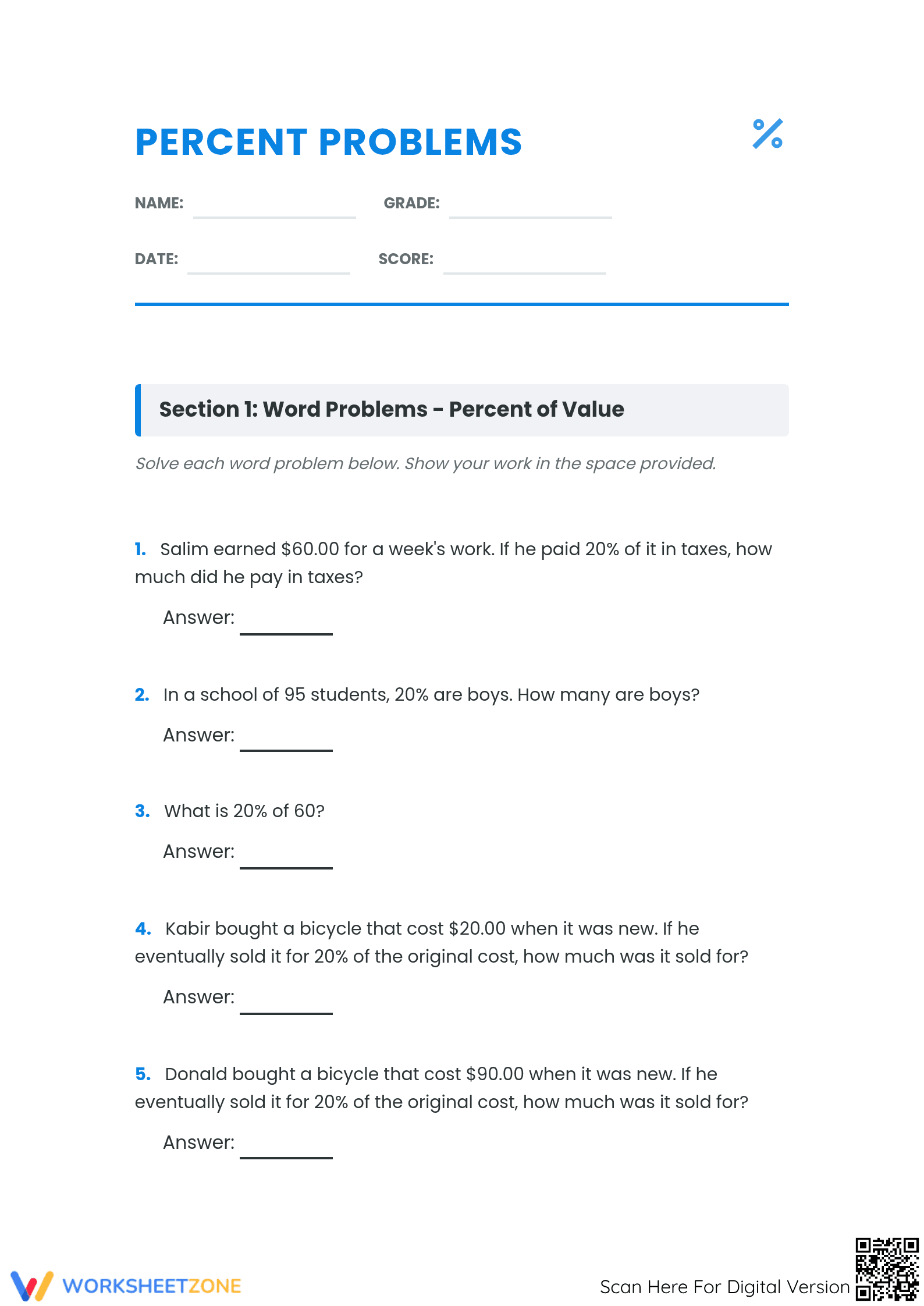
This Grade 6 math worksheet focuses on mastering percentages through real-world scenarios and calculation exercises. Students develop fluency in finding a percent of a value, determining the whole from a part, and solving multi-step challenge problems involving taxes. Lead students toward mastery of proportional reasoning.
At a Glance
- Grade: 6 · Subject: Math
- Standard:
6.RP.A.3.C— Find a percent of a quantity and determine the whole given a part- Skill Focus: Percent Word Problems & Calculations
- Format: 4 pages · 25 problems · Answer key included · PDF
- Best For: Independent practice and formative math assessment
- Time: 30–45 minutes
What's Inside
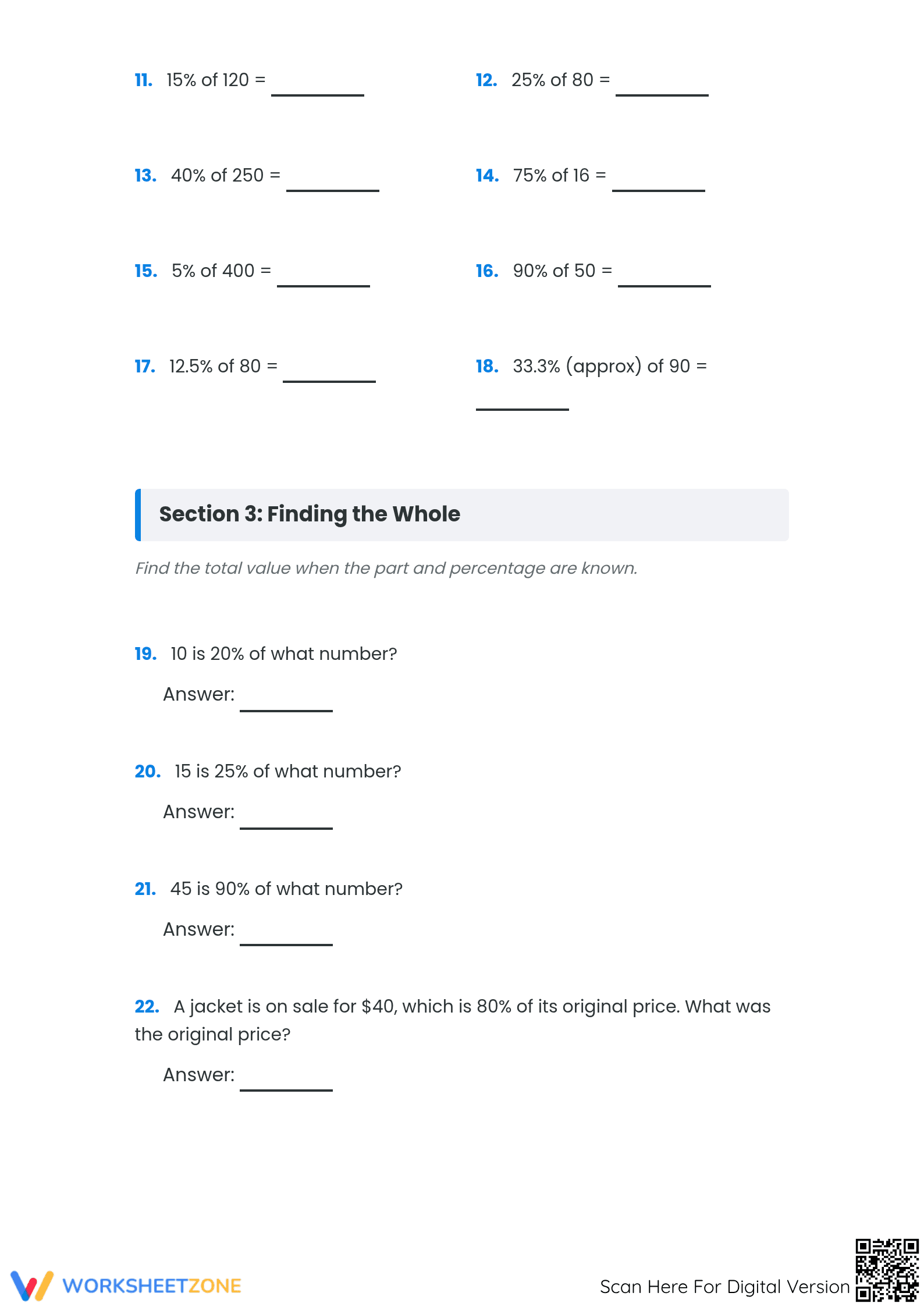
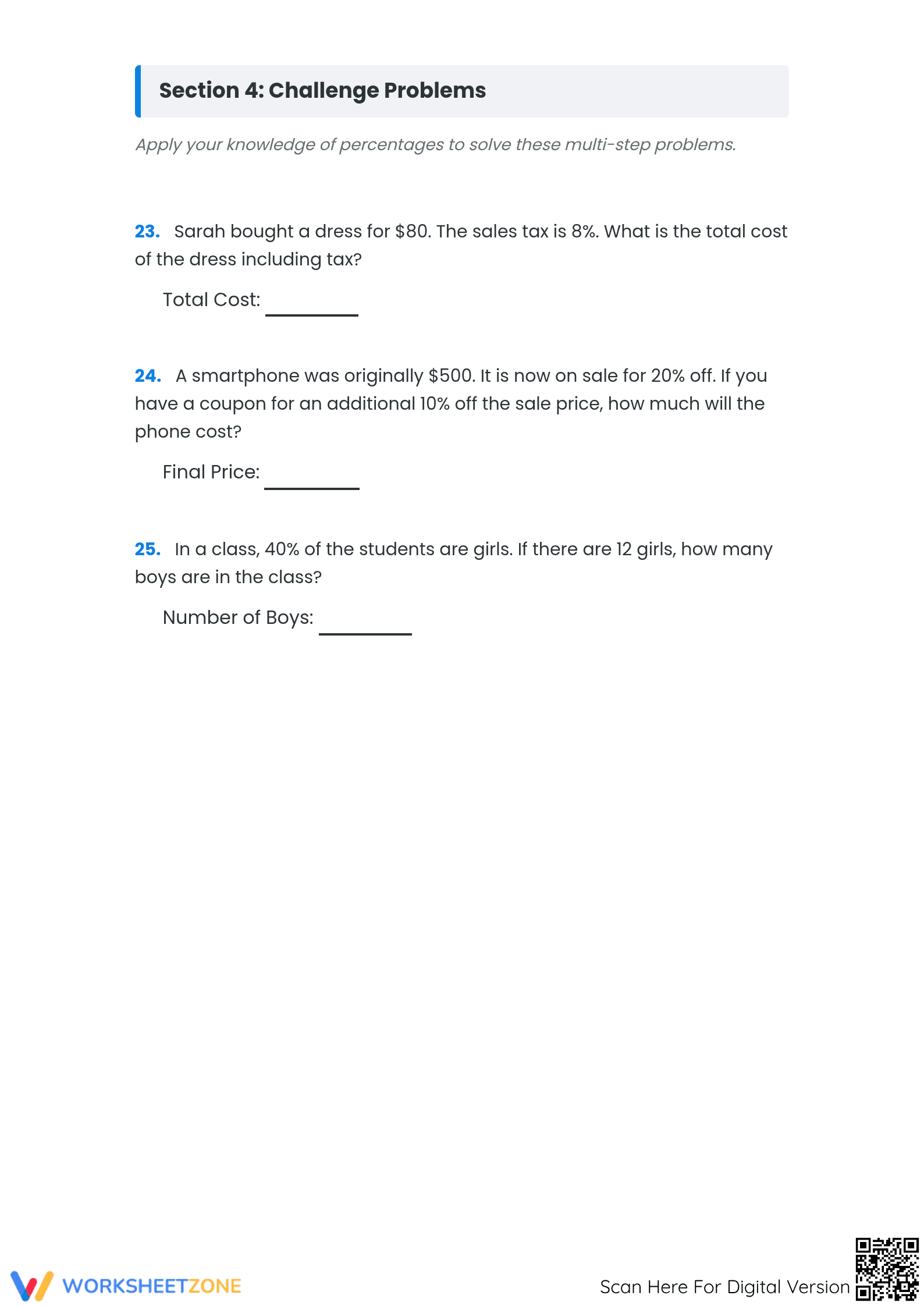
This four-page PDF includes 25 structured math problems across four sections. Section 1 features 10 word problems finding percent of a value. Section 2 provides 8 direct calculation tasks. Section 3 includes 4 problems for finding the whole, and Section 4 offers 3 challenge problems. A full answer key is included.
Skill Progression
- Guided practice: Initial word problems provide context and ample workspace for students to set up their proportions.
- Supported practice: Section 2 transitions to abstract percentage calculations, requiring students to apply their understanding of percent as a rate per 100.
- Independent practice: Final sections challenge students to find the missing whole and solve multi-step scenarios.
This structured progression follows a gradual-release model for deep conceptual mastery of ratio reasoning.
Standards Alignment
The primary alignment is 6.RP.A.3.C: "Find a percent of a quantity as a rate per 100; solve problems involving finding the whole, given a part and the percent." This also supports Grade 7 standards for multi-step percent problems. Both codes can be copied into lesson plans, IEP goals, or curriculum mapping tools.
How to Use It
Assign this worksheet during the "You Do" phase of a lesson on proportional relationships. Use Section 1 as a collaborative activity for setup discussion. During independent work, observe students in Section 3 to identify misconceptions about parts versus wholes. Total completion time is 35 minutes.
Who It's For
Designed for Grade 6 general education students, this resource is also suitable for Grade 7 review or Grade 5 enrichment. It pairs naturally with an anchor chart on the "part/whole = %/100" proportion method or a direct instruction lesson on converting percentages to decimals.
This Grade 6 worksheet aligns with the instructional shifts identified by NAEP, which emphasizes the transition from basic computation to applying proportional reasoning in varied contexts. By integrating finding the part, percent, and whole within a single 25-task progression, the resource facilitates the "spaced practice" strategy recommended by the RAND AIRS 2024 report for improving long-term retention. Research from EdReports 2024 indicates that high-quality materials must balance procedural fluency with conceptual understanding; this worksheet achieves that balance by requiring both direct calculation and critical thinking. Educators can use the provided 25-item set to gather robust evidence of student mastery of 6.RP.A.3.C before progressing to more complex financial literacy topics. Each section is designed to isolate specific skills while maintaining the cognitive load required for standards-level performance, ensuring students are prepared for rigorous state assessments. This approach builds the durable math skills necessary for success in secondary algebra and real-world financial decision-making.


