


























Views
Downloads
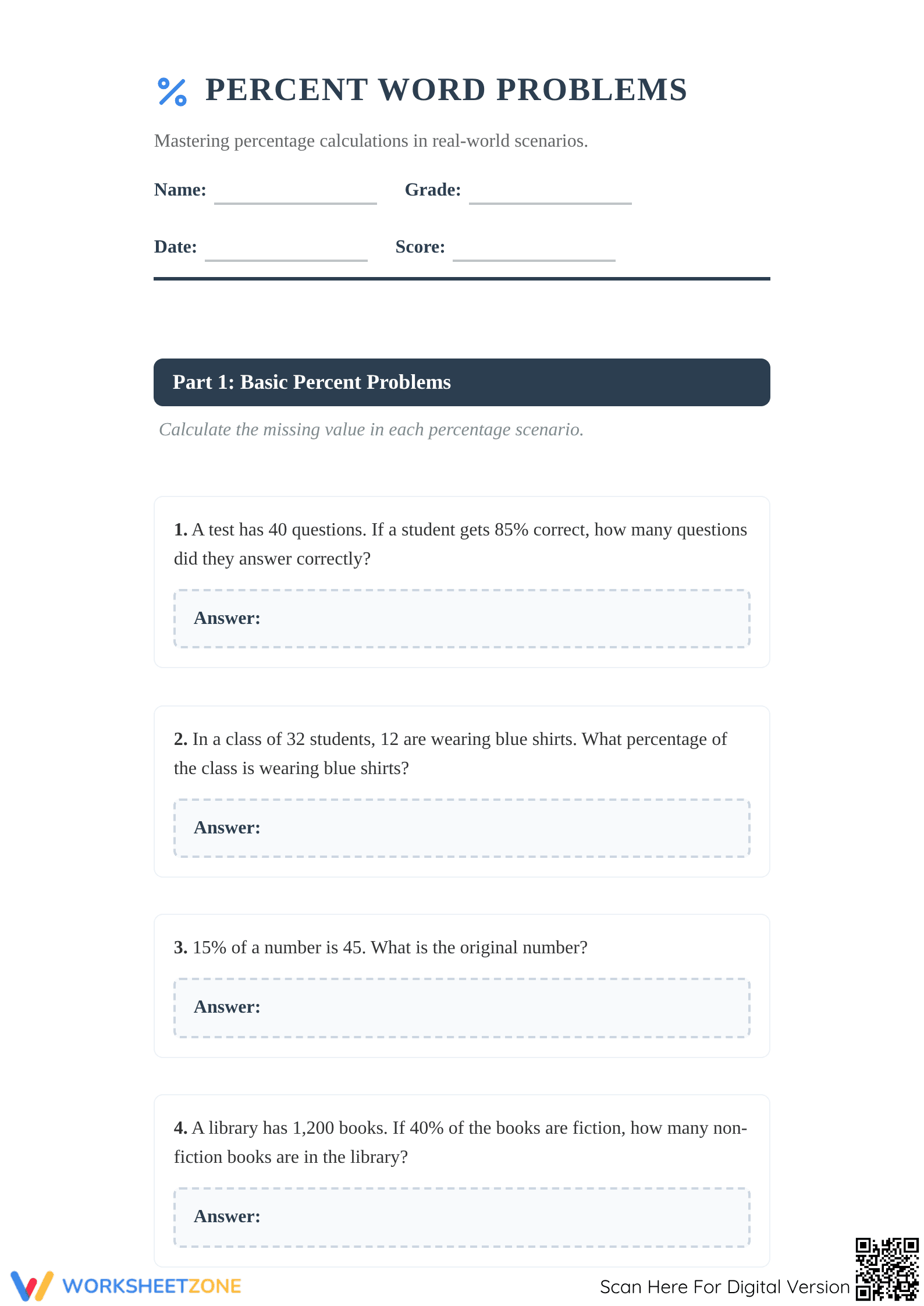


Percent Word Problems Worksheet | Essential Grade 7 Math
Paste this activity's link or code into your existing LMS (Google Classroom, Canvas, Teams, Schoology, Moodle, etc.).
Students can open and work on the activity right away, with no student login required.
You'll still be able to track student progress and results from your teacher account.
This comprehensive Grade 7 math worksheet empowers students to master percent word problems through eighteen realistic scenarios. By calculating discounts, sales tax, simple interest, and percentage changes, learners build the financial literacy and mathematical fluency required for real-world success. This resource ensures students can confidently apply proportional reasoning to solve complex, multi-step percentage challenges.
At a Glance
- Grade: 7 · Subject: Math
- Standard:
CCSS.MATH.CONTENT.7.RP.A.3— Use proportional relationships to solve multi-step ratio and percent problems in real-world contexts- Skill Focus: Percent Word Problems
- Format: 5 pages · 18 problems · Answer key included · PDF
- Best For: Middle school math practice and assessment
- Time: 45–60 minutes
What's Inside
This five-page PDF features 18 tiered word problems divided into four thematic sections. It includes a percent bar model visual for conceptual support, a dedicated section on shopping and finance, and complex multi-step scenarios. A complete answer key is provided to facilitate rapid grading and provide immediate feedback to students on their calculation accuracy and problem-solving logic.
Skill Progression
- Guided Practice: The initial "Basic Percent Problems" use straightforward language and lower numerical values to establish foundational techniques for finding parts, wholes, and percentages across four introductory tasks.
- Supported Practice: The "Shopping & Finance" and "Percent Increase & Decrease" sections introduce specific vocabulary like "commission" and "markdown," requiring students to translate financial terms into mathematical operations.
- Independent Practice: The final "Real-World Scenarios" present multi-step challenges, such as calculating successive discounts or finding remaining battery life, ensuring students have reached independent mastery of the concept.
This sequence ensures a smooth gradual release of responsibility, moving students from basic comprehension to advanced application.
Standards Alignment
The primary focus of this resource is CCSS.MATH.CONTENT.7.RP.A.3: "Use proportional relationships to solve multistep ratio and percent problems. Examples: simple interest, tax, markups and markdowns, gratuities and commissions, fees, percent increase and decrease, percent error." Both standard codes can be copied directly into lesson plans, IEP goals, or district curriculum mapping tools.
How to Use It
Use this worksheet during independent practice after a direct instruction lesson on proportional relationships. It serves as an excellent formative assessment; teachers should observe whether students correctly identify the "whole" in problems involving percent increase versus those involving percent decrease. The expected completion time is approximately 50 minutes, making it suitable for a full class period or a comprehensive homework assignment.
Who It's For
This resource is designed for seventh-grade students, but it is also highly effective for eighth-grade review or accelerated sixth-grade learners. It provides necessary scaffolding for students with IEP goals related to functional math by using clear, relatable scenarios. Pair this worksheet with a percent anchor chart or a shopping simulation to deepen student engagement and conceptual understanding.
Mastering percentages is a critical milestone in middle school mathematics that bridges foundational arithmetic and algebraic reasoning. This worksheet aligns with the instructional shifts recommended by EdReports (2024), which emphasize the importance of applying mathematical concepts to real-world contexts to ensure deep conceptual understanding. By engaging with 18 varied problems, students develop the procedural fluency and problem-solving stamina identified by Fisher & Frey (2014) as essential for secondary math success. Research from the NAEP consistently shows that students who can fluidly solve ratio and proportion tasks, including those involving tax, interest, and multi-step discounts, are better prepared for high school algebra and personal financial management. The inclusion of visual aids like bar models supports cognitive load management, allowing students to focus on the underlying proportional relationships. This standards-aligned resource provides the rigorous practice necessary to move students from basic computation to sophisticated mathematical modeling.


