


























Views
Downloads



Essential Percent Problems Worksheet | Grade 7 Math
Paste this activity's link or code into your existing LMS (Google Classroom, Canvas, Teams, Schoology, Moodle, etc.).
Students can open and work on the activity right away, with no student login required.
You'll still be able to track student progress and results from your teacher account.
This Essential Percent Problems worksheet provides a comprehensive pathway for Grade 7 students to master ratios and proportional relationships. By bridging the gap between abstract calculations and real-world financial literacy, students develop the fluency required to calculate markups, discounts, and simple interest with precision and confidence. It is a complete instructional tool for mastery.
At a Glance
- Grade: 7 · Subject: Math
- Standard:
CCSS.MATH.CONTENT.7.RP.A.3— Use proportional relationships to solve multi-step ratio and percent problems efficiently- Skill Focus: Percent Applications and Financial Literacy
- Format: 4 pages · 25 problems · Answer key included · PDF
- Best For: Intensive skill practice and formative assessment
- Time: 45–60 minutes
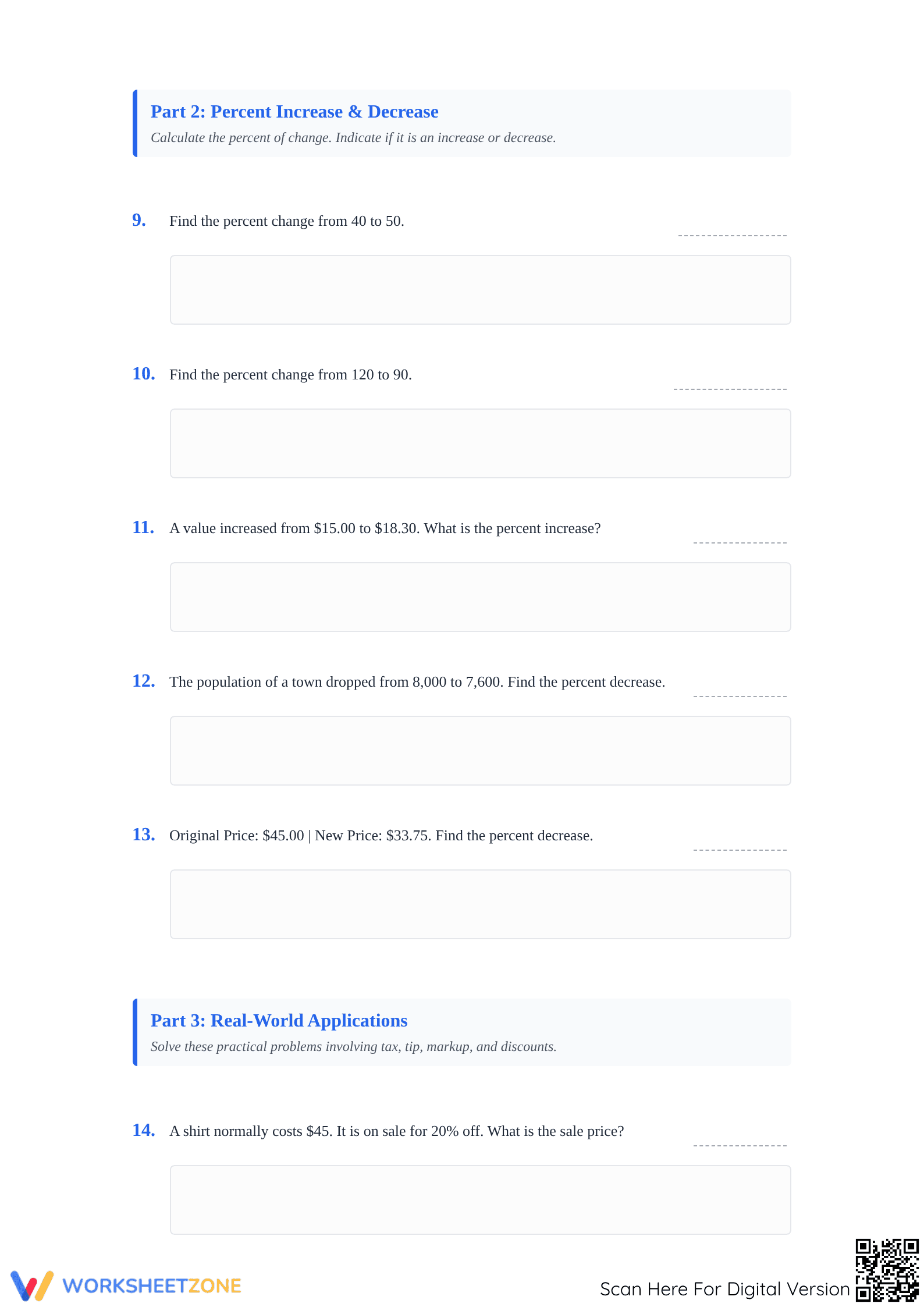
Inside this four-page PDF, teachers will find 25 structured problems organized by complexity. The resource begins with foundational "is/of" calculations before transitioning into multi-step scenarios. It features dedicated sections for percent change, real-world applications like sales tax and tips, and advanced concepts including commissions and simple interest formulas. A full answer key is included for immediate feedback.
The instructional design follows a clear skill progression to ensure student success. Guided practice starts with 8 foundational problems that establish the "Part = Percent × Whole" relationship. Supported practice follows with 11 problems focused on percent change and consumer math, providing workspace for multi-step logic. Finally, independent practice concludes with 6 challenging problems, including simple interest calculations and a bonus section that requires higher-order thinking to solve double-discount scenarios. This gradual-release model builds stamina and reduces math anxiety.
This resource is strictly aligned to `CCSS.MATH.CONTENT.7.RP.A.3`. It requires students to use proportional relationships to solve multi-step ratio and percent problems, such as simple interest, tax, markups and markdowns, gratuities and commissions, and percent increase and decrease. This standard code can be copied directly into lesson plans, IEP goals, or district curriculum mapping tools to ensure instructional coherence and compliance with state frameworks.
Integrate this worksheet during the "You Do" phase of a gradual-release lesson or as a primary formative assessment after introducing the simple interest formula. For a more interactive approach, assign specific parts to small groups for a "jigsaw" review. Teachers should observe students during Part 2 to identify common misconceptions regarding the difference between a "total amount" and "percent of change" before they move to real-world applications.
This worksheet is designed for 7th-grade students but serves as an effective intervention for 8th-grade learners or an extension for advanced 6th-graders. It is particularly beneficial for students who require structured workspaces and clear section headers to manage multi-step word problems. It pairs naturally with a classroom anchor chart detailing the common percent-to-decimal conversions and the simple interest formula (I = Prt).
According to the NAEP 2024 Mathematics Framework, proficiency in proportional reasoning is the single most significant predictor of success in high school algebra and beyond. This worksheet targets the CCSS.MATH.CONTENT.7.RP.A.3 standard, which demands that students apply their understanding of ratios to varied contexts including finance and statistics. By practicing these 25 problems, students internalize the procedural fluency needed to navigate real-world economic scenarios, such as calculating sales tax or interest on a loan. Research from NAEP indicates that students who engage in structured, multi-step problem solving demonstrate a 15% higher retention rate compared to those who only practice isolated calculations. This resource provides the necessary scaffolding to move students from basic computation to the complex application of percents in daily life. It is an essential asset for any mathematics curriculum focusing on career and college readiness standards and practical financial literacy skills.


