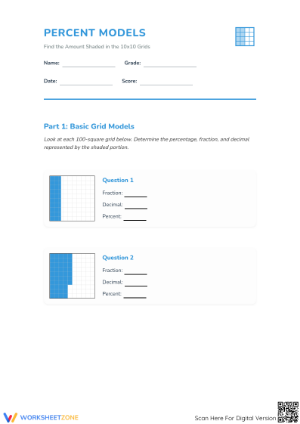
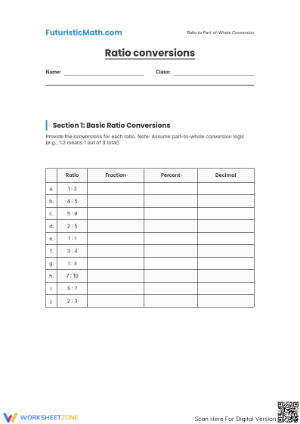
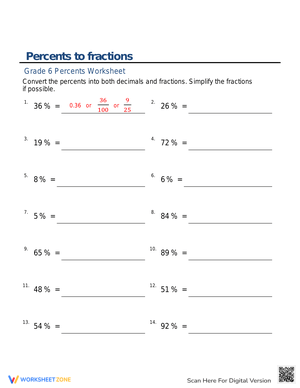
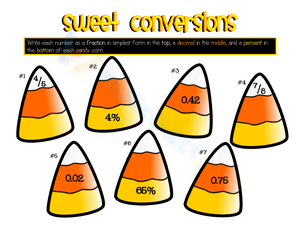
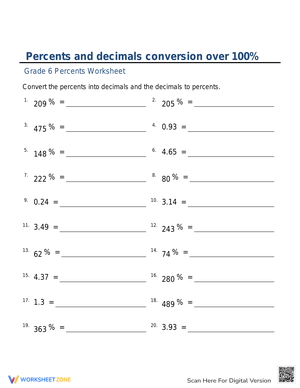
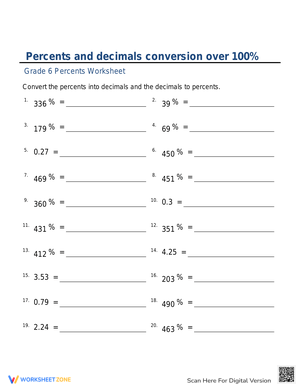
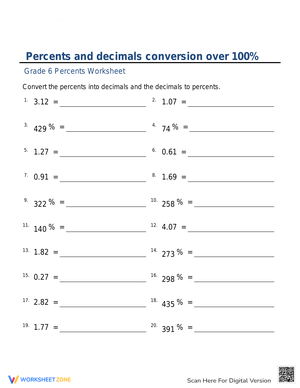
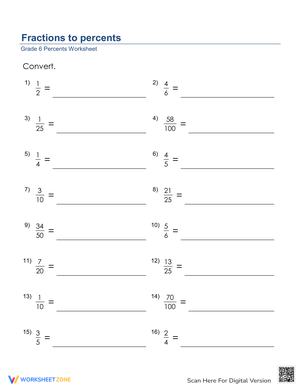
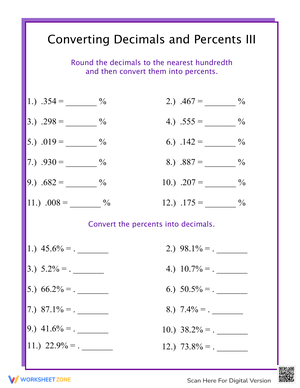
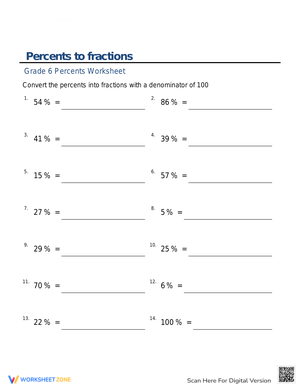
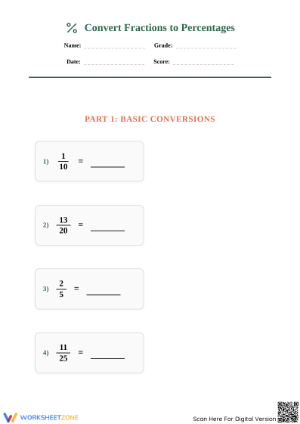
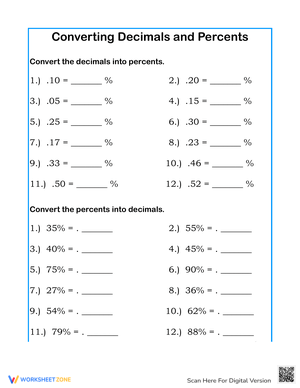
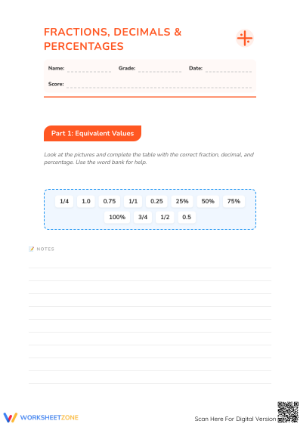
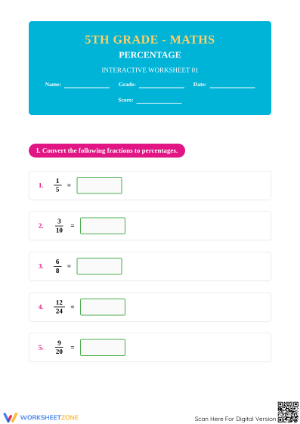
These converting percents decimals and fractions printable worksheets give grades 5–8 teachers a set of targeted practice tools for one of the most persistently tested skills in middle school math — moving fluently among three representations of the same rational number. The set covers all six conversion directions, and each worksheet builds procedural fluency so students can execute conversions accurately without hunting for rules mid-problem.
The Six Conversion Directions, Each Practiced Directly
The six conversion directions divide into three pairs: percent ↔ decimal, percent ↔ fraction, and fraction ↔ decimal. Each direction gets dedicated practice before worksheets combine them in mixed review. This sequence matters because students who only practice two or three directions tend to apply the wrong procedure when formats rotate mid-set — a problem that shows up reliably on every unit test and on standardized assessments.
Three worksheet formats anchor the practice:
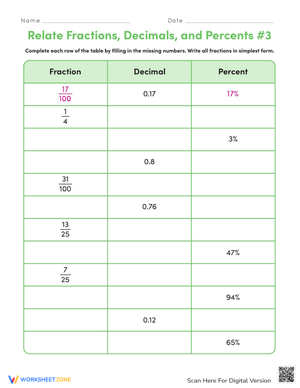
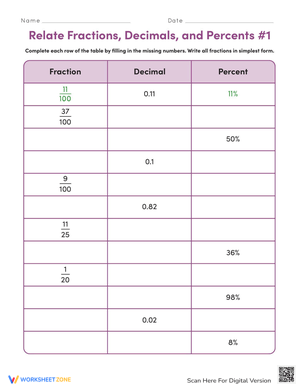
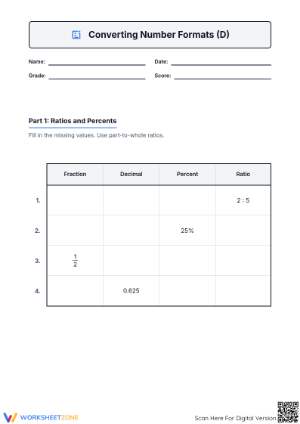
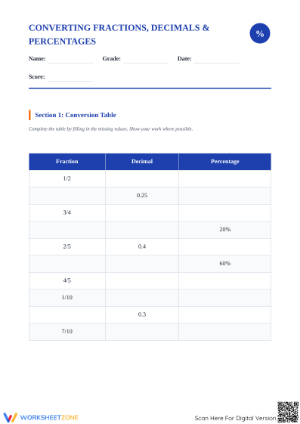
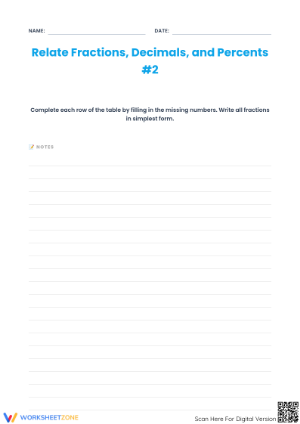
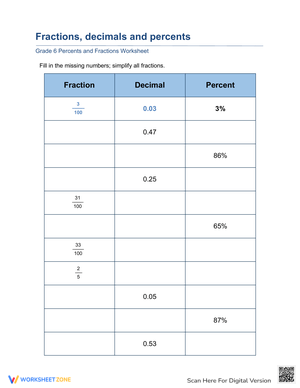
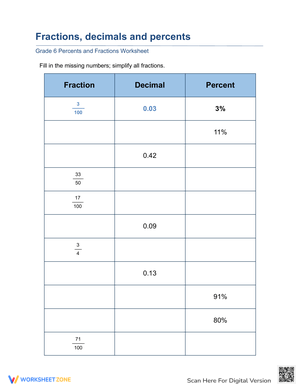
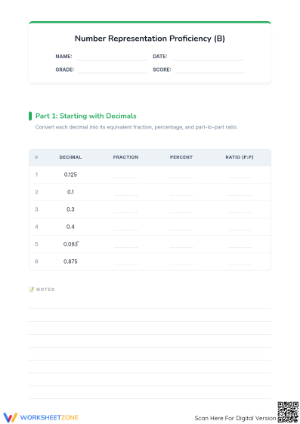
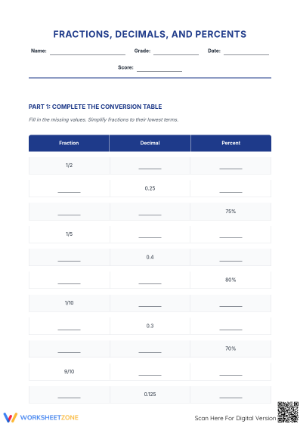
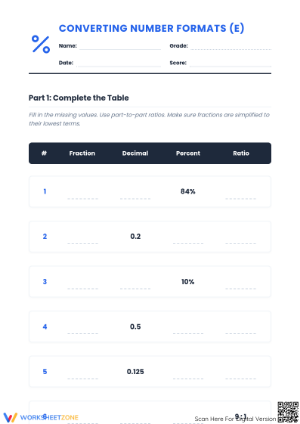
- Fill-in conversion tables — a three-column layout labeled Percent, Decimal, and Fraction, with one value given per row. Students complete the other two columns, which makes the relationship between representations visually explicit rather than abstract.
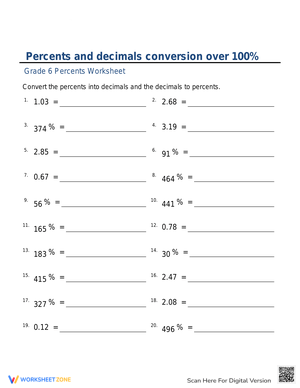
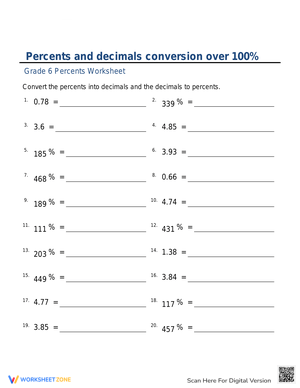
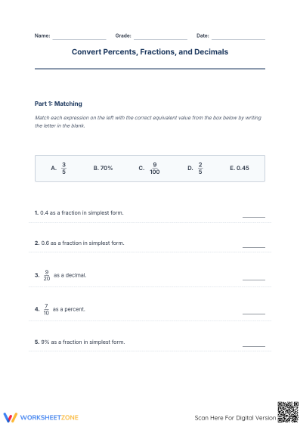
- Mixed-review worksheets — 15–20 problems rotating all six conversion directions. Students have to read each problem and select the correct procedure rather than repeat one method for 20 consecutive items. This format directly mirrors the structure of most unit tests.
- Real-context problems — conversions embedded in scenarios students recognize, such as rewriting a 0.320 batting average as a fraction and a percent, or converting a 25% discount to its decimal equivalent to compute a sale price.
Mistakes Students Make That These Worksheets Help You Catch
The most damaging error is directional. Students learn "move the decimal point two places" without anchoring it to a reason, then move it the wrong way — 35% becomes 3500 rather than 0.35. Because the rule feels arbitrary to them, the flip is unpredictable and inconsistent across students. The conceptual fix is repetition of one phrase: "percent means per hundred, so divide by 100, and dividing by 100 always moves the decimal left." That reasoning, said aloud and written out during worked examples, closes the gap faster than procedural drilling alone.
The second persistent error surfaces with fractions. Students write 60/100 as the answer to "convert 60% to a fraction" and stop — they see the conversion as complete, which it technically is, but haven't treated simplification as part of the same step. A practical habit-builder: require students to circle the final simplified fraction and leave any unsimplified form uncircled. The visual gap between the two makes it immediately obvious that the work is unfinished.
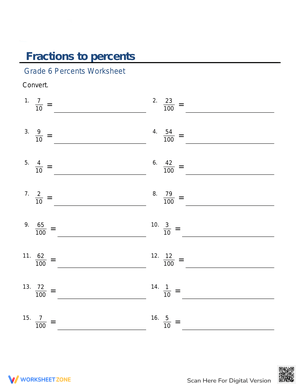
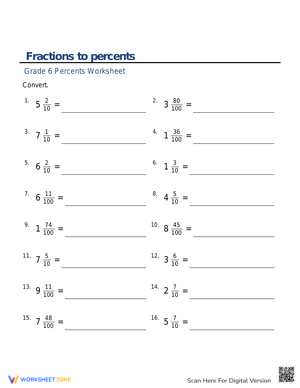
A third error emerges specifically in fraction-to-percent conversions. Students who have practiced multiplying fractions sometimes multiply by 10 instead of 100 — so 3/8 becomes 3.75% instead of 37.5%. The answer is internally consistent with their logic, which is exactly what makes it persist. Writing the full procedure each time as "divide numerator by denominator, then multiply that decimal by 100" prevents students from abbreviating a step they haven't yet automated correctly.
Building These Worksheets Into a Unit That Sticks
The most effective sequence runs two weeks. In week one, assign one conversion direction per day: percent → decimal on Monday, the reverse on Tuesday, percent ↔ fraction across Wednesday and Thursday, and fraction ↔ decimal on Friday. Each session opens with a 3-minute worked example at the board, then moves directly into 12–15 minutes of independent practice while you circulate. The converting percents decimals and fractions printable worksheets in this set are organized by direction, so you pull exactly the right worksheet each morning without sorting through a mixed packet.
Week two shifts to mixed-review worksheets. The cognitive demand changes substantially — students now select the correct procedure rather than repeat one method. This is also where the fill-in conversion table earns its place as a formative tool: collect it at the end of class, scan for decimal-point errors and unsimplified fractions, and spend 5 minutes the next morning addressing the two most common mistakes before moving forward.
The three-color highlighter routine works particularly well during the first mixed-review session. Students mark every percent value in yellow, every decimal in blue, and every fraction in green. When they finish, the color pattern shows which representation they started from and which they produced — and it tells you, during circulation, which students are reading problems carefully and which are converting in one direction regardless of what was asked.
Standard Alignment
The core worksheets in this set align to CCSS 6.RP.A.3c, which requires students to find a percent of a quantity and solve problems involving finding the whole given a part and a percent. Fluency with conversion between representations is the procedural prerequisite for that standard. Grade 6 is the primary placement in the Common Core sequence, though many teachers use the entry-level tier in late grade 5 as preparation and return to the advanced-tier worksheets in grade 7 when percent applications grow more complex.
Adjusting the Worksheets Across a Range of Learners
Three difficulty tiers let teachers assign by readiness rather than by general ability label. The entry-level tier uses benchmark values only — 25%, 50%, 75%, 0.25, 0.5, 1/4, 1/2 — numbers many students already hold in memory from earlier grades. Working from familiar values while learning a new procedure keeps cognitive load manageable and builds confidence before less intuitive numbers appear. The converting percents decimals and fractions printable worksheets at this tier include a reference strip at the top of each worksheet showing all three conversion rules, so students have a quick reference without raising their hands every two minutes.
The intermediate tier introduces any whole-number percent and denominators that require actual computation rather than recall. The advanced tier adds repeating decimals — 1/3 as 0.333..., 5/6 as 0.8333... — and asks students to express those as percents rounded to the nearest tenth. A predictable error at this level is writing 1/3 = 33% rather than 33.3%, and the answer key flags this distinction explicitly. Students who complete the advanced tier can work a natural extension: given 0.272727..., find the equivalent fraction — an exercise that anticipates algebraic reasoning they will formalize in grade 8.
Frequently Asked Questions
What grade levels do these worksheets fit?
Grade 6 is the primary placement, aligned to CCSS 6.RP.A.3c, but the tiered format makes the set useful from late grade 5 through grade 8. Grade 5 teachers use the benchmark-only tier as enrichment; grade 8 teachers pull the advanced tier for intervention or spiral review before state testing.
How long does a typical worksheet take to complete?
A 15-problem mixed-review worksheet takes most grade 6 students 12–15 minutes of independent work. Fill-in conversion tables run 8–10 minutes — the format reduces reading load significantly. The advanced tier with repeating decimals takes careful workers closer to 18–20 minutes.
Do the worksheets come with answer keys?
Yes. Every worksheet in the set includes a corresponding answer key. The keys for repeating decimal conversions show both the exact answer and an acceptable rounded form, so teachers do not have to make judgment calls on borderline responses during grading.
Are these better used in class or as homework?
The converting percents decimals and fractions printable worksheets work in both settings, but the fill-in conversion tables are most valuable as in-class formative tools — collected at the end of the period, they give a clear snapshot of where each student stands before the next day's lesson. Mixed-review sheets, which assume students already know the procedures, are better assigned as homework after classroom practice has established a baseline.













 Interactive Worksheet Maker
 Quiz Maker
 Word Search Maker
 Crossword Puzzle Maker
 Word Scramble Generator
 Sentence Scramble Generator
 Handwriting Worksheet Generator
 Name Tracing Generator
 Fill In The Blank Generator