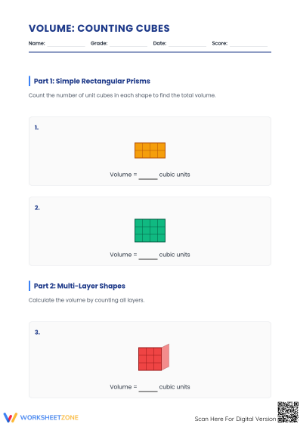
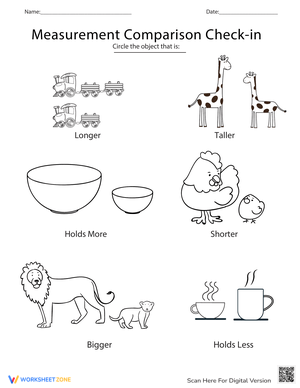
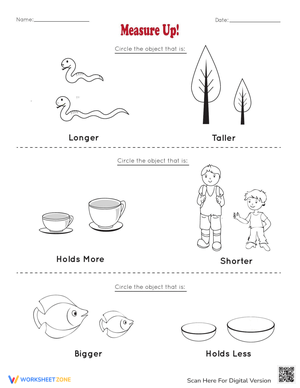
These comparing volume worksheets give teachers a ready-to-print progression from early visual comparison all the way through multi-unit problems, covering the full K–5 span of measurement instruction. Each page targets a specific skill level — which matters more than it might seem when a single classroom contains students working two or three grade levels apart on measurement.
What Area of Practice These Comparing Volume Worksheets Address
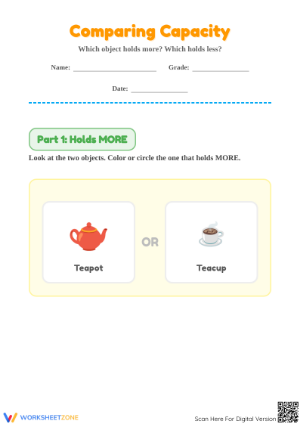
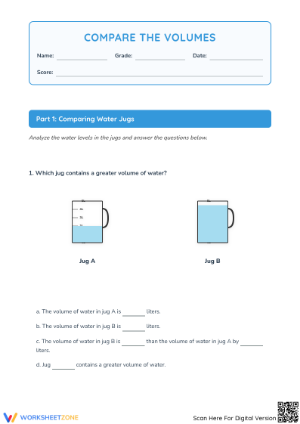
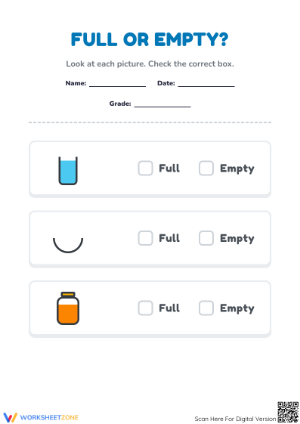
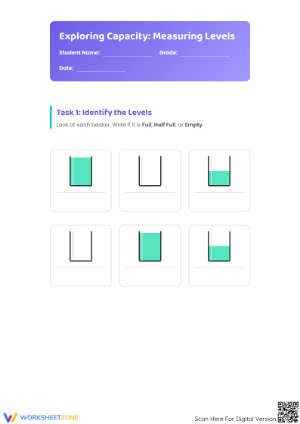
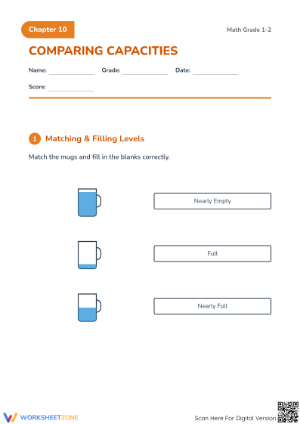
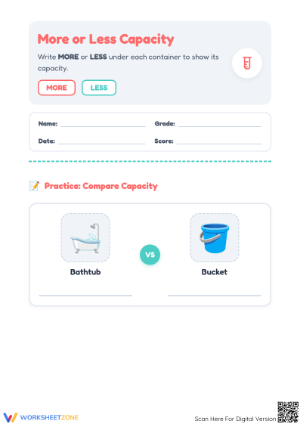
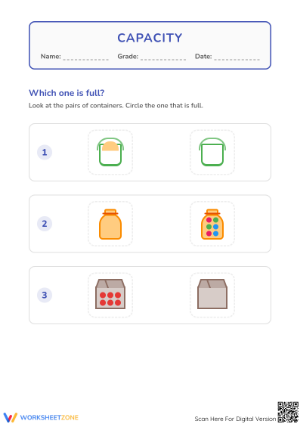
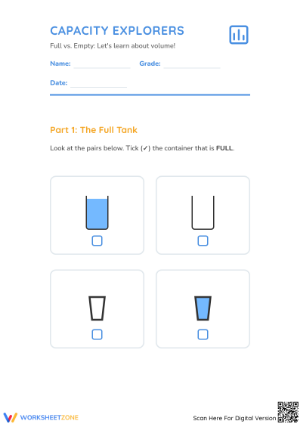
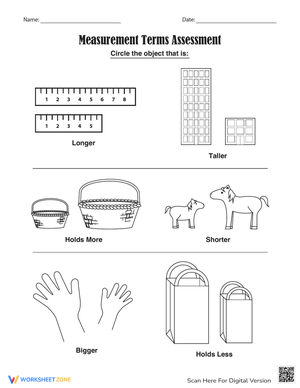
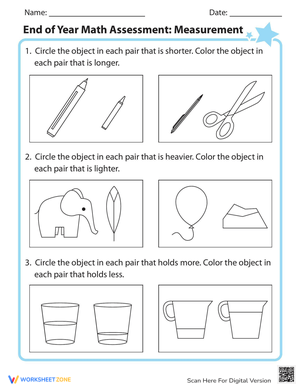
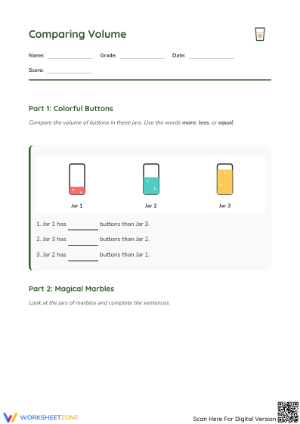
These worksheets addresses volume and capacity comparison across four distinct skill bands. At the foundational level, students look at illustrations of two containers filled to different levels and mark which holds more or shade the one with less — no numerals required, just perceptual judgment. The next band introduces non-standard units: students count scoops or cups to decide which vessel holds more, building the informal reasoning that makes later unit work feel intuitive rather than arbitrary.
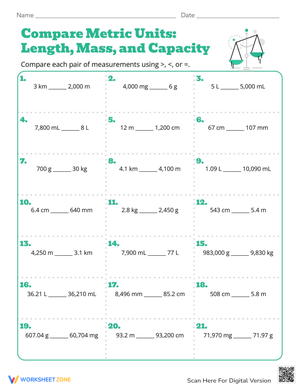
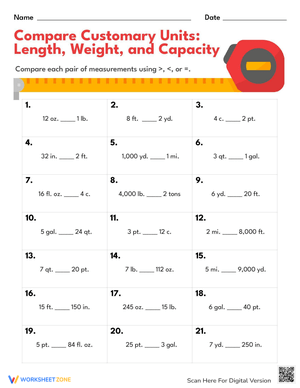
From there, pages move into standard-unit comparison. Students write >, <, or = between pairs like 750 mL and 1 L, which requires unit conversion before any comparison is possible — that's the cognitive move students most often skip. The most demanding pages embed volume comparisons inside word problems with real contexts: two aquariums with different dimensions, juice containers labeled in different unit systems, a recipe that calls for both pints and quarts.
Standards Alignment
The core standard for this content is CCSS.MATH.CONTENT.3.MD.A.2, which asks third graders to measure and estimate liquid volumes in standard metric units and solve one-step word problems involving the same unit. That standard is the anchor for the numerical comparison pages. The visual and non-standard-unit work below that level supports readiness rather than the standard itself, and the mixed-unit problems extend beyond it toward the grade 4 and 5 measurement expectations around unit conversion (4.MD.A.1, 5.MD.C.3).
What 3.MD.A.2 doesn't make explicit — but classroom work makes obvious — is that students need direct instruction on the comparison step, not just the measurement step. The standard emphasizes estimating and measuring; the worksheets here target the comparison judgment that follows measurement, which is where instruction most commonly stops short.
Where These Worksheets Fit in a Measurement Lesson Plan
The visual-comparison pages work well as a unit opener, even for third graders who technically passed this content in first grade. Pulling out a quick picture-based page before introducing liters and milliliters lets you gauge which students retained the underlying concept and which just memorized the symbols. Five minutes is enough — you're not reteaching, you're checking.
The symbol-insertion pages fit naturally after a mini-lesson on unit conversion. A reliable routine: work the first problem together at the board, name the steps aloud ("I see liters on the left and milliliters on the right — I need to make the units match before I can compare"), then release students to complete the rest in pairs. Circulate and watch for students who skip the conversion step and compare numerals directly — 500 mL versus 1 L becomes a wrong answer fast if a student just sees 500 and 1.
Word-problem pages are well-suited to Friday's review block or the last ten minutes of a period when you want students thinking rather than waiting. They're also a strong station pairing alongside graduated cylinders and water; students who finish early can physically verify answers they got by calculation.
Where Students Struggle Most
The most predictable error across grades 3–5 is treating numerals as comparable without checking units first. A student will write 2 L > 800 mL because 2 is greater than 800 — the number sense is working, but the measurement reasoning isn't. This error surfaces constantly and consistently. Worksheets that mix units within a single row are the fastest diagnostic tool you have; if a student answers those confidently and correctly, they've internalized the conversion step. If they don't, they're operating on numerals alone.
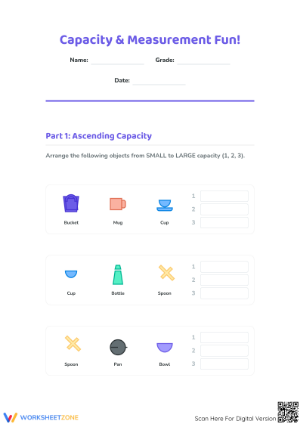
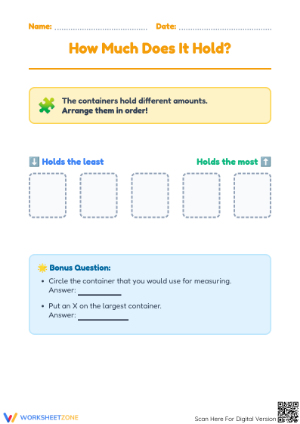
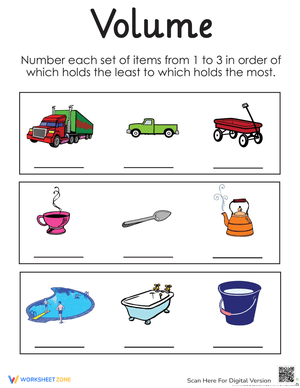
A second pattern appears in the ordering tasks, where students must arrange three or four containers from least to greatest. Students who handle pairwise comparisons correctly will sometimes lose track of relative order when a third item is introduced — particularly when one measurement requires conversion and the others don't. The error isn't conceptual so much as working-memory load: too many open threads at once. Having students write converted values in a small box above each measurement before ordering helps significantly.
For the youngest students on visual-comparison pages, the error to watch for is attending to container height rather than fill level. A tall, narrow glass with a low fill line will be marked as holding "more" because it's taller. This is exactly the Piagetian conservation issue those pages are designed to surface — it's a developmental finding, not a deficit, and it's worth naming for students directly.
Adapt Suitable Worksheets for Different Students' Levels
Print three versions for a mixed-ability class: visual-comparison pages for students still building number fluency, single-unit numerical pages for on-level work, and mixed-unit or word-problem pages for students who need the extra layer of challenge. The differentiation doesn't require a separate lesson plan — the pages cover the same conceptual territory at different entry points, so whole-class discussion still works after independent practice.
One format that occasionally frustrates students who need support is the cut-and-paste ordering task. The physical manipulation is engaging, but students who freeze when spatial organization is added to the cognitive load sometimes get the ordering wrong for non-mathematical reasons — the pieces shift, they lose track of which box is "first." For those students, a written ordering task (write 1, 2, 3 in the blank beside each container) accomplishes the same goal with less friction.
Frequently Asked Questions
Do younger students need to know liters and milliliters before using these pages?
No. The K–2 pages use pictures and non-standard units specifically so students can work on comparison reasoning before formal unit vocabulary is introduced. The metric unit pages are designed for grades 3 and up.
What's the difference between capacity and volume on these pages?
For practical purposes at the elementary level, these terms are used interchangeably on the worksheets — both refer to how much a container holds. The conceptual distinction (capacity as maximum hold, volume as actual amount of space occupied) becomes relevant in middle school geometry. If a student asks, it's worth a brief honest answer: "They're closely related, and we'll use them to mean the same thing for now."
Can I use these as exit tickets?
The single-skill pages — one row of visual comparisons, or four symbol-insertion problems — work well as a quick formative check at the end of a lesson. Scanning ten papers takes about two minutes and gives a clear read on who got the conversion step and who didn't.













 Interactive Worksheet Maker
 Quiz Maker
 Word Search Maker
 Crossword Puzzle Maker
 Word Scramble Generator
 Sentence Scramble Generator
 Handwriting Worksheet Generator
 Name Tracing Generator
 Fill In The Blank Generator