


























Views
Downloads

Preschool Capacity Worksheet | Essential Math Practice
Paste this activity's link or code into your existing LMS (Google Classroom, Canvas, Teams, Schoology, Moodle, etc.).
Students can open and work on the activity right away, with no student login required.
You'll still be able to track student progress and results from your teacher account.
This preschool math worksheet helps young learners develop a foundational understanding of volume and capacity by physically ordering objects from least to most. Students engage in a hands-on activity that transforms abstract measurement concepts into a concrete visual experience, ensuring they can distinguish between different container sizes and their holding potential.
At a Glance
- Grade: Preschool · Subject: Math
- Standard:
CCSS.MATH.CONTENT.K.MD.A.2— Compare two objects with a common measurable attribute like capacity- Skill Focus: Capacity Comparison and Ordering
- Format: 2 pages · 7 problems · Answer key included · PDF
- Best For: Hands-on math centers and measurement introduction
- Time: 10–15 minutes
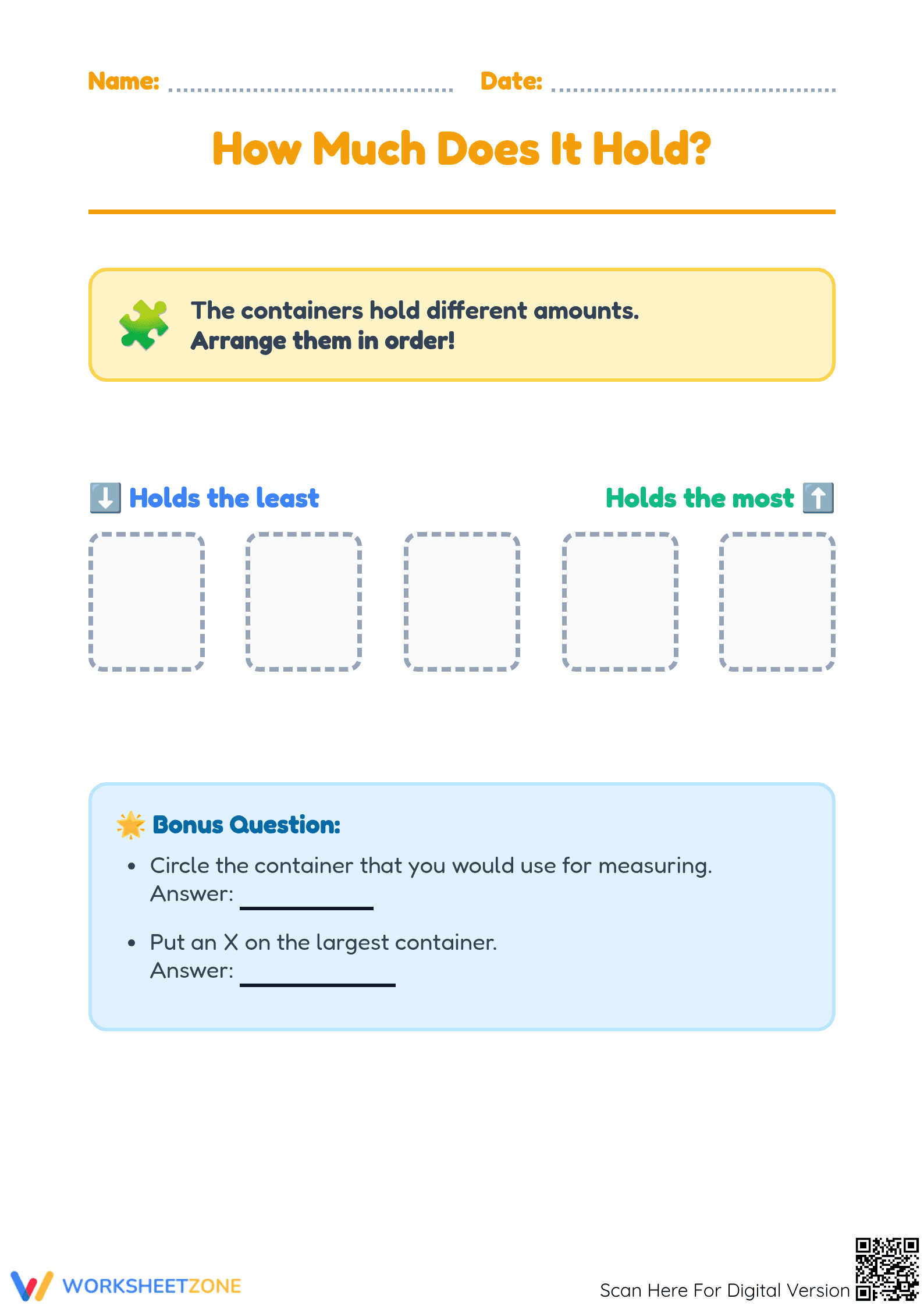
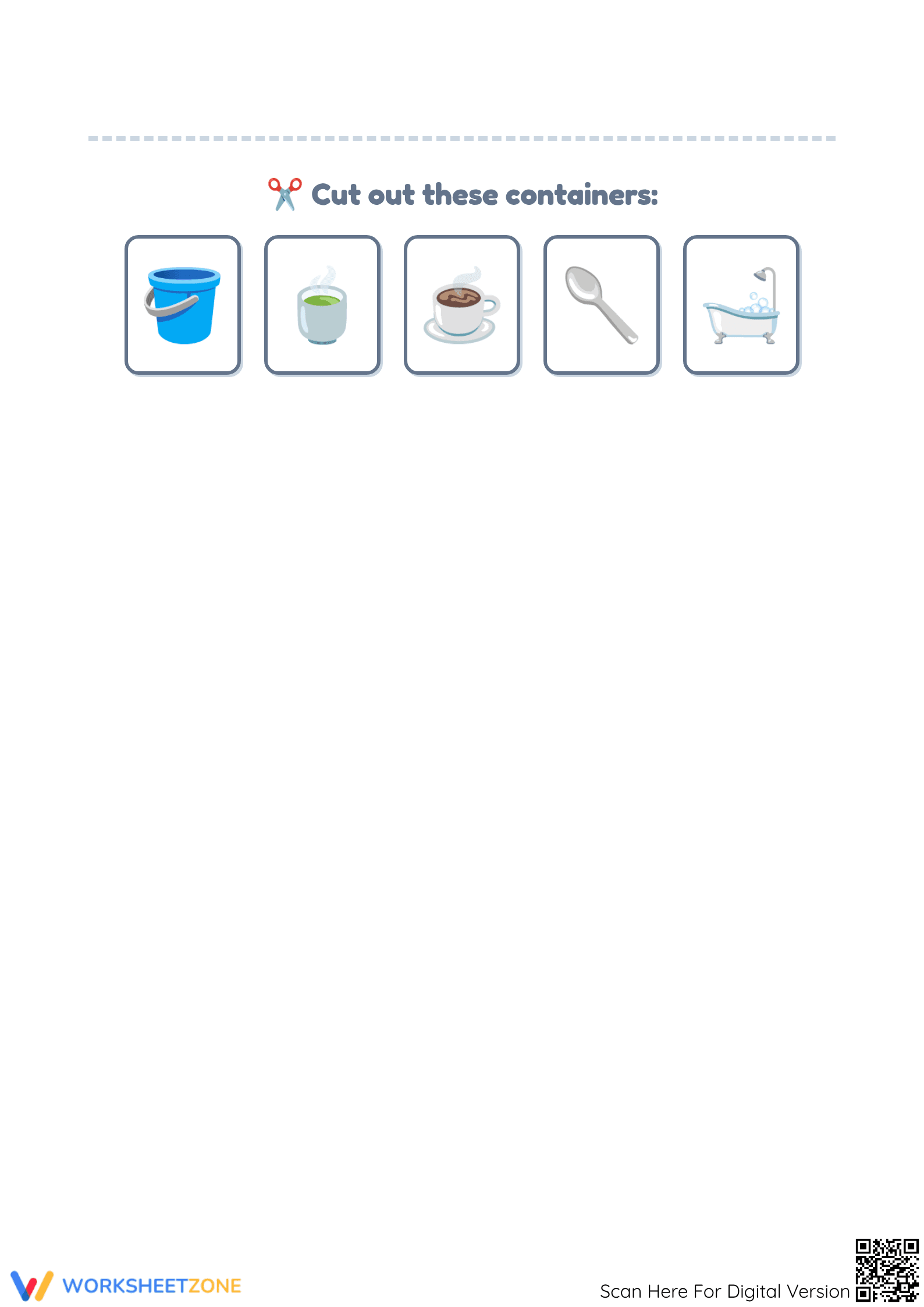
What's Inside: This 2-page PDF includes a dedicated sorting mat with five designated slots ranging from "Holds the least" to "Holds the most." The second page provides five high-contrast illustrations for cutting and pasting: a spoon, a cup, a mug, a bucket, and a bathtub. Two bonus questions at the bottom challenge students to identify specific measuring tools and the largest container, reinforcing vocabulary and critical thinking.
Zero-Prep Workflow
- Print (1 minute): Simply print the two pages in color or grayscale. No laminating or special assembly is required for immediate use.
- Distribute (30 seconds): Provide students with scissors and glue sticks. The clear visual cues allow for minimal verbal instruction.
- Review (30 seconds): Use the included answer key for a quick visual check of the sequence or have students explain their reasoning for the "least" and "most" placements.
Standards Alignment
This resource aligns with CCSS.MATH.CONTENT.K.MD.A.2: Directly compare two objects with a measurable attribute in common, to see which object has "more of"/"less of" the attribute, and describe the difference. While designed for preschool, it builds the prerequisite skills for kindergarten measurement standards. Both standard codes can be copied directly into lesson plans, IEP goals, or district curriculum mapping tools.
How to Use It
This worksheet is ideal for a math center or small-group instruction following a live demonstration with water or sand. During the activity, observe if students can identify the bathtub as the largest container without prompting; this serves as a formative assessment of their spatial awareness. Expect completion within 10 to 15 minutes depending on fine motor speed.
Who It's For
This resource is tailored for preschool and Pre-K students, as well as kindergarteners needing remedial support in measurement. It pairs naturally with a classroom "water table" exploration or a read-aloud about sizes and containers.
According to research by Fisher & Frey (2014) on the gradual release of responsibility, hands-on sorting tasks like this capacity worksheet provide the necessary "collaborative practice" phase that bridges teacher modeling and independent mastery. By manipulating physical representations of objects, students internalize the concept of CCSS.MATH.CONTENT.K.MD.A.2 more effectively than through passive observation alone. The inclusion of 7 distinct tasks—including the ordering of 5 items and 2 analytical bonus questions—ensures that learners are not just memorizing but are actively comparing attributes. This alignment with evidence-based instructional strategies supports early numeracy development and spatial reasoning, which are critical predictors of later mathematical success in elementary school. The structured layout reduces cognitive load, allowing the student to focus entirely on the skill of capacity comparison.


