


























Views
Downloads


Capacity Worksheet: Which One is Full? | Essential Math
Paste this activity's link or code into your existing LMS (Google Classroom, Canvas, Teams, Schoology, Moodle, etc.).
Students can open and work on the activity right away, with no student login required.
You'll still be able to track student progress and results from your teacher account.
This foundational capacity worksheet helps early learners distinguish between full and empty or partially full containers through clear visual comparisons. By identifying which object holds its maximum volume, students build the conceptual vocabulary necessary for more complex measurement and data analysis in later primary grades.
At a Glance
- Grade: Kindergarten · Subject: Math
- Standard:
CCSS.MATH.CONTENT.K.MD.A.2— Directly compare two objects with a measurable attribute in common- Skill Focus: Identifying full containers
- Format: 2 pages · 6 problems · Answer key included · PDF
- Best For: Introduction to measurement and volume
- Time: 10–15 minutes
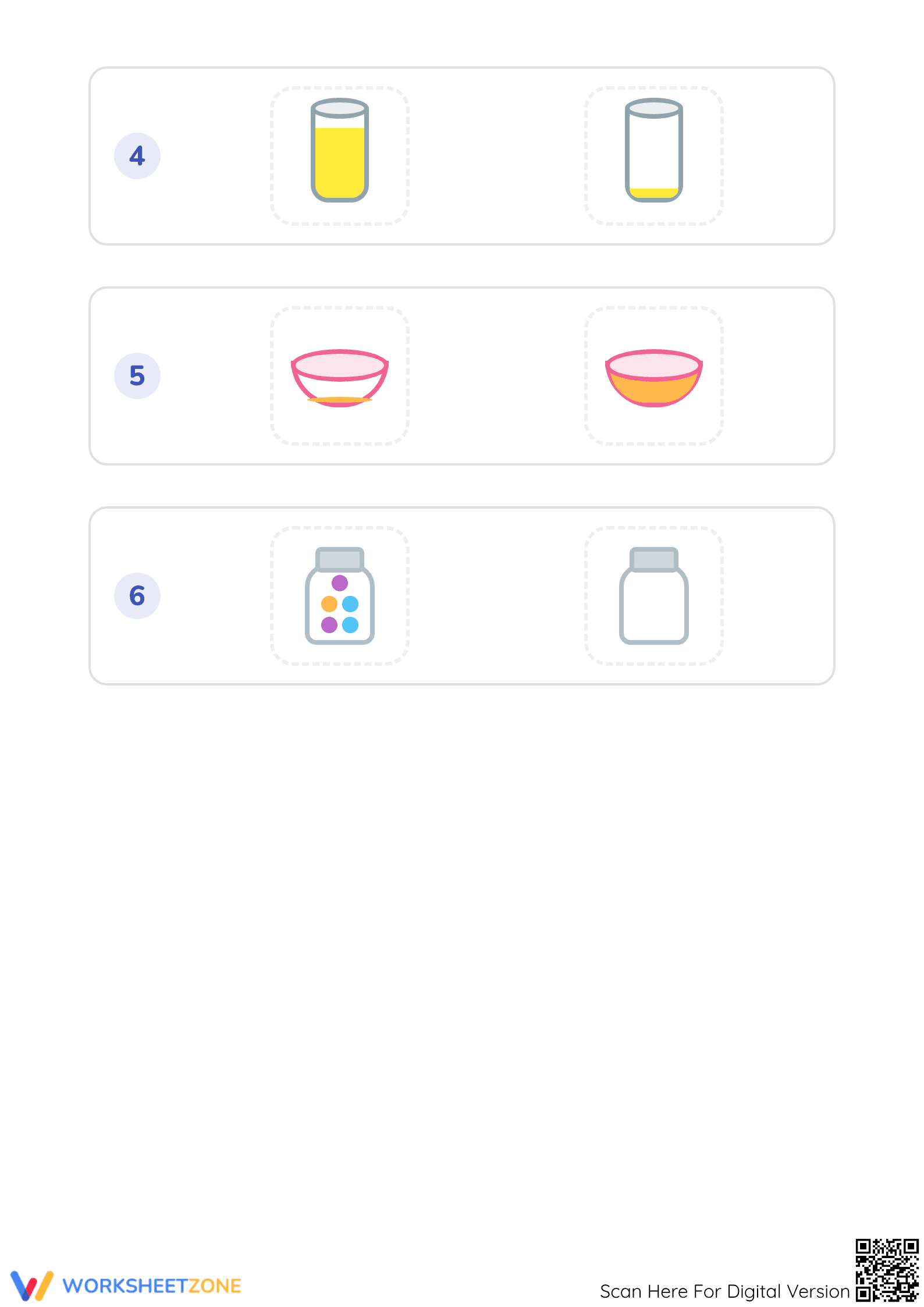
The resource consists of two high-quality PDF pages featuring six distinct comparison tasks. Each problem presents a pair of common household items—such as buckets, jars, boxes, and glasses—where one is clearly full and the other is not. The clean layout and large illustrations are specifically designed for young children who are still developing fine motor skills for circling and marking. A complete answer key is provided for quick grading.
This resource is designed for a zero-prep workflow to save teacher time. First, print the two-page PDF (30 seconds). Second, distribute the sheets to students during your measurement unit (1 minute). Third, use the included answer key to review the six problems as a whole class or during small-group intervention (5 minutes). Total preparation time is under 2 minutes, making it an ideal choice for emergency sub plans or morning work.
This worksheet aligns with CCSS.MATH.CONTENT.K.MD.A.2: "Directly compare two objects with a measurable attribute in common, to see which object has 'more of'/'less of' the attribute, and describe the difference." It specifically targets the "more of" aspect of capacity. This standard code can be copied directly into lesson plans, IEP goals, or district curriculum mapping tools.
Use this worksheet as a formative assessment after a hands-on water or sand table activity. Observe if students can transfer their physical experience with "fullness" to 2D representations. It also serves as an excellent independent practice activity during math centers. Expect students to complete the six tasks in approximately 12 minutes, allowing for discussion about what "full" looks like in different shapes.
This activity is tailored for Preschool, Kindergarten, and Grade 1 students. It is particularly effective for English Language Learners (ELLs) because it relies on visual cues rather than heavy text. Pair this worksheet with a physical demonstration using a pitcher and glass to reinforce the vocabulary before students begin their independent work.
According to the RAND AIRS 2024 report on early childhood mathematics, visual-spatial reasoning and the ability to compare attributes like capacity are critical precursors to formal arithmetic. This worksheet addresses the CCSS.MATH.CONTENT.K.MD.A.2 standard by requiring students to evaluate volume through direct visual comparison. Research indicates that early exposure to measurement concepts through structured worksheets helps solidify the "more than/less than" logic required for number line mastery. By focusing on the binary state of "full," students develop the cognitive schema needed to eventually understand fractions and liquid measurement. This resource provides 6 specific opportunities for students to practice this skill, ensuring that the concept of capacity is grounded in observable reality. Such targeted practice is essential for meeting NAEP benchmarks in early mathematical development and ensuring students are prepared for the rigors of first-grade geometry and measurement standards.


