


























Views
Downloads


Comparing Capacity Worksheet | Grade K-1 Essential
Paste this activity's link or code into your existing LMS (Google Classroom, Canvas, Teams, Schoology, Moodle, etc.).
Students can open and work on the activity right away, with no student login required.
You'll still be able to track student progress and results from your teacher account.
This comparing capacity worksheet helps early learners distinguish between volumes using familiar household objects. By identifying which containers hold more or less, students build a foundational understanding of measurement and data. This resource provides clear visual cues to support mathematical reasoning and vocabulary development in preschool, kindergarten, and first-grade classrooms.
At a Glance
- Grade: K · Subject: Math
- Standard:
CCSS.MATH.CONTENT.K.MD.A.2— Directly compare two objects with a measurable attribute in common to see which has more- Skill Focus: Volume and Capacity
- Format: 4 pages · 6 problems · Answer key included · PDF
- Best For: Introduction to measurement and volume
- Time: 10–15 minutes
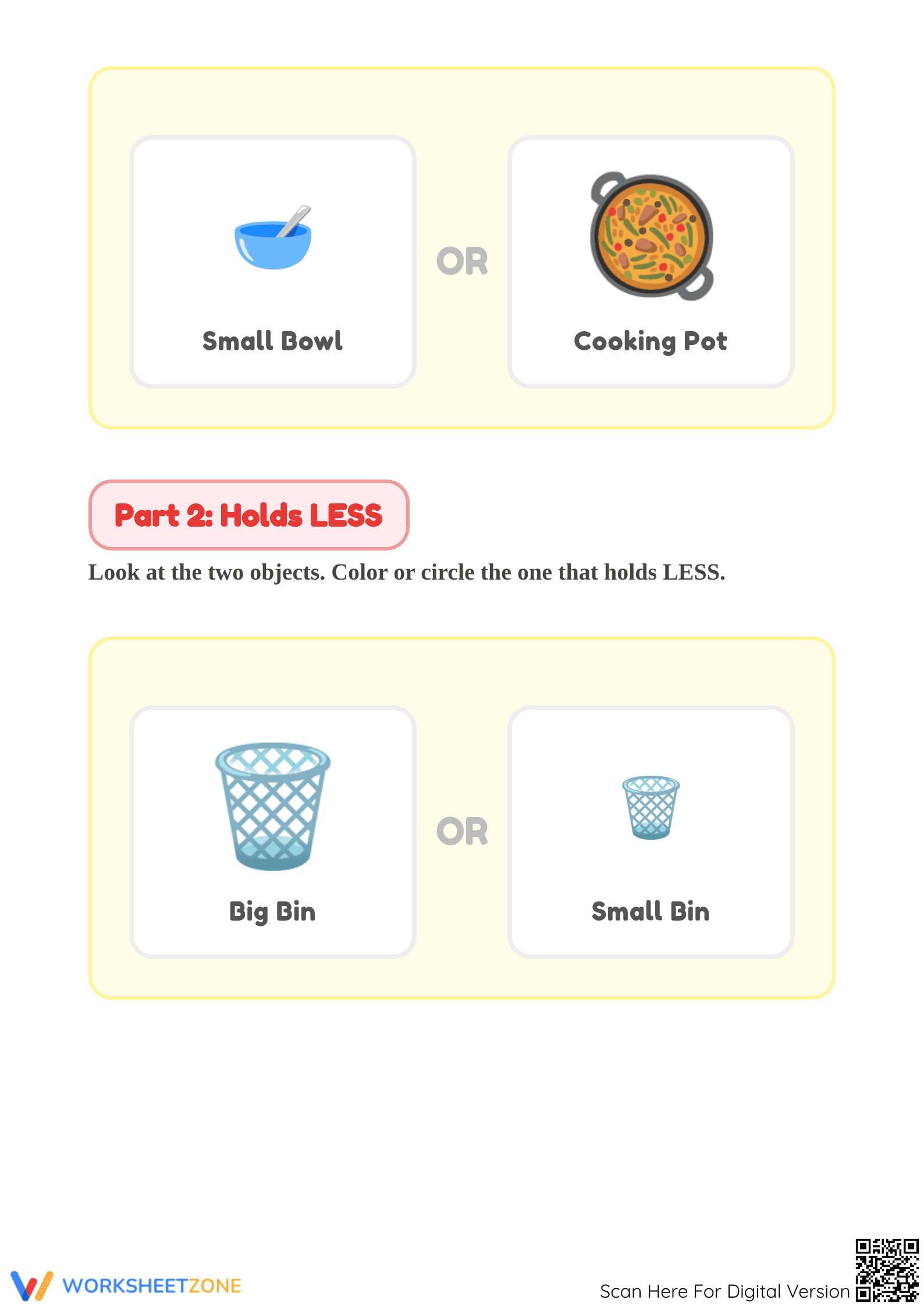
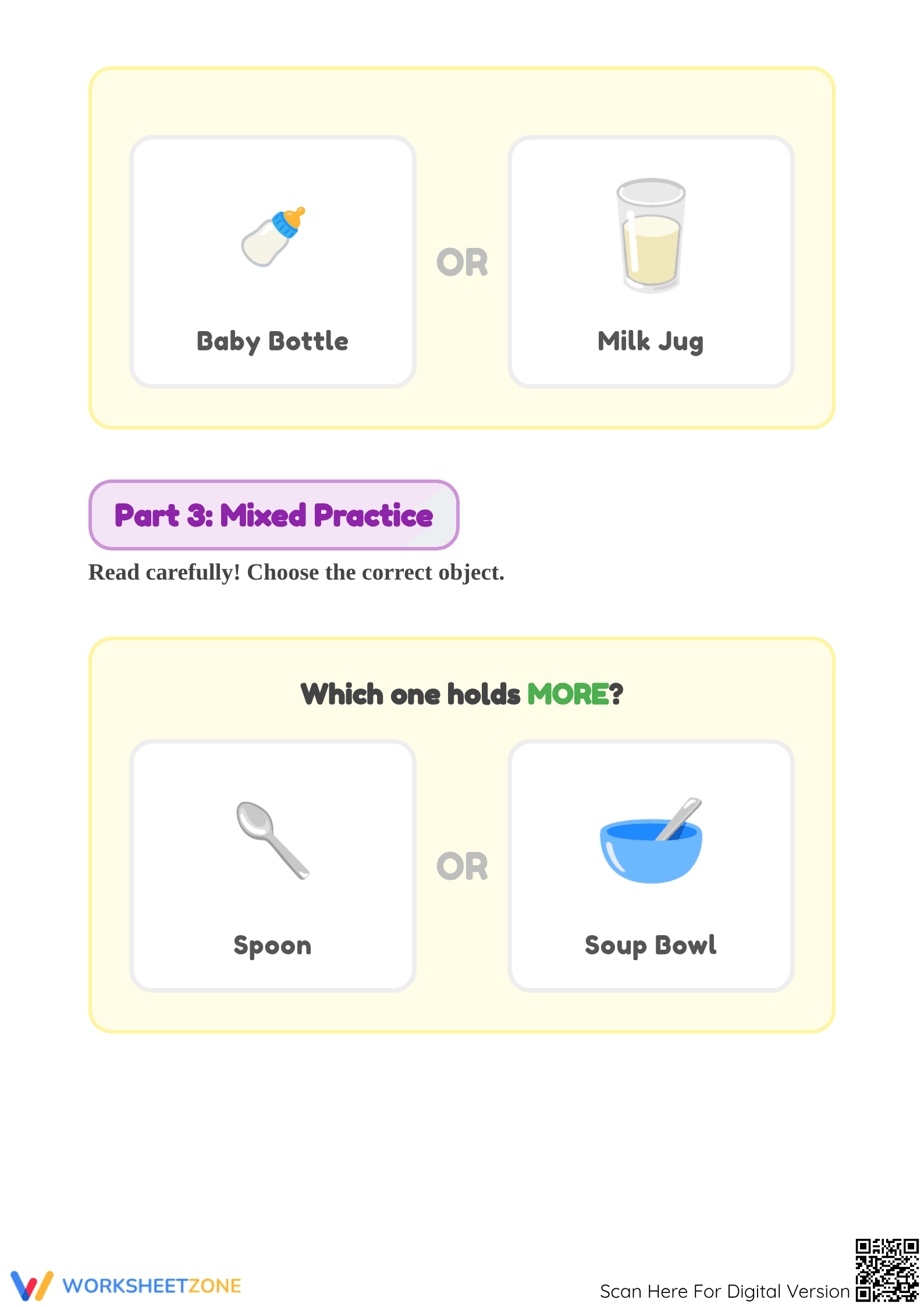
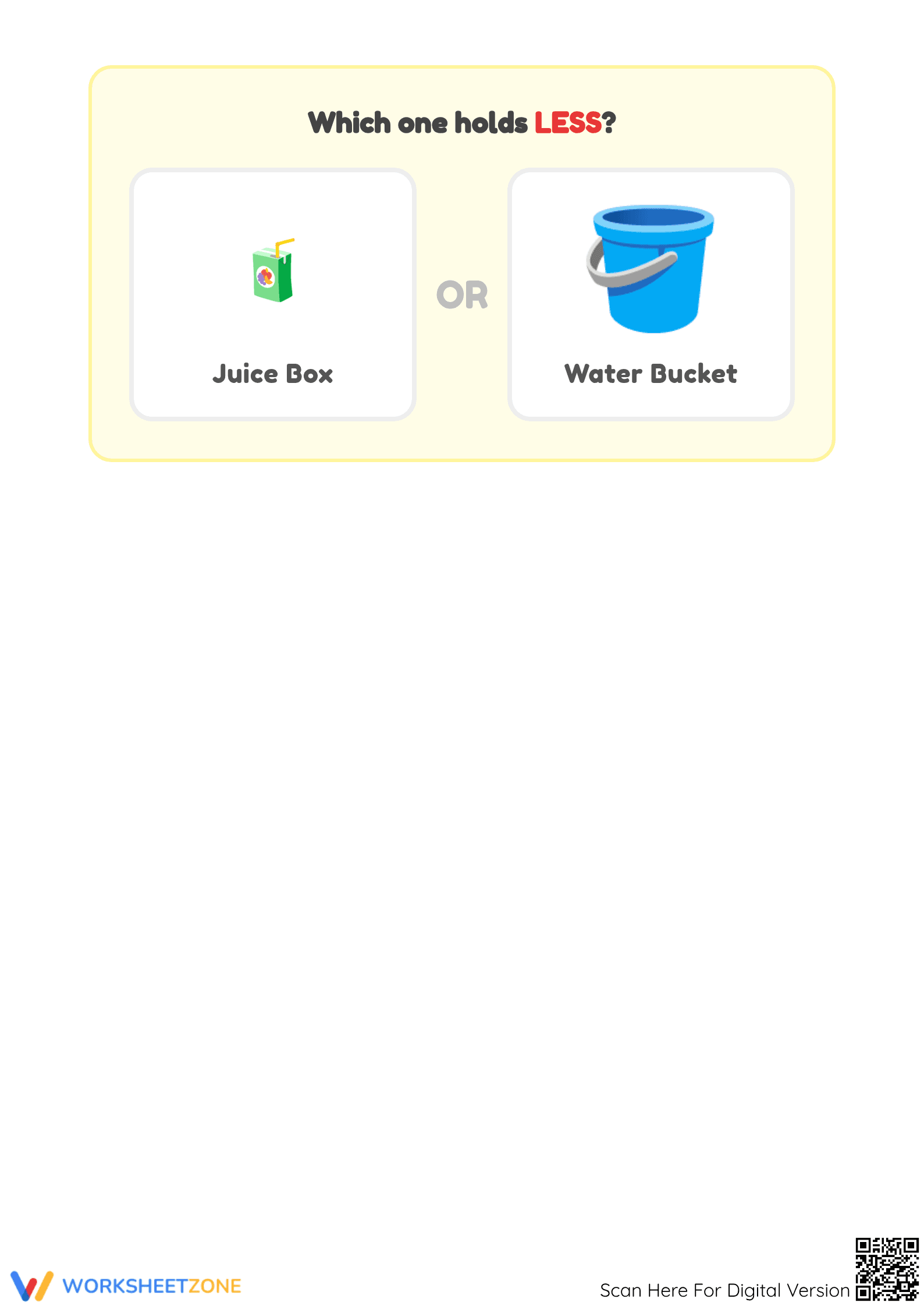
Inside this 4-page PDF, you will find three distinct sections: "Holds MORE," "Holds LESS," and "Mixed Practice." Each page features large, high-quality illustrations of common items like teapots, bins, and milk jugs. The layout includes clear headers and simple instructions, making it accessible for emerging readers. A full answer key is provided for quick grading.
The zero-prep workflow is designed for busy educators. First, print the 4-page document (30 seconds). Second, distribute the sheets to students or small groups (1 minute). Third, review the visual comparisons together or use the answer key for independent checking (30 seconds). Total teacher preparation time is under 2 minutes, making it an ideal sub plan.
This resource aligns with CCSS.MATH.CONTENT.K.MD.A.2, which requires students to directly compare two objects with a measurable attribute in common. It also supports early geometry and measurement standards by introducing the concept of volume. Both standard codes can be copied directly into lesson plans, IEP goals, or district curriculum mapping tools.
Use this worksheet during a measurement unit after a hands-on water table activity. It serves as an excellent formative assessment to see if students can transfer physical experiences to 2D representations. Teachers should observe if students can explain why a bucket holds more than a juice box. Completion typically takes 10 to 15 minutes.
This is designed for preschool, kindergarten, and first-grade students. It is particularly effective for English Language Learners (ELLs) due to the heavy reliance on visual aids rather than complex text. Pair this with a physical demonstration using real containers or a measurement anchor chart for maximum instructional impact.
According to the RAND AIRS 2024 report on early childhood numeracy, visual-spatial reasoning is a critical precursor to formal mathematical operations. This worksheet addresses that need by requiring students to evaluate the capacity of objects through direct comparison, a skill linked to later success in geometry and physics. By focusing on the standard CCSS.MATH.CONTENT.K.MD.A.2, the resource ensures that students are meeting developmentally appropriate milestones for volume and capacity. Research from Fisher & Frey (2014) emphasizes that gradual release of responsibility—moving from guided identification of "more" to independent mixed practice—is essential for mastery in early grades. This 4-page set provides exactly that structure, offering 6 targeted problems that build confidence. The inclusion of an answer key and clear visual prompts allows for immediate feedback, which is a high-leverage practice for improving student outcomes in foundational mathematics.


