


























Views
Downloads

Comparing Volume Worksheet | Grade 3 Math Printable
Paste this activity's link or code into your existing LMS (Google Classroom, Canvas, Teams, Schoology, Moodle, etc.).
Students can open and work on the activity right away, with no student login required.
You'll still be able to track student progress and results from your teacher account.
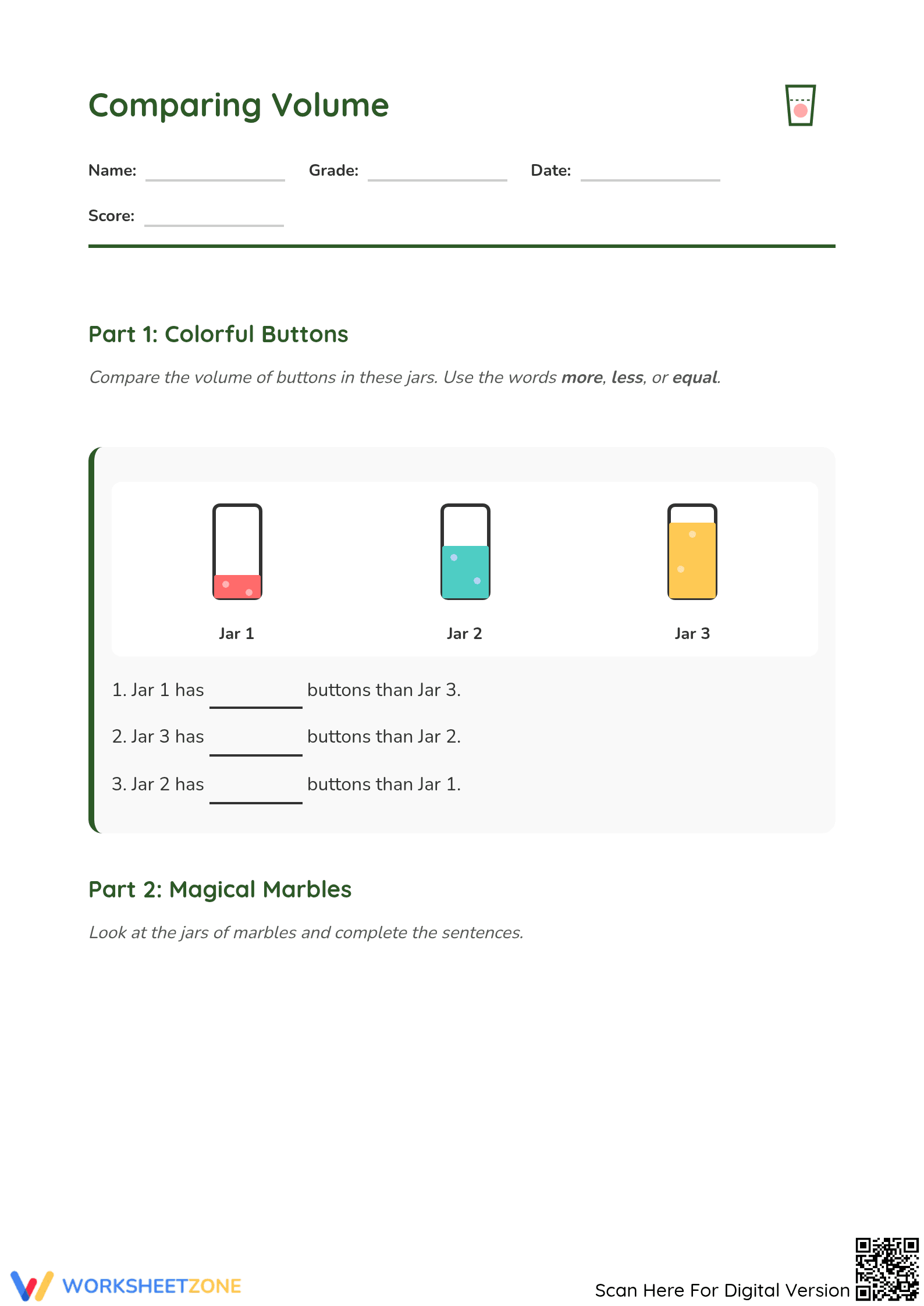
This printable comparing volume worksheet helps Grade 3 students master measurement vocabulary by visually analyzing containers. Students practice using the terms "more," "less," and "equal" to describe liquid levels and object quantities, building a strong foundation for advanced measurement concepts and real-world capacity estimation.
At a Glance
- Grade: 3 · Subject: Math
- Standard:
CCSS.MATH.CONTENT.3.MD.A.2— Estimate and compare liquid volumes and capacities- Skill Focus: Comparing Volume (More, Less, Equal)
- Format: 3 pages · 12 problems · Answer key included · PDF
- Best For: Independent practice and review
- Time: 15–20 minutes
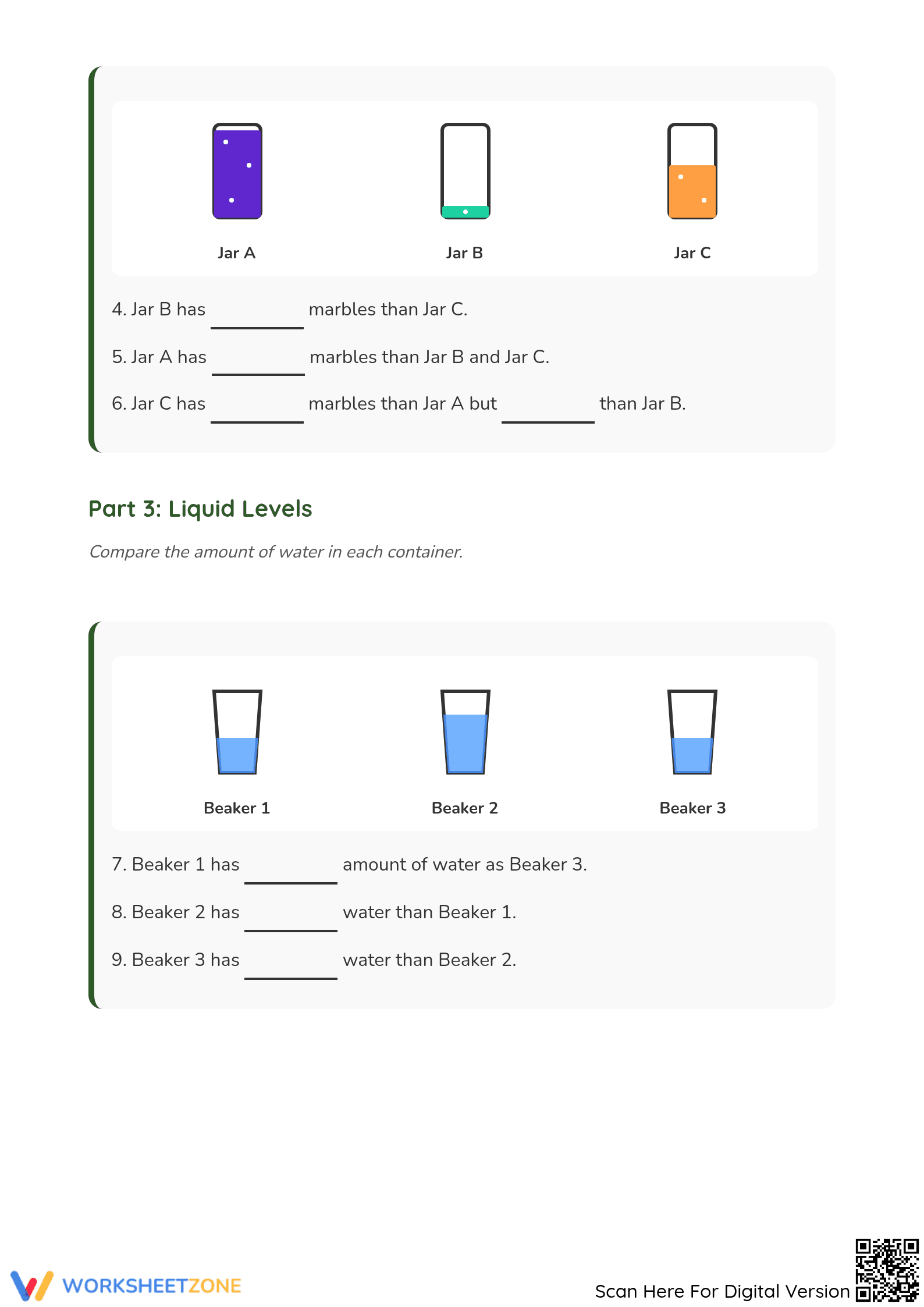
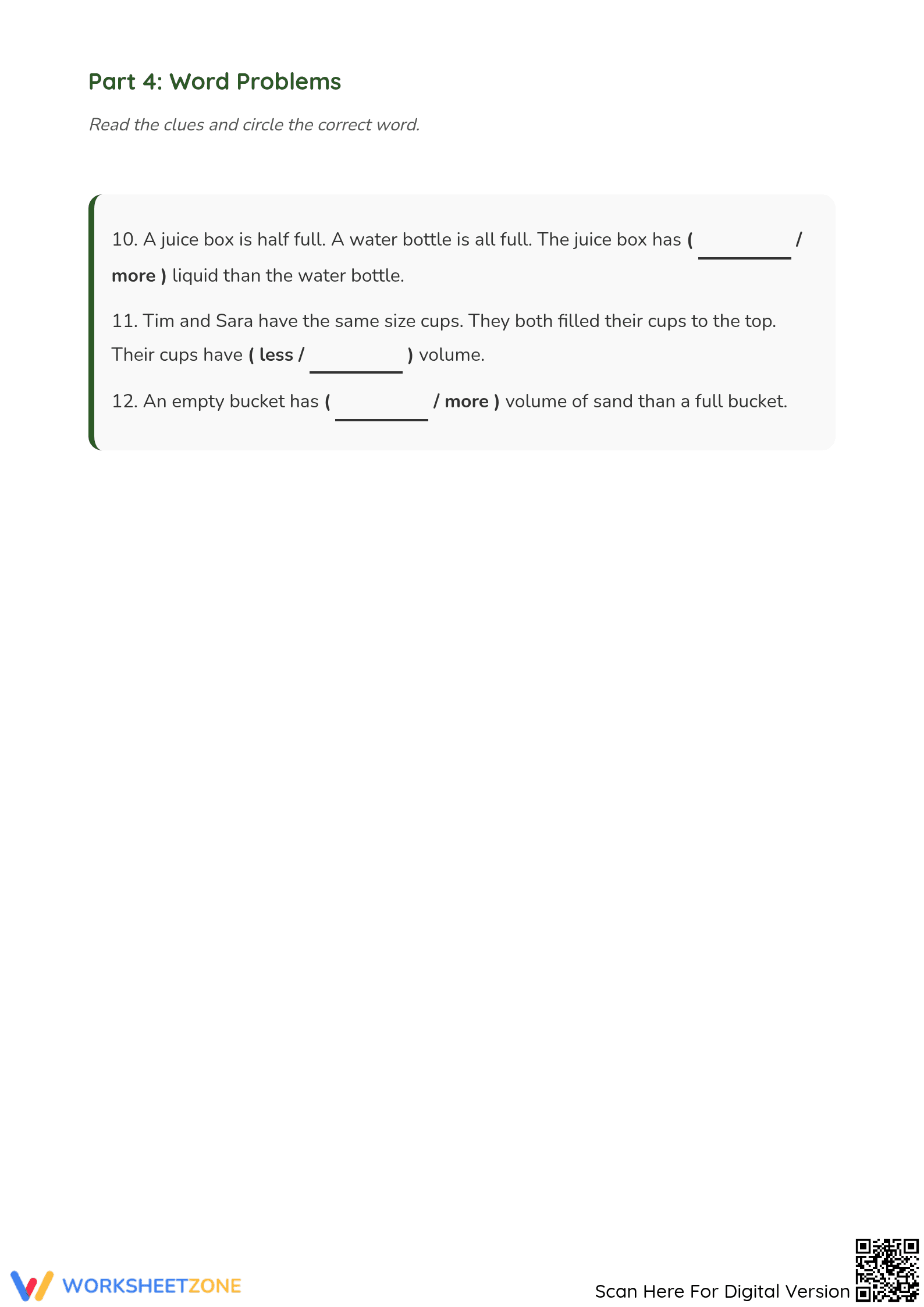
This comprehensive three-page resource features four distinct sections designed to reinforce volume comparison. Students will analyze visual representations of jars filled with buttons and marbles, compare liquid levels in beakers, and solve text-based word problems. The worksheet includes 12 total questions with clear fill-in-the-blank and multiple-choice formats, plus a complete answer key for quick grading.
- Guided practice: Parts 1 and 2 provide strong visual scaffolds, asking students to compare the contents of three distinct jars using clear visual cues.
- Supported practice: Part 3 transitions to liquid levels in identical beakers, requiring students to carefully observe and compare water volume.
- Independent practice: Part 4 removes visual aids, challenging students to apply their vocabulary to three real-world word problems.
This gradual-release structure ensures students confidently move from visual recognition to conceptual application.
Aligned to primary standard CCSS.MATH.CONTENT.3.MD.A.2: Measure and estimate liquid volumes and masses of objects using standard units. This resource specifically targets the foundational skill of estimating and comparing relative capacities before introducing exact standard units. Both standard codes can be copied directly into lesson plans, IEP goals, or district curriculum mapping tools.
Deploy this worksheet during your measurement unit after initial direct instruction on capacity. It serves perfectly as an independent math center activity or a focused homework assignment. While students work, observe whether they correctly identify "equal" volumes when container shapes remain constant—a key formative assessment checkpoint. Expected completion time is 15 to 20 minutes.
This resource is ideal for Grade 3 students developing their measurement vocabulary, as well as Grade 2 students ready for an introduction to volume concepts. The strong visual supports make it highly accessible for English Language Learners and students needing concrete representations before moving to abstract measurements. Pair it with hands-on water pouring stations for maximum impact.
Mastering measurement vocabulary is a critical step in early elementary mathematics. According to a 2024 report by EdReports, students who engage with visual models before transitioning to abstract word problems demonstrate higher retention of measurement concepts. This worksheet directly supports that pedagogical approach by aligning with CCSS.MATH.CONTENT.3.MD.A.2, requiring students to estimate and compare liquid volumes and capacities. By systematically moving learners from visual jar comparisons to text-based scenarios, the resource builds essential cognitive bridges. The explicit focus on the terms "more," "less," and "equal" ensures that foundational academic language is solidified alongside mathematical reasoning. Educators can rely on this structured practice to accurately gauge student comprehension of relative volume, providing a necessary stepping stone before introducing standard units like liters and milliliters.


