


























Views
Downloads

Essential Capacity Worksheet | Grade 1 Math
Paste this activity's link or code into your existing LMS (Google Classroom, Canvas, Teams, Schoology, Moodle, etc.).
Students can open and work on the activity right away, with no student login required.
You'll still be able to track student progress and results from your teacher account.
This Grade 1 capacity worksheet helps students visualize and identify liquid levels in containers. By distinguishing between full, half full, and empty states, learners build the foundational vocabulary necessary for more complex volume measurements. It provides immediate practice through visual identification and creative coloring tasks to ensure conceptual mastery of non-standard measurement attributes.
At a Glance
- Grade: 1 · Subject: Math
- Standard:
CCSS.MATH.CONTENT.1.MD.A.1— Describe and compare measurable attributes of objects like capacity and volume- Skill Focus: Capacity Identification
- Format: 2 pages · 13 problems · Answer key included · PDF
- Best For: Introduction to non-standard measurement units
- Time: 15–20 minutes
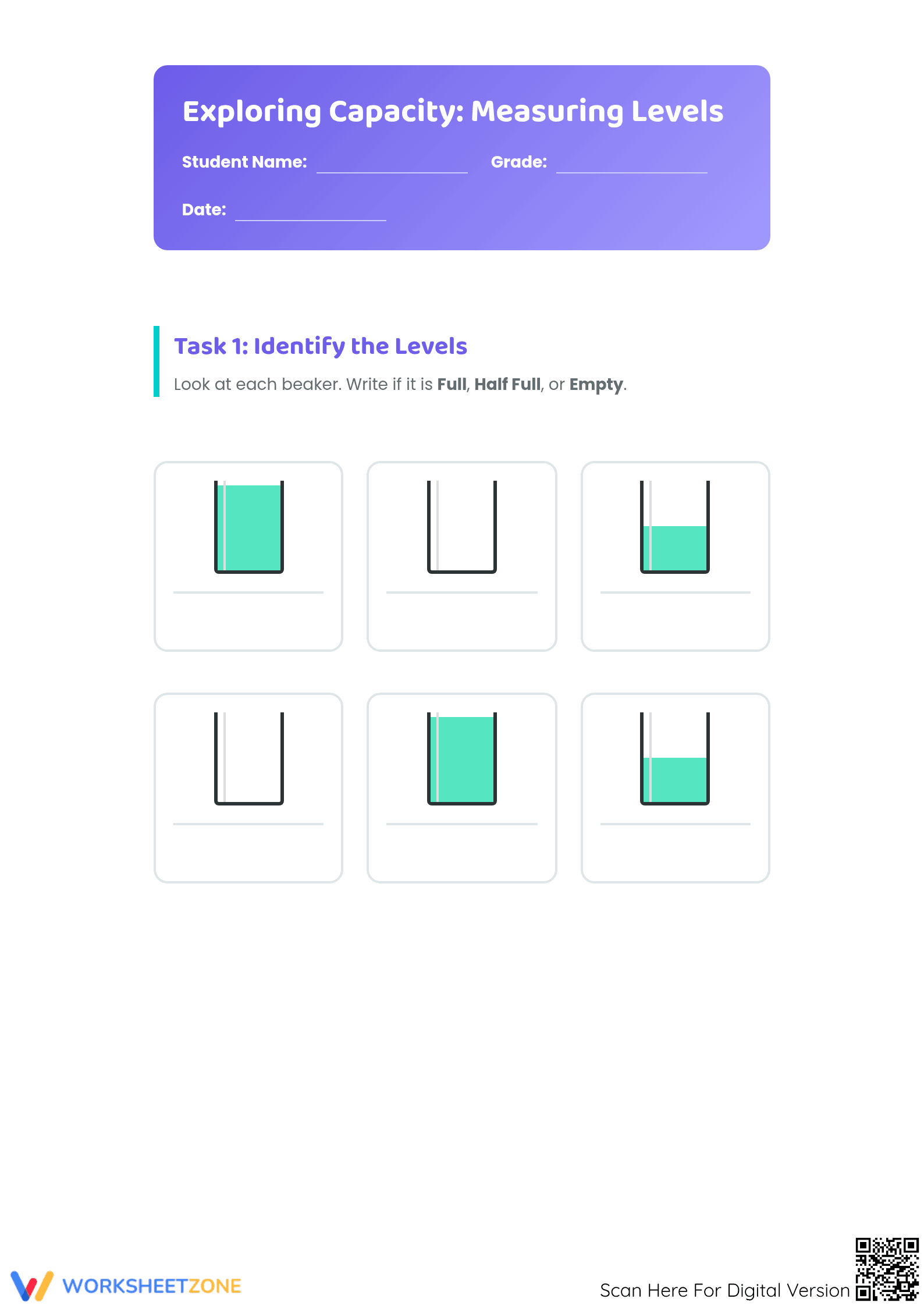
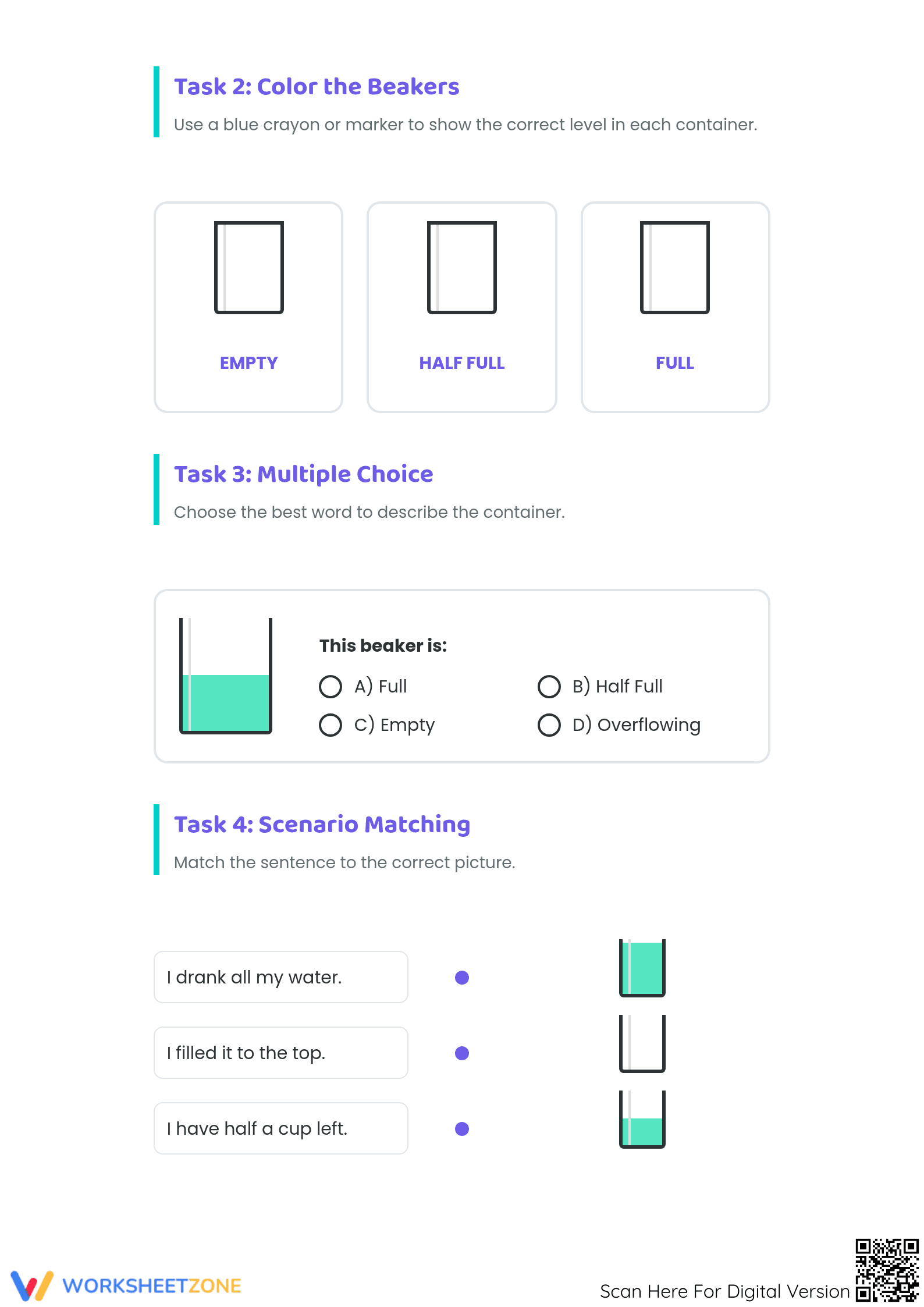
The resource contains two comprehensive pages featuring four distinct task types. Students begin by labeling six different beaker illustrations with the correct terminology. The second page introduces a coloring activity to demonstrate understanding, a multiple-choice question for assessment, and a scenario-matching exercise that connects mathematical terms to real-world contexts like drinking water or filling a cup to the top.
The zero-prep workflow is designed for maximum efficiency in busy classrooms. First, print the two-page PDF and generate enough copies for your group in under 30 seconds. Second, distribute the sheets along with blue crayons or markers for the coloring task. Finally, use the provided answer key to check student work or project it for a whole-class self-correction session. Total teacher preparation time is under two minutes, making this an ideal resource for emergency sub plans or last-minute morning work.
This worksheet aligns with CCSS.MATH.CONTENT.1.MD.A.1, focusing on the ability to describe measurable attributes of objects. While the standard often emphasizes length, the conceptual framework extends to capacity as students compare the fullness of various containers. Both standard codes can be copied directly into lesson plans, IEP goals, or district curriculum mapping tools to ensure compliance with state and federal reporting requirements.
Use this during the guided practice phase of a measurement unit. After demonstrating with real water and clear cups, assign Task 1 and 2 to check for understanding. It also serves as a quick formative assessment; observe students during the matching task to see if they can link abstract terms to situational logic. Completion typically takes 15 to 20 minutes depending on the student's reading level.
This is designed for first-grade students but is highly effective for Kindergarten enrichment or Grade 2 review. It supports English Language Learners (ELLs) through heavy visual scaffolding and clear, repetitive vocabulary. Pair this with a hands-on water table activity or a direct instruction lesson on volume for a multi-sensory learning experience that reaches all types of learners in the classroom.
According to the RAND AIRS 2024 report on early childhood numeracy, visual scaffolding in measurement tasks significantly reduces cognitive load for Grade 1 learners. This worksheet utilizes that principle by providing clear beaker illustrations that allow students to focus on the vocabulary of capacity—full, half full, and empty—without the distraction of complex numerical scales. By aligning with CCSS.MATH.CONTENT.1.MD.A.1, the resource ensures that students develop the prerequisite spatial reasoning skills needed for later success with standard units of volume. Research from Fisher & Frey (2014) emphasizes that connecting mathematical terms to real-world scenarios, such as the matching tasks included here, reinforces long-term retention. This 2-page PDF provides 13 specific opportunities for students to demonstrate mastery, making it a reliable tool for formative assessment. Educators can confidently integrate this into their curriculum knowing it meets rigorous instructional design standards for early elementary mathematics.


