




























Views
Downloads


Compare the Volumes of Liquids | Essential Grade 3-5 Math

Paste this activity's link or code into your existing LMS (Google Classroom, Canvas, Teams, Schoology, Moodle, etc.).
Students can open and work on the activity right away, with no student login required.
You'll still be able to track student progress and results from your teacher account.
This comprehensive measurement worksheet helps students master the ability to compare and order liquid volumes using metric units. By analyzing visual models of jugs and bottles, learners develop a concrete understanding of liters and milliliters. Students will calculate differences between volumes and solve real-world word problems to demonstrate functional math proficiency.
At a Glance
- Grade: 3-5 · Subject: Math
- Standard:
CCSS.MATH.CONTENT.3.MD.A.2— Measure and estimate liquid volumes using standard units like liters and milliliters- Skill Focus: Comparing and ordering liquid volumes
- Format: 3 pages · 4 tasks · Answer key included · PDF
- Best For: Independent practice or formative assessment
- Time: 20–30 minutes
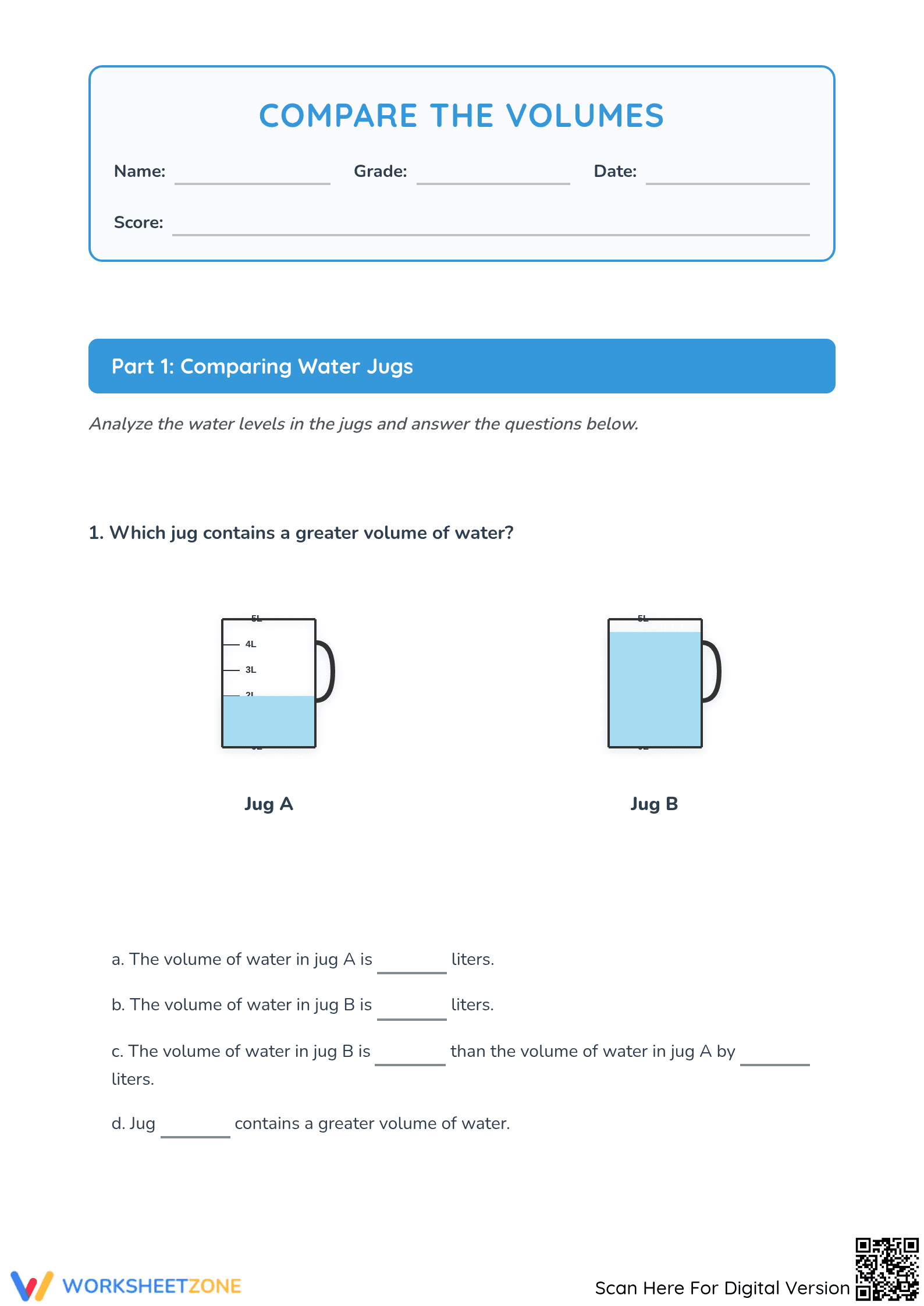
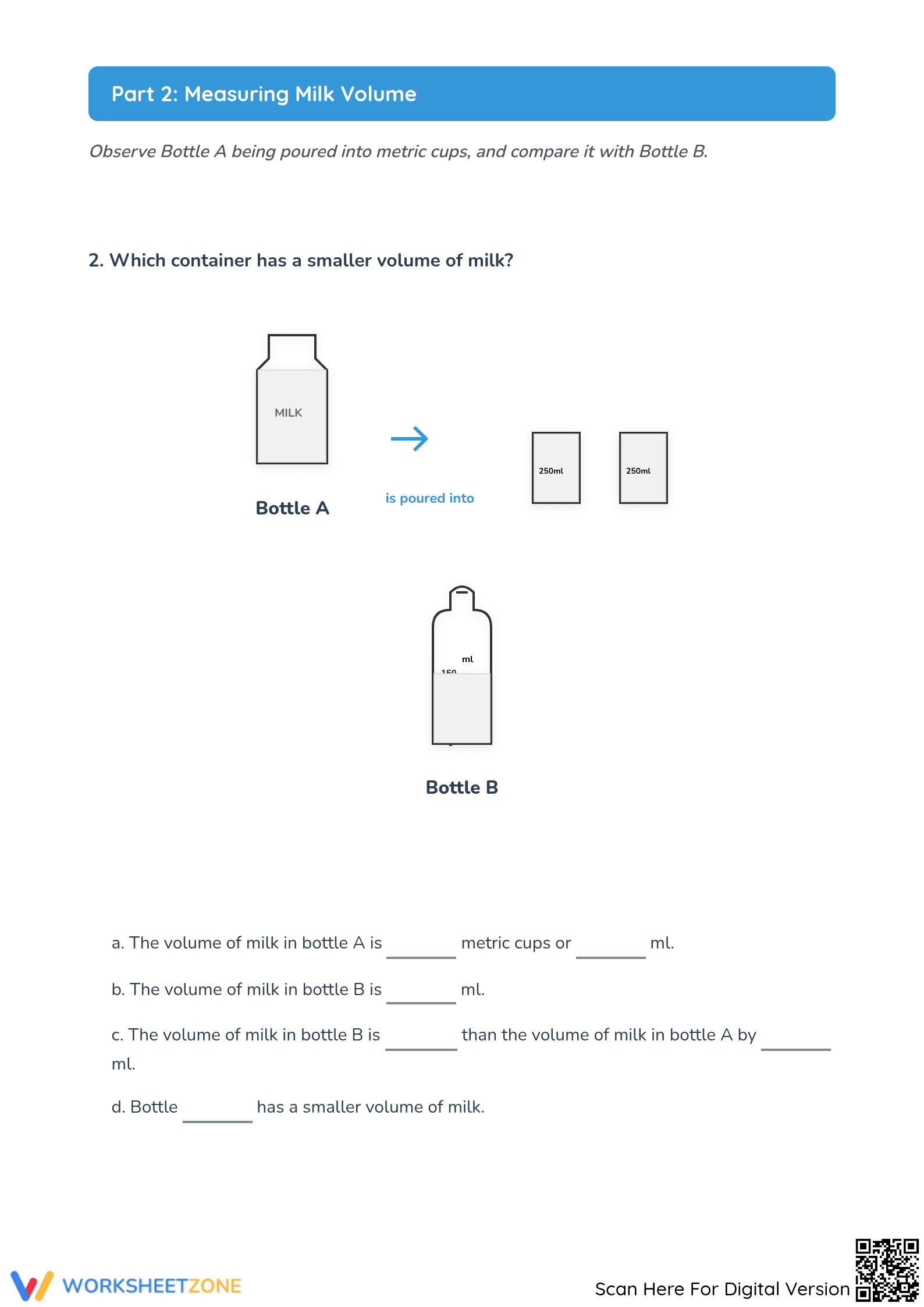
What's Inside: This 3-page PDF resource contains four distinct sections designed to build measurement fluency. It includes visual comparison tasks using water jugs, conversion-style logic puzzles involving metric cups and bottles, an ordering activity for mixed units, and two multi-step word problems. A full answer key is provided to facilitate quick grading or student self-correction.
Zero-Prep Workflow: This resource is designed for immediate classroom implementation with a total teacher prep time of under 2 minutes. First, print the three-page set for your class (30 seconds). Second, distribute the packets for independent work or center rotations (1 minute). Finally, use the included answer key to review the 4 major task sections during a whole-group wrap-up or for rapid grading (5 minutes). It is an ideal solution for emergency sub plans.
Standards Alignment: The primary focus is `CCSS.MATH.CONTENT.3.MD.A.2`, which requires students to measure and estimate liquid volumes and masses of objects using standard units of grams, kilograms, and liters. This worksheet specifically targets the volume component, extending into 4th and 5th-grade expectations for unit comparison and problem-solving. Both standard codes can be copied directly into lesson plans, IEP goals, or district curriculum mapping tools.
How to Use It: Use this worksheet during the "You Do" phase of a gradual release lesson on measurement. It works effectively as a mid-unit formative assessment to identify students who struggle with the relationship between milliliters and liters. Teachers should observe if students can correctly identify that 1,200 ml is less than 1.5 Liters during the ordering task. Expect completion within a 20 to 30-minute window depending on student familiarity with metric conversions.
Who It's For: This resource is tailored for general education students in Grades 3, 4, and 5. It provides necessary scaffolding for English Language Learners through clear visual representations of containers. It pairs naturally with a hands-on lab using graduated cylinders or a measurement anchor chart displaying common metric benchmarks.
According to research by Fisher & Frey (2014) regarding the gradual release of responsibility, providing students with structured independent practice that mirrors visual modeling is essential for long-term retention of abstract concepts like volume. This worksheet aligns with those findings by transitioning students from simple visual jug comparisons to complex word problems requiring mental computation. By engaging with `CCSS.MATH.CONTENT.3.MD.A.2` through multiple modalities—visual, numerical, and linguistic—students build a robust mathematical framework for measurement. The inclusion of both liters and milliliters ensures that learners are prepared for upper-elementary standards involving unit conversions and fractional parts of a whole. This resource serves as a reliable tool for documenting student progress toward mastery in measurement and data domains, providing clear evidence of a student's ability to interpret scale and volume in various contexts. It is a high-utility asset for any standards-aligned mathematics curriculum.


