These comparing weight worksheets give PreK through first-grade teachers a focused set of paper-based practice pages for one of the most conceptually tricky early measurement skills. Weight is the attribute that most reliably defeats visual guessing — students who confidently sort objects by color or length will pause and genuinely reconsider when asked which of two objects is heavier. That pause is exactly where these pages do their work.
What Students Learn and Practice With These Comparing Weight Worksheets
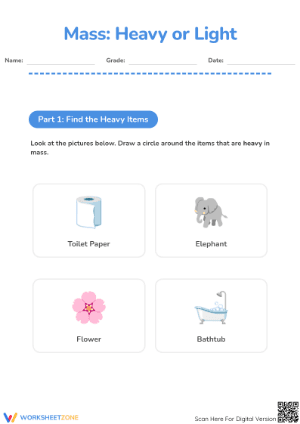
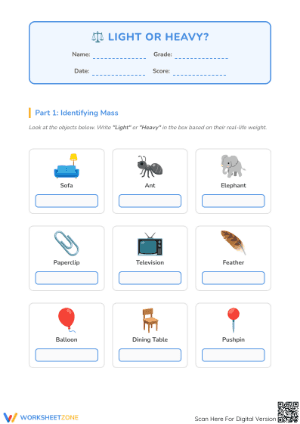
The worksheet set moves through three distinct skill layers. The first asks students to study pairs of illustrated objects and mark which one is heavier or lighter. Images were selected specifically to challenge visual assumptions: a watermelon paired with a stapler, a pillow paired with a hardcover dictionary. These pairings matter because students who rely on size alone will get several wrong and learn something from it.
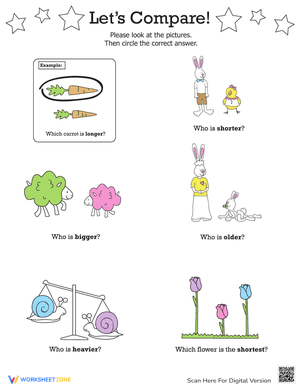
The second layer centers on reading a balance scale. Each problem shows a scale mid-tip or in balance, and students identify the relationship between the two objects shown. A common sticking point: students read the higher side as heavier because it's more prominent visually. The worksheet addresses this by labeling the first few problems with directional arrows before removing that scaffold.
The third layer introduces ordering — three or more objects ranked from lightest to heaviest. Several of these pages include a cut-and-paste format, which slows students down usefully. Physically moving the pictures before gluing them forces a second look before committing to an answer.
Standards Alignment
These worksheets address CCSS K.MD.A.1 and K.MD.A.2, which ask kindergartners to describe measurable attributes and directly compare two objects with a measurable attribute in common. In classroom terms, this standard sits between the qualitative sorting work of early fall (sorting by color, shape, size) and the more precise measurement work of first grade, where students begin using non-standard units to quantify what they're comparing. The vocabulary introduced here — heavier, lighter, equal — reappears in second grade when students begin working with grams and ounces, so the language established in kindergarten carries forward.
How Teachers Integrate These Worksheets Into Their Lesson Plans
Most teachers reach for these pages in one of three spots: the ten minutes after a hands-on balance scale exploration before students scatter back to seats, the Monday morning warm-up that revisits last week's measurement block, or a small-group rotation during math workshop when the rest of the class is working independently. The picture-based pages with no reading demand work well as true independent practice for kindergartners; the balance scale and ordering pages are better suited to guided small-group use where you can hear students' reasoning out loud.
The cut-and-paste ordering pages have a practical downside worth knowing: students who need scissors and glue sticks tend to spend four of ten available minutes on setup. If time is short, have students number the pictures in order rather than cut. Same cognitive work, less friction.
Patterns Teachers Should Notice and Focus in Student Work
The most consistent error pattern involves size-weight confusion. Students associate bigger with heavier so strongly that a large illustrated balloon will beat a small illustrated anchor in a surprising number of kindergarten papers. This isn't carelessness — it reflects a genuine working theory that size predicts weight, one that only direct contradiction dissolves.
On the balance scale pages, watch for students who circle the object on the higher side of the scale. They're not misreading carelessly; they're applying a "higher = more important" heuristic that makes intuitive sense until someone explains the mechanics. A brief demonstration with a physical scale — pressing down on one side and watching the other rise — usually resolves this immediately and permanently.
In the ordering tasks, the middle-weight object is where errors cluster. Students can usually identify the lightest and heaviest with some confidence, but placing the middle item correctly requires holding three comparisons in mind at once. If you see consistent errors on just the middle position, that's a working memory load issue, not a conceptual one.
Frequently Asked Questions
Should I wait until after hands-on scale time to hand these out?
Yes. Students who complete these pages before they've physically handled a balance scale produce work that looks correct but often isn't grounded in understanding. The paper practice reinforces the hands-on experience — it doesn't substitute for it. Even a brief station with a balance scale and four or five classroom objects before the worksheet changes the quality of what students write.
My PreK students can't read the object labels. Will these still work?
The picture-based pages were built for exactly this. Object labels are secondary; the illustrations carry the task. If a student can't identify a drawn object from the picture alone, that's worth noting — it suggests the image needs a quick verbal introduction before independent work begins. Walking through the first row together as a class handles this in under two minutes.
How do these fit with second-grade weight work on standard units?
These pages focus on qualitative comparison, not measurement in grams or pounds. They build the foundational language and conceptual framework that second-grade standard-unit work assumes students already have. A second grader who still confuses the heavier and lighter sides of a balance scale will struggle with gram-based problems — so these pages serve as both an introduction at the K–1 level and a useful diagnostic or remediation tool in second grade.
















 Interactive Worksheet Maker
 Quiz Maker
 Word Search Maker
 Crossword Puzzle Maker
 Word Scramble Generator
 Sentence Scramble Generator
 Handwriting Worksheet Generator
 Name Tracing Generator
 Fill In The Blank Generator