


























Views
Downloads


Find the Volume Worksheet | Grade 5 Essential Math
Paste this activity's link or code into your existing LMS (Google Classroom, Canvas, Teams, Schoology, Moodle, etc.).
Students can open and work on the activity right away, with no student login required.
You'll still be able to track student progress and results from your teacher account.
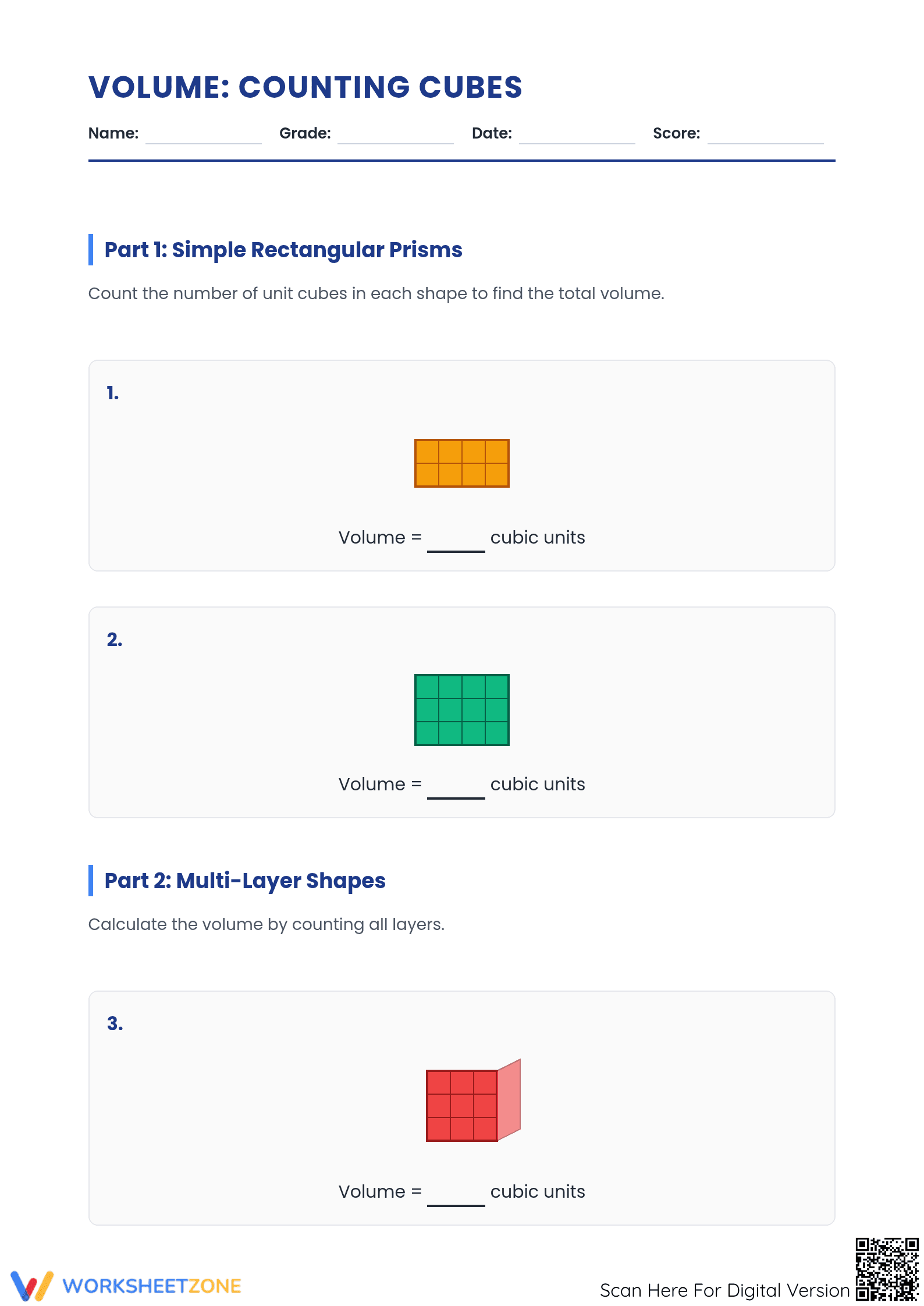
This Grade 5 math worksheet provides a comprehensive approach to understanding volume through visual and formula-based practice. Students progress from counting unit cubes to applying the standard volume formula and calculating additive volume for compound rectangular prisms. It is designed to build conceptual mastery and procedural fluency in measurement.
At a Glance
- Grade: 5 · Subject: Math
- Standard:
CCSS.MATH.CONTENT.5.MD.C.5— Relate volume to multiplication and addition to solve mathematical problems- Skill Focus: Volume of Rectangular Prisms
- Format: 3 pages · 7 problems · Answer key included · PDF
- Best For: Independent practice or formative assessment
- Time: 20–30 minutes
The resource spans 3 pages and includes 7 multi-part tasks. It features visual representations of unit cubes, word problems requiring the length times width times height formula, and a complex compound shape calculation. A full 3-page answer key is provided for immediate feedback and easy grading, ensuring students can self-correct as they work through the measurement concepts.
Skill Progression
- Guided Practice: Problems 1-2 use visual unit cube grids to establish the concept of 3D space and cubic units, allowing students to physically count the space occupied.
- Supported Practice: Problems 3-6 transition students from counting layers to using the volume formula with provided dimensions in word-problem formats.
- Independent Practice: The final task requires students to decompose a compound figure into two separate prisms and calculate the total additive volume.
This sequence follows the gradual-release model, moving from concrete visualization to abstract mathematical application.
Standards Alignment
The primary focus is `CCSS.MATH.CONTENT.5.MD.C.5`, which requires students to relate volume to the operations of multiplication and addition. This includes recognizing volume as additive by finding volumes of solid figures composed of two non-overlapping right rectangular prisms. Both standard codes can be copied directly into lesson plans, IEP goals, or district curriculum mapping tools.
How to Use It
Use this worksheet during the independent practice phase of a lesson on measurement. It works well as a mid-unit formative assessment to check if students can transition from counting cubes to using formulas. Teachers should observe if students correctly identify the shared dimensions in the compound shape task on the final page. Completion typically takes 20–30 minutes depending on student familiarity with multiplication facts.
Who It's For
This resource is ideal for fifth-grade students mastering measurement standards or fourth-grade students ready for enrichment. It pairs naturally with base-ten block manipulatives or a digital anchor chart demonstrating the volume formula. It is also suitable for small group intervention for students struggling with spatial reasoning.
According to the NAEP framework, spatial visualization and the ability to decompose complex shapes are critical milestones for middle-school geometry readiness. This worksheet aligns with the instructional shifts identified in EdReports 2024, emphasizing the connection between geometric measurement and algebraic operations. By requiring students to calculate volume using both unit cube counting and the standard formula, the resource supports the development of mathematical coherence. Research from Fisher & Frey (2014) suggests that a scaffolded approach—moving from concrete visual models to abstract formulas—significantly improves long-term retention of geometric concepts. This Grade 5 resource ensures students meet CCSS.MATH.CONTENT.5.MD.C.5 requirements through 7 targeted tasks that bridge the gap between simple prisms and additive compound figures.


