


























Views
Downloads
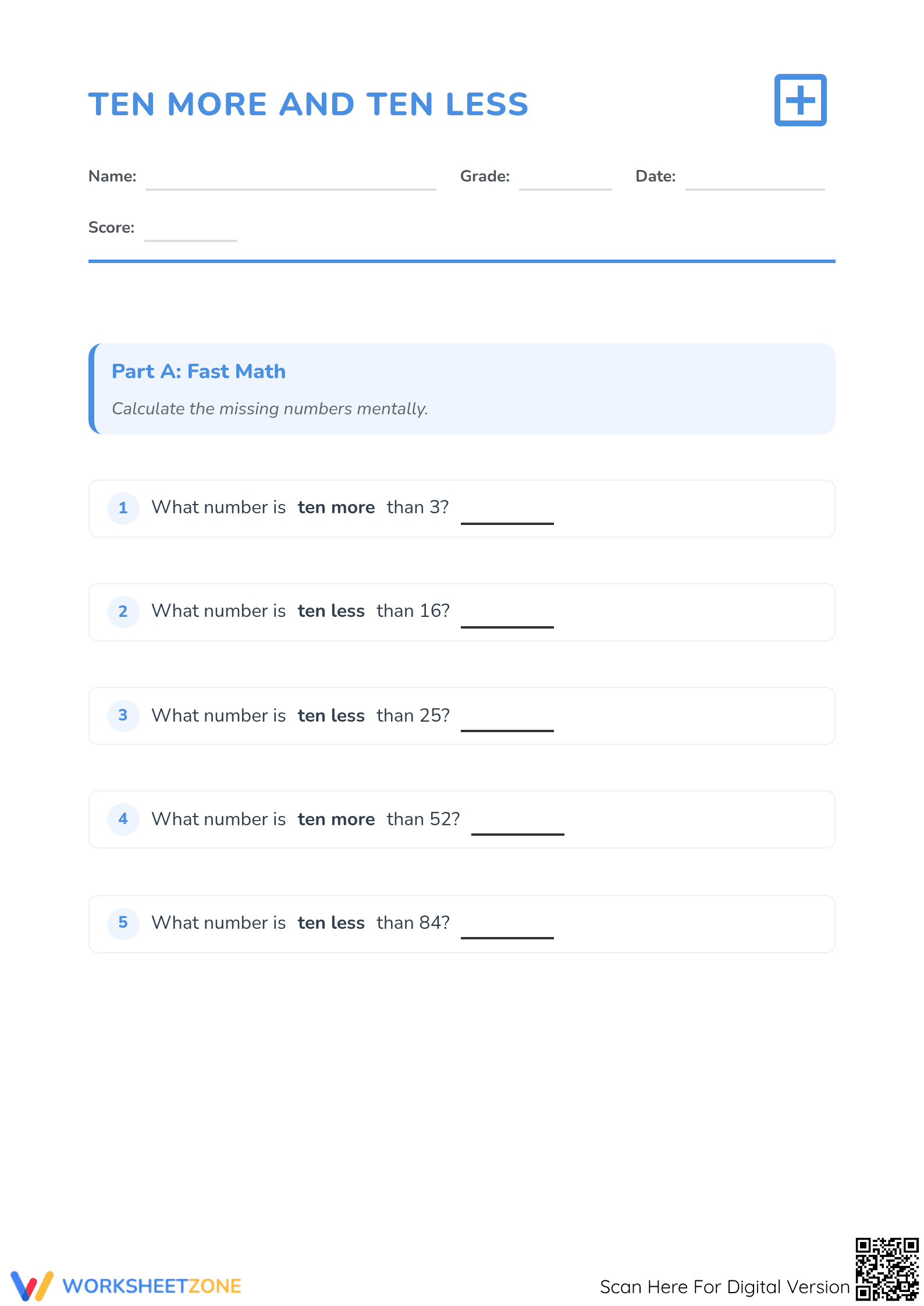


10 More 10 Less Review | Grade 2 Essential Math
Paste this activity's link or code into your existing LMS (Google Classroom, Canvas, Teams, Schoology, Moodle, etc.).
Students can open and work on the activity right away, with no student login required.
You'll still be able to track student progress and results from your teacher account.
This Grade 2 math worksheet provides comprehensive practice for adding and subtracting ten mentally. Students develop number sense by identifying patterns in the tens place across 15 diverse problems. By mastering this skill, learners build the foundational fluency required for multi-digit addition and subtraction in higher grade levels.
At a Glance
- Grade: 2 · Subject: Math
- Standard:
CCSS.MATH.CONTENT.2.NBT.B.8— Mentally add 10 or subtract 10 from a given number 10-900- Skill Focus: Mental Math Fluency (10 More/Less)
- Format: 3 pages · 15 problems · Answer key included · PDF
- Best For: Morning work or quick formative assessment
- Time: 15–20 minutes
What's Inside: This 3-page PDF contains four distinct sections designed to keep students engaged. Part A features "Fast Math" mental calculations, Part B offers a "Matching Challenge" to connect phrases with numerical results, and Part C uses "Comparative Logic" to reinforce the relationship between numbers. A final Bonus Challenge pushes students to apply their knowledge to boundary cases like 95 and 10. A full answer key is provided for rapid grading.
Zero-Prep Workflow: This resource is designed for immediate classroom implementation. Teachers can print the three-page set in under 1 minute. Distribution takes seconds, as the instructions for each section are self-explanatory for second-grade readers. Reviewing the work is simplified by the included answer key, allowing for a total teacher time investment of less than 5 minutes from printer to gradebook. It serves as an ideal emergency sub plan or bell ringer activity.
Standards Alignment: The primary focus is CCSS.MATH.CONTENT.2.NBT.B.8: "Mentally add 10 or subtract 10 from a given number 100–900, and mentally add 10 or subtract 10 from a given number 10–100." The worksheet specifically targets the lower end of this range to ensure mastery of the base-ten pattern. Both standard codes can be copied directly into lesson plans, IEP goals, or district curriculum mapping tools.
How to Use It: Use this worksheet as a mid-unit check during your Place Value module. It works effectively as a Ticket Out the Door to gauge which students still struggle with the concept of the tens place changing while the ones place remains constant. Expected completion time is 15 to 20 minutes. For a formative assessment tip, observe students during Part A to see if they are counting on fingers or identifying the digit shift immediately.
Who It's For: This resource is tailored for general education second-grade students. It also provides excellent scaffolding for third graders who need a refresher on mental math strategies or first-grade students ready for enrichment. Pair this worksheet with a hundreds chart or base-ten blocks for students who require visual support before moving to purely mental calculations.
According to the RAND AIRS 2024 report on elementary mathematics, consistent practice with mental math patterns is a significant predictor of later success in algebraic reasoning. This worksheet targets the specific skill of adding and subtracting ten, which reinforces the structure of the base-ten system. By engaging with 15 varied tasks, students move beyond rote memorization toward conceptual understanding of place value. Research from Fisher & Frey (2014) emphasizes that checking for understanding through structured independent practice allows teachers to identify misconceptions before they become ingrained. This resource provides that necessary bridge between direct instruction and mastery. The inclusion of comparative logic tasks ensures that students are not just performing operations but are also analyzing the quantitative relationships between numbers, a key component of the CCSS.MATH.CONTENT.2.NBT.B.8 standard.


