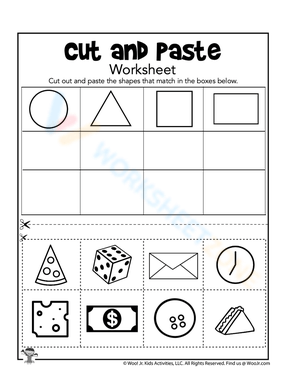
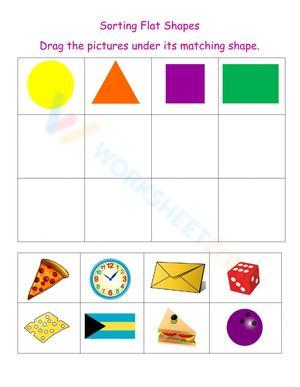
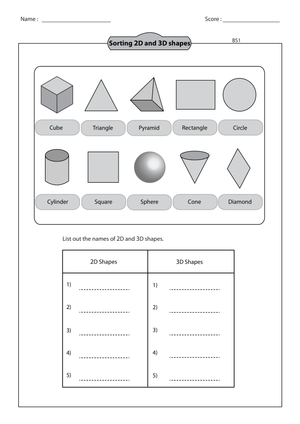
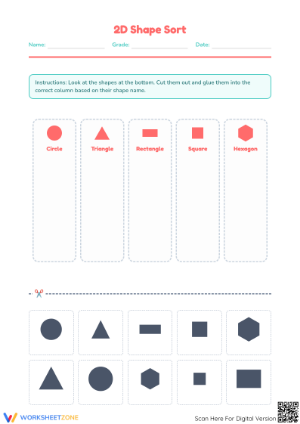
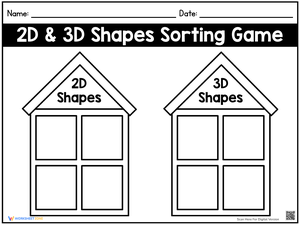
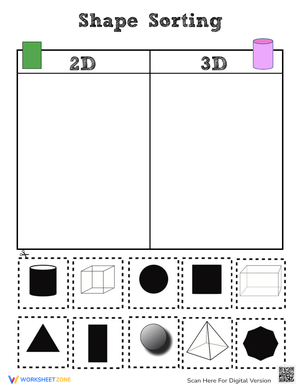
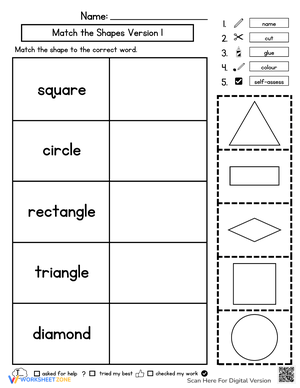
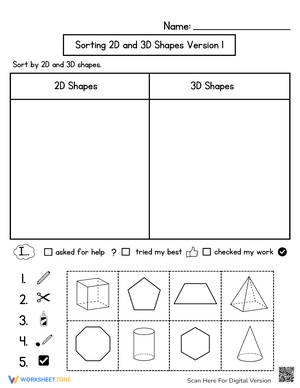
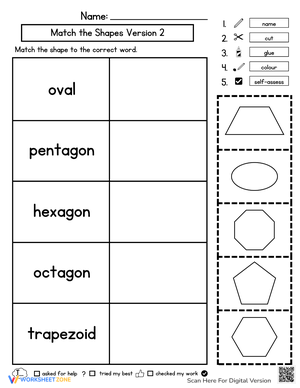
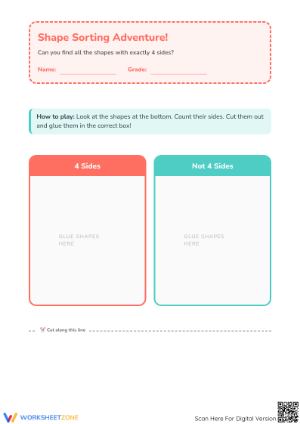
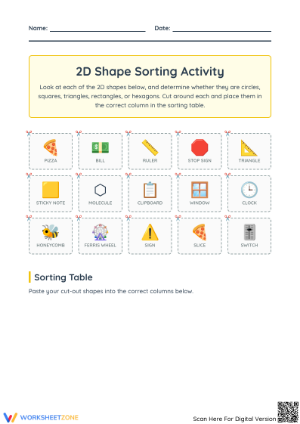
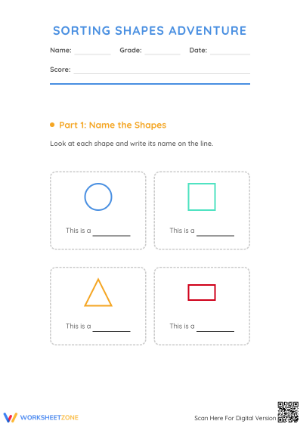
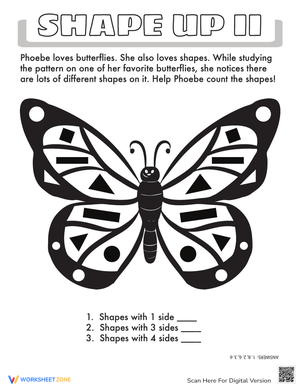
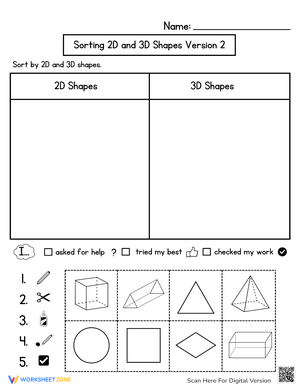
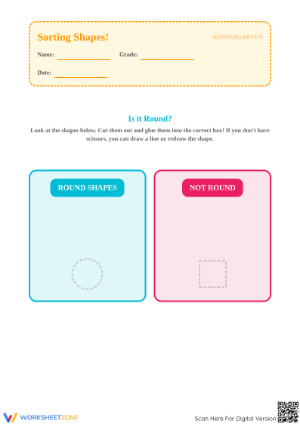
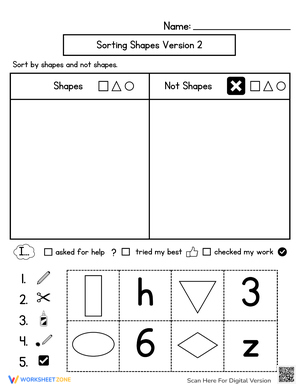
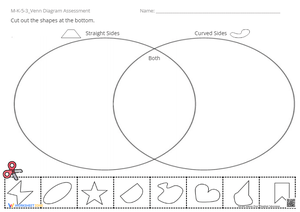
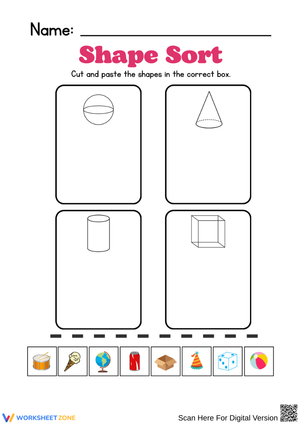
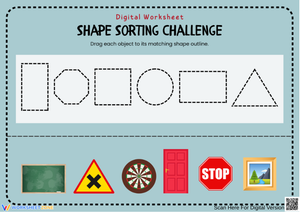
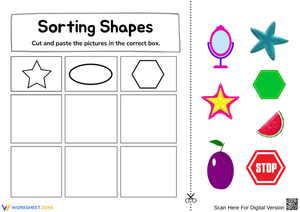
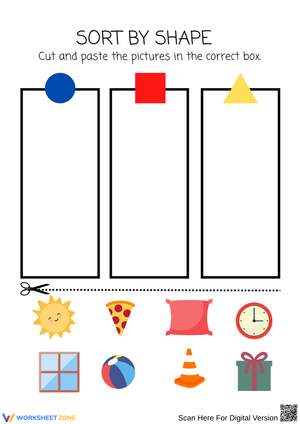
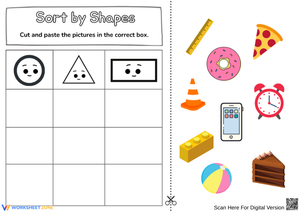
These kindergarten sorting shapes printable worksheets give teachers focused, visual geometry practice at exactly the right developmental moment — when students are learning to see what makes shapes alike or different, not just what looks familiar. Each worksheet targets one clear sorting task, whether students are grouping shapes by name, size, number of sides, or orientation, keeping the cognitive load manageable for five-year-olds who are still building visual discrimination skills. The set works cleanly across math centers, whole-group lessons, independent practice, and end-of-unit checks.
The Specific Skills These Worksheets Target
Early geometry in kindergarten is less about memorizing shape names and more about noticing attributes — the defining features that explain why a shape belongs in one group rather than another. The worksheets build that noticing through repeated visual comparison. Students circle, color, cut, and sort shapes rather than passively looking at them, which matters at this age because physical engagement with an image strengthens recognition in ways that passive observation alone does not.
Skills addressed across the set include:
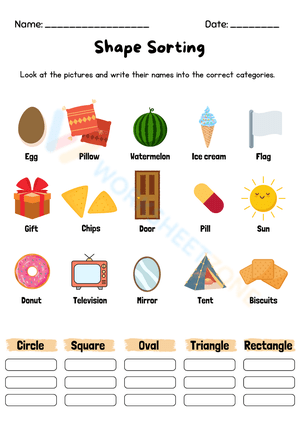
- Identifying common 2D shapes: circles, triangles, squares, rectangles, and hexagons
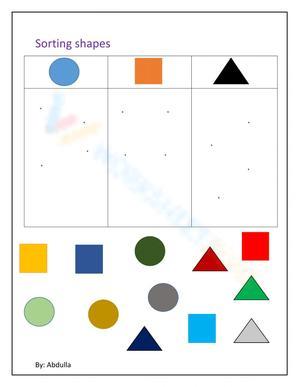
- Sorting shapes by type, placing all triangles together and all circles together
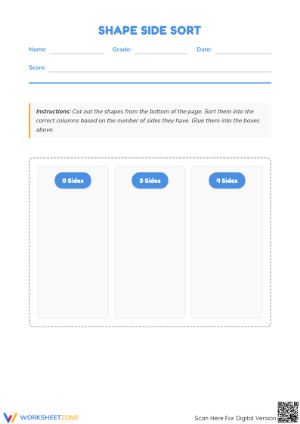
- Sorting by number of sides or corners rather than by visual appearance alone
- Sorting by size within a single shape family
- Recognizing the same shape across different orientations — a triangle pointing left, right, or downward is still a triangle
- Using precise vocabulary: side, corner, vertex, same, different
Orientation is where instruction most often breaks down. Adults take for granted that a rotated square is still a square, but kindergarten students frequently treat a tilted square as a distinct object, often calling it a diamond. Kindergarten sorting shapes printable worksheets that include rotated examples throughout every set — not just a token rotation or two — are the ones that genuinely shift this misconception over time.
Where Students Go Wrong in Shape Sorting Work
Three errors appear consistently in what students produce during shape sorting tasks. The first: sorting by visual gestalt rather than by attribute. A short, wide rectangle and a long, narrow rectangle look different enough that students who have not yet learned to count sides will put them in separate piles — not out of confusion, but because they are using the wrong feature to make their decision. The second: switching the sorting rule mid-task. Students start grouping by shape name, then somewhere around the fourth or fifth item quietly shift to sorting by size instead. The result looks organized but follows no single logic, and it takes a teacher asking "how did you decide?" to surface what happened. The third: calling all four-sided shapes squares. This is one of the most consistent patterns in early geometry work and reflects normal concept overgeneralization rather than a sign of a struggling learner. The correction is not to simply relabel but to place several rectangles and squares side by side and ask what is the same and what changes.
When a student traces a triangle's three sides with a finger while placing it in a sort, that action signals genuine attribute understanding. When a student places the same shape by pointing position alone — "it looks like it goes there" — the understanding is shallower and worth a quick follow-up question before moving on.
Building These Worksheets Into Your Weekly Lesson Plan
Shape sorting works best in sequence: real objects first, then picture cards alongside a partner, then independent practice with a printable. Skipping straight to the worksheet before students have sorted actual pattern blocks or classroom objects tends to produce more guessing and lower accuracy. Teachers who maintain that sequence report that the printed practice takes hold faster because students bring a physical sorting experience to the task rather than encountering the concept for the first time through a flat image on paper.
Within that structure, here are the moments during the week where these worksheets fit most naturally:
- Math center rotation: Pair each worksheet with a small bin of foam shapes so students can verify their sort with real objects before marking their answers.
- Morning warm-up: A short worksheet with a single sorting rule makes a calm, focused start before whole-group instruction begins.
- Small-group pull: Choose worksheets focused on one shape family for students who still confuse rectangles with squares or triangles with diamonds.
- Exit check: The last five minutes before dismissal is a natural slot for a quick sort that shows who internalized the day's attribute focus and who still needs review.
- Homework after instruction: Once the sort has been practiced in class, these worksheets hold up at home — the visual directions work without a teacher present to redirect.
One detail worth building in consistently: keep a visible sorting-rule card at the top of the work area throughout the entire task. In classrooms that use kindergarten sorting shapes printable worksheets regularly, a small picture cue reading "sort by shape type" or "sort by number of sides" reduces mid-task rule-switching considerably — students can point back to the rule instead of guessing, and independent accuracy improves without any change to the task itself.
Standard Alignment
These worksheets align to CCSS.MATH.CONTENT.K.G.A.2, which asks kindergarten students to correctly name shapes regardless of orientation or overall size, and to CCSS.MATH.CONTENT.K.G.B.4, which focuses on analyzing and comparing 2D shapes using attributes such as number of sides and corners. In classroom terms, K.G.A.2 is where name-based sorting lives, and K.G.B.4 is where students move past recognition into the more demanding work of sorting by a specific attribute — number of sides, size, or whether edges are straight or curved. Most kindergarten geometry units introduce K.G.A.2 first, and this set supports both that entry-level name sorting and the attribute sorts that follow later in the same unit.
Using the Set Across Different Skill Levels
The clearest adjustment for different learners is the complexity of the sorting rule, not the number of worksheets assigned. Students still building reliable shape recognition work best with tasks that ask them to sort two shape types — triangles and circles, for example — using large, unambiguous images. Students who have those two types solid move to three or four shape types in a single sort. Students ready for more challenge work with tasks that layer criteria: sort by shape type first, then identify which items within each group also share a size attribute.
Response format is another practical adjustment. Some students work more accurately when they circle shapes belonging to a category rather than cutting and gluing — the physical demand of scissors is a separate challenge that can interfere with the geometry task if it is not accounted for. Other students need the hands-on action of cutting and moving pieces to stay engaged. Choosing the response format by student rather than by worksheet keeps every learner working on the geometry goal rather than wrestling with the mechanics of the task.
For students who are English language learners or who need additional vocabulary support, kindergarten sorting shapes printable worksheets that label sorting categories with a picture icon alongside the printed word — a circle icon next to the word "circle" on the sorting mat — reduce the language barrier without changing the math demand at all. Students can complete the sort without needing to decode text labels first.
Frequently Asked Questions
Which shapes should kindergarten students be expected to sort?
The CCSS geometry standards for kindergarten center on circles, squares, rectangles, triangles, and hexagons. Most teachers begin with two or three shape types and add more as students demonstrate accuracy. Rhombuses and other quadrilaterals can appear in more advanced sorts, but the five core types are where most kindergarten shape sorting instruction is grounded.
My students keep calling tilted squares "diamonds." What actually helps?
Repeated side-by-side comparison is what moves this. Each worksheet that groups rotated squares alongside axis-aligned squares — and asks students to confirm they belong in the same category — gives students the visual evidence they need. This misconception does not clear up after one lesson. Students need to encounter rotated shapes across multiple worksheets and discuss explicitly why orientation does not change the shape's identity.
Should students use these worksheets before or after hands-on sorting?
After. Students who have sorted real objects or manipulatives first bring stronger mental models to the printed task, and accuracy is noticeably higher. Using a printable as first exposure tends to produce guessing rather than reasoning. The worksheet works best as consolidation, not as introduction.
How can I use these for formative assessment rather than just practice?
Watch where students hesitate or quietly self-correct, not just where they land on a final answer. During small-group work, ask one student to explain a placement aloud while others are still working. A student who says "because it has three sides" and a student who says "because it looks right" may both have the correct answer, but only the first is ready to move into attribute-based sorts.













 Interactive Worksheet Maker
 Quiz Maker
 Word Search Maker
 Crossword Puzzle Maker
 Word Scramble Generator
 Sentence Scramble Generator
 Handwriting Worksheet Generator
 Name Tracing Generator
 Fill In The Blank Generator