


























Views
Downloads


Printable Sorting Shapes Worksheet | Kindergarten Math
Paste this activity's link or code into your existing LMS (Google Classroom, Canvas, Teams, Schoology, Moodle, etc.).
Students can open and work on the activity right away, with no student login required.
You'll still be able to track student progress and results from your teacher account.
This printable sorting shapes worksheet provides early learners with a comprehensive adventure in geometry. Students engage in naming, counting, and categorizing foundational 2D shapes, including circles, squares, triangles, and rectangles. By transitioning from identification to active classification, children build the spatial reasoning and mathematical vocabulary necessary for kindergarten mastery and future geometric concepts.
At a Glance
- Grade: Kindergarten · Subject: Math
- Standard:
CCSS.MATH.CONTENT.K.G.A.2— Correctly name shapes regardless of their orientations or overall size- Skill Focus: 2D Shape Identification and Classification
- Format: 2 pages · 12 problems · Answer key included · PDF
- Best For: Early geometry practice and shape mastery
- Time: 15–20 minutes
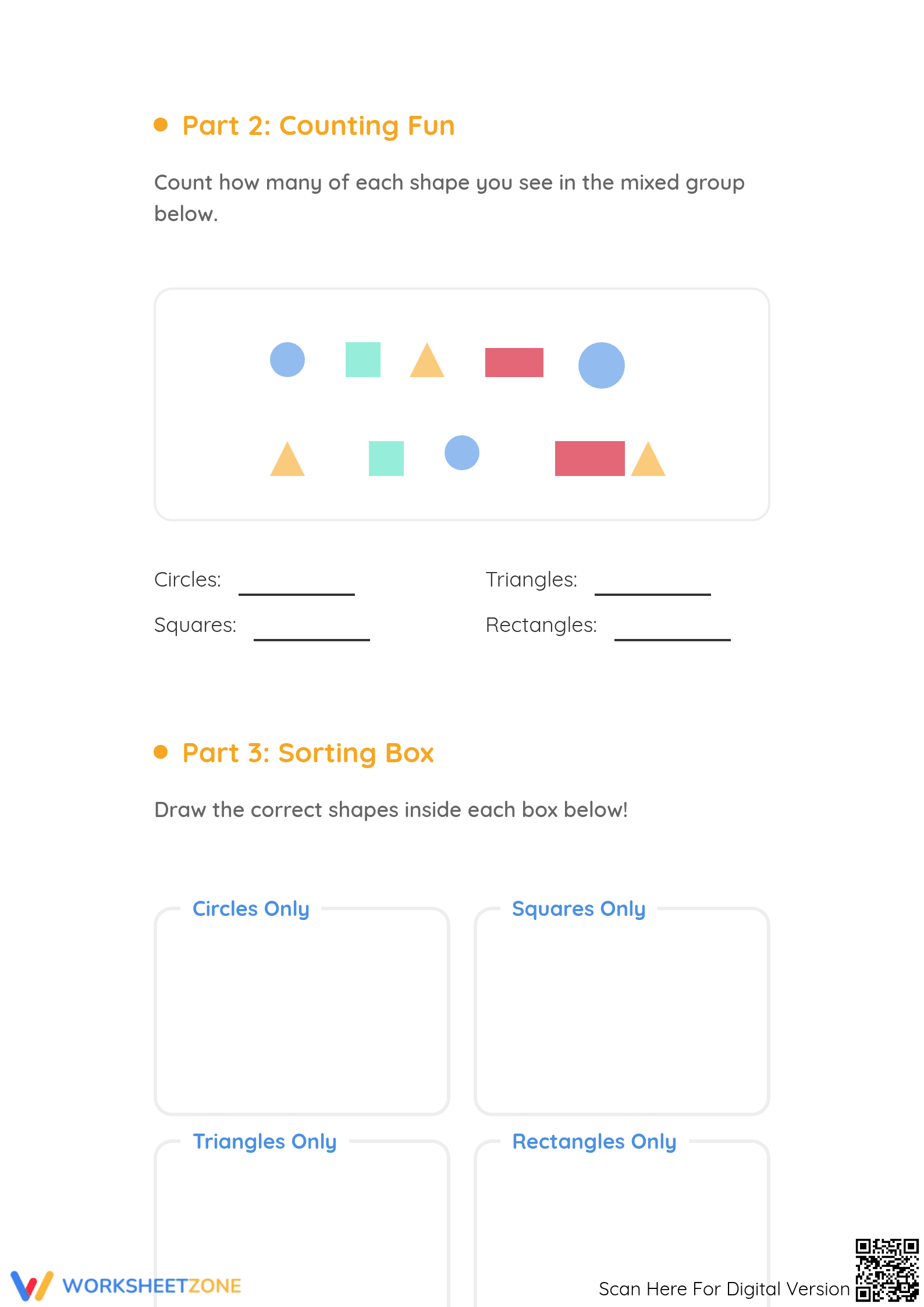
The "Sorting Shapes Adventure" package consists of two high-quality PDF pages designed for clear visual engagement. Page one features four identification tasks where students write shape names beneath clear geometric icons. Page two introduces a mixed group of shapes for a counting challenge, followed by four dedicated sorting boxes. The layout includes a complete answer key, ensuring teachers and parents can provide immediate feedback without additional preparation.
Skill Progression
- Guided Identification: Part 1 provides isolated 2D shapes with sentence stems ("This is a...") to build initial naming confidence through four focused prompts.
- Supported Analysis: Part 2 moves to a mixed-group visual field, requiring students to count eight distinct objects and record totals for each shape category.
- Independent Synthesis: Part 3 challenges students to draw shapes within specific "Sorting Boxes," moving from recognition to active production and categorization.
This systematic approach scaffolds the learning process, moving from basic recognition to higher-order classification skills through a gradual-release model.
Standards Alignment
This resource is explicitly aligned with CCSS.MATH.CONTENT.K.G.A.2, which requires students to "correctly name shapes regardless of their orientations or overall size." Additionally, the counting and categorizing activities support CCSS.MATH.CONTENT.K.MD.B.3, focusing on classifying objects into given categories and counting the numbers of objects in each category. Both standard codes can be copied directly into lesson plans, IEP goals, or district curriculum mapping tools.
How to Use It
Incorporate this worksheet during the independent practice phase of a geometry lesson. After introducing the properties of circles, squares, triangles, and rectangles, distribute the packet to assess individual student progress. For a formative assessment observation, watch as students tackle Part 3; those who can accurately draw the shapes in the correct boxes demonstrate a strong internal schema of geometric attributes. Expect completion within 20 minutes for most kindergarteners.
Who It's For
Designed primarily for Kindergarten students, this resource is also ideal for preschool enrichment or first-grade intervention. The clean layout supports students with fine motor challenges by providing ample writing space. Pair this worksheet with a physical shape hunt around the classroom or a set of pattern blocks to provide a multisensory learning experience that bridges concrete and representational understanding.
The "Sorting Shapes Adventure" worksheet implements evidence-based practices for early geometric development by integrating identification, counting, and classification tasks into a single instructional sequence. According to Fisher & Frey (2014), the gradual release of responsibility model is essential for cognitive development in early mathematics, moving students from teacher-led naming to independent production. This worksheet aligns with CCSS.MATH.CONTENT.K.G.A.2 by requiring students to name 2D shapes in isolation before applying that knowledge to a mixed visual field. Research from the NAEP highlights that early mastery of geometric attributes is a significant predictor of later success in spatial reasoning and algebraic thinking. By providing twelve structured tasks across two pages, this resource ensures that students encounter enough repetitions to solidify their understanding of circles, squares, triangles, and rectangles. The inclusion of an answer key further supports the feedback loops necessary for early childhood math instruction.


