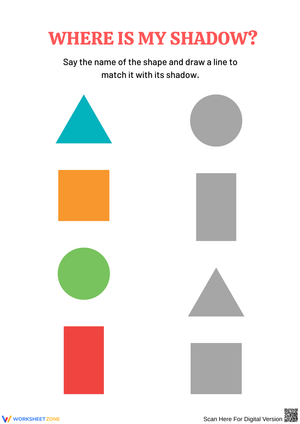
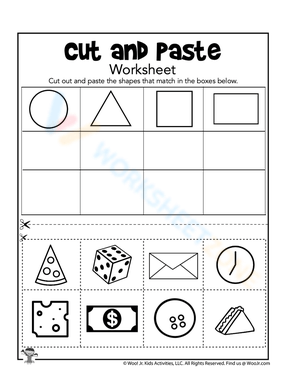
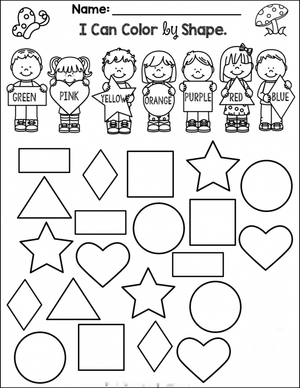
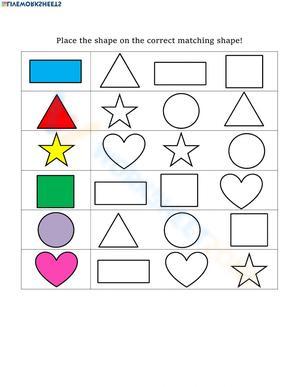
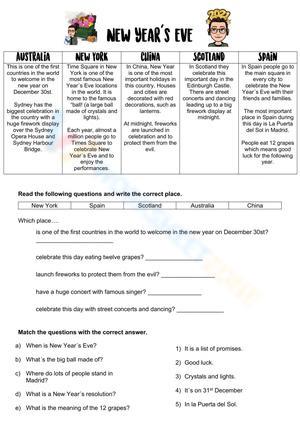
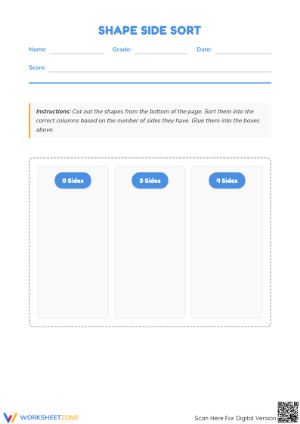
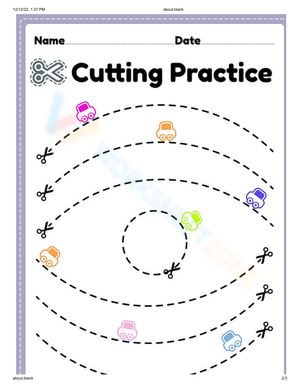
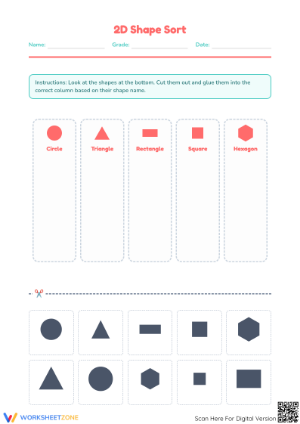
These geometry others worksheets for kindergarten fill the gap between basic shape identification and the full kindergarten geometry standard — the positional language practice, flat-vs.-solid sorting, and shape composition work that many instructional programs treat as optional enrichment rather than core content. Each worksheet targets one narrow concept, which makes it practical to slot into a lesson without restructuring an existing plan.
Concepts Covered Across the Set
Positional language is the first major area. Kindergarteners learn words like above, below, beside, next to, in front of, and behind, and each worksheet here asks them to apply those terms actively — circling the object above the table, drawing a star next to the house, or marking the animal behind the fence. These aren't vocabulary drills; they are spatial reasoning tasks that require students to interpret a visual scene and connect it to a specific word.
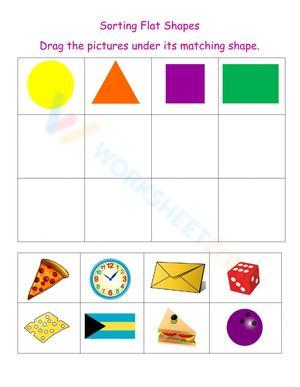
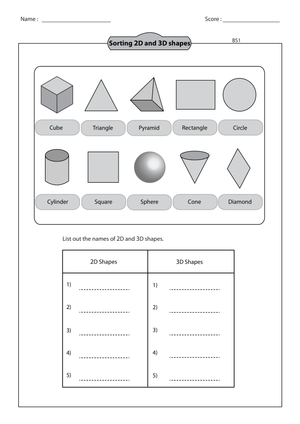
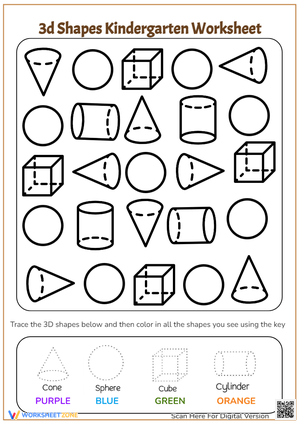
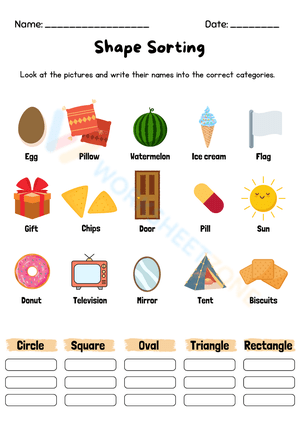
Flat-vs.-solid sorting is the second area. Students look at images of spheres and circles, cubes and squares, cylinders and rectangles, then mark or sort each into the correct category. The conceptual work is understanding that flat shapes have length and width while solid shapes also have depth — a distinction that sounds simple but takes more reinforcement than most teachers expect at age five.
Shape composition rounds out the set. Students see an outline — a hexagon, a trapezoid, a rectangle — and determine which smaller shapes can be combined to fill it. A worksheet might show a hexagon outline and ask students to trace or mark how many triangles fit inside, or show a square divided by a diagonal and ask what two shapes result. This is foundational spatial reasoning that connects, years later, to fraction concepts and area measurement.
Analyzing shape attributes completes the four-area coverage: counting sides and vertices, identifying shapes regardless of size or rotation, and comparing two shapes by what they share and what differs. A well-sequenced set of geometry others worksheets for kindergarten covers all four of these areas without overlap, giving teachers a distinct resource for each point in the unit.
What Student Work Reveals About Geometry Gaps at This Level
The orientation error is the most persistent one. A square rotated 45° looks like a "diamond" to most kindergarteners, and many students mark it as a different shape even after you have explicitly taught that orientation does not change identity. Worksheets that show the same shape in three or four orientations on the same task are useful here because they force repeated confrontation with the concept — but expect to revisit this in small groups before it fully resolves.
Flat-vs.-solid sorting trips students up in a specific and predictable way: they look at the most prominent visible face of a three-dimensional object rather than the whole figure. A student shown a cylinder will often write "circle" because the circular end is the feature they latch onto. This reflects a genuine cognitive tendency, not carelessness. Handling a real cylinder during direct instruction — pointing explicitly to the curved surface, the two circular ends, and asking students whether the object is flat or has depth — makes a measurable difference before students complete the sorting worksheet independently.
"In front of" is consistently the hardest positional term. Students interpret it relative to themselves, not relative to the pictured object. A dog sitting on the far side of a chair is "in front of" the chair, but students who mentally place themselves behind the chair mark it as "behind." Naming this confusion explicitly at the start of the lesson — before distributing the worksheet — prevents a pattern of errors that otherwise looks like a reading problem when it is actually a spatial-reference problem.
Where These Worksheets Fit in Your Instructional Sequence
The most reliable entry point is immediately after whole-group instruction, while the demonstration is still fresh. Spend 10 minutes with real objects — holding a cube next to a flat drawing of a square, moving a stuffed animal above and below a chair while students call out the positional word — then distribute the worksheet. Students who move from physical manipulation to paper within the same block make fewer errors and use more precise language when explaining their answers.
Geometry others worksheets for kindergarten also work well in math center rotations, where one worksheet per station rotates weekly. Revisiting the same concept across multiple centers — once with pattern blocks, once with a sorting mat and real objects, once with a paper task — gives students four or five exposures to the concept across two weeks without the repetition feeling mechanical, because the format shifts each time.
For teachers who collect formative data, these worksheets double as a low-overhead assessment tool. Scanning a completed flat-vs.-solid worksheet takes less than a minute per student and tells you immediately who is conflating the circle and the sphere — exactly the information you need before deciding whether to reteach or move on. Collecting every third or fourth worksheet rather than every one keeps the paperwork manageable without losing the diagnostic picture.
Standard Alignment
These worksheets address the kindergarten geometry domain of the Common Core State Standards for Mathematics (CCSS.MATH.CONTENT.K.G). Four sub-standards are directly covered:
- K.G.A.1 — Describing positions of objects using terms such as above, below, beside, in front of, behind, and next to. The positional-language worksheets in this set address this standard specifically.
- K.G.A.3 — Identifying shapes as two-dimensional or three-dimensional. The flat-vs.-solid sorting worksheets target this standard directly.
- K.G.B.4 — Analyzing and comparing shapes by their attributes, including number of sides and vertices. The attribute-comparison worksheets cover this standard.
- K.G.B.6 — Composing simple shapes to form larger shapes. The shape-composition worksheets address this standard with visual tasks that mirror hands-on work students do with pattern blocks and tangrams.
In classroom terms, K.G.A.1 and K.G.A.3 typically surface early in a kindergarten geometry unit as teachers build foundational vocabulary. K.G.B.4 and K.G.B.6 come later, once students can describe and sort shapes with some confidence. Sequencing the geometry others worksheets for kindergarten in that order — positional language and flat-vs.-solid first, attribute analysis and composition later — matches how most kindergarten pacing guides build the unit.
Adjusting the Set for a Range of Learners
For students still building confidence with directional language, the positional-word worksheets work better when the key term is marked before distribution. Underlining "above" in yellow or circling "behind" in the directions draws the eye to the operative word and reduces the chance that a student answers the wrong question — not because the concept is beyond them, but because the language-processing load is too high to catch the one word that matters most.
Students working above grade level on shape identification can extend the composition worksheets by finding multiple solutions: if triangles fill the hexagon outline, how many different arrangements work? Some compositions have more than one valid answer, and asking students to find a second or third arrangement pushes spatial reasoning further than the standard task requires. Dictating or writing a sentence explaining why both arrangements work adds a language component that connects to the mathematical practices standard.
For English language learners, pairing each worksheet with a brief picture-word reference card — showing positional terms alongside a simple diagram — gives students access to the mathematical task without requiring fluency in reading English directions. The geometry concept can be assessed even when language access is still developing, which matters for accurate progress monitoring.
Frequently Asked Questions
What are "other" geometry concepts in kindergarten, beyond basic shape naming?
The kindergarten geometry standard includes four areas beyond circle-square-triangle identification: positional language (above, below, beside, in front of, behind), distinguishing flat two-dimensional shapes from solid three-dimensional figures, composing larger shapes from smaller ones, and analyzing shapes by attribute including side count and vertex count. All four areas appear in CCSS.MATH.CONTENT.K.G and are represented across this set.
How do positional-language worksheets work best at this age?
Lead with a physical demonstration — place objects around the room and have students call out the correct term aloud before any written work begins. Then distribute the worksheet while the vocabulary is still fresh. Reading the directions together and pointing to the key positional term before students work independently reduces the errors that come from misreading the question rather than misunderstanding the concept.
Can these worksheets be reused across a unit rather than used once?
Yes. Printing a class set and sliding the worksheets into dry-erase sleeves lets students complete them with markers, wipe clean, and repeat during center rotations. This works especially well for the positional-language and flat-vs.-solid worksheets, which benefit from repeated exposure. Reusing the same worksheet two or three times across a week also makes growth visible — same task, stronger performance, concrete evidence of learning for you and for the student.













 Interactive Worksheet Maker
 Quiz Maker
 Word Search Maker
 Crossword Puzzle Maker
 Word Scramble Generator
 Sentence Scramble Generator
 Handwriting Worksheet Generator
 Name Tracing Generator
 Fill In The Blank Generator