


























Views
Downloads

Grade K 2D Shape Sorting — Printable No-Prep Worksheet
Paste this activity's link or code into your existing LMS (Google Classroom, Canvas, Teams, Schoology, Moodle, etc.).
Students can open and work on the activity right away, with no student login required.
You'll still be able to track student progress and results from your teacher account.
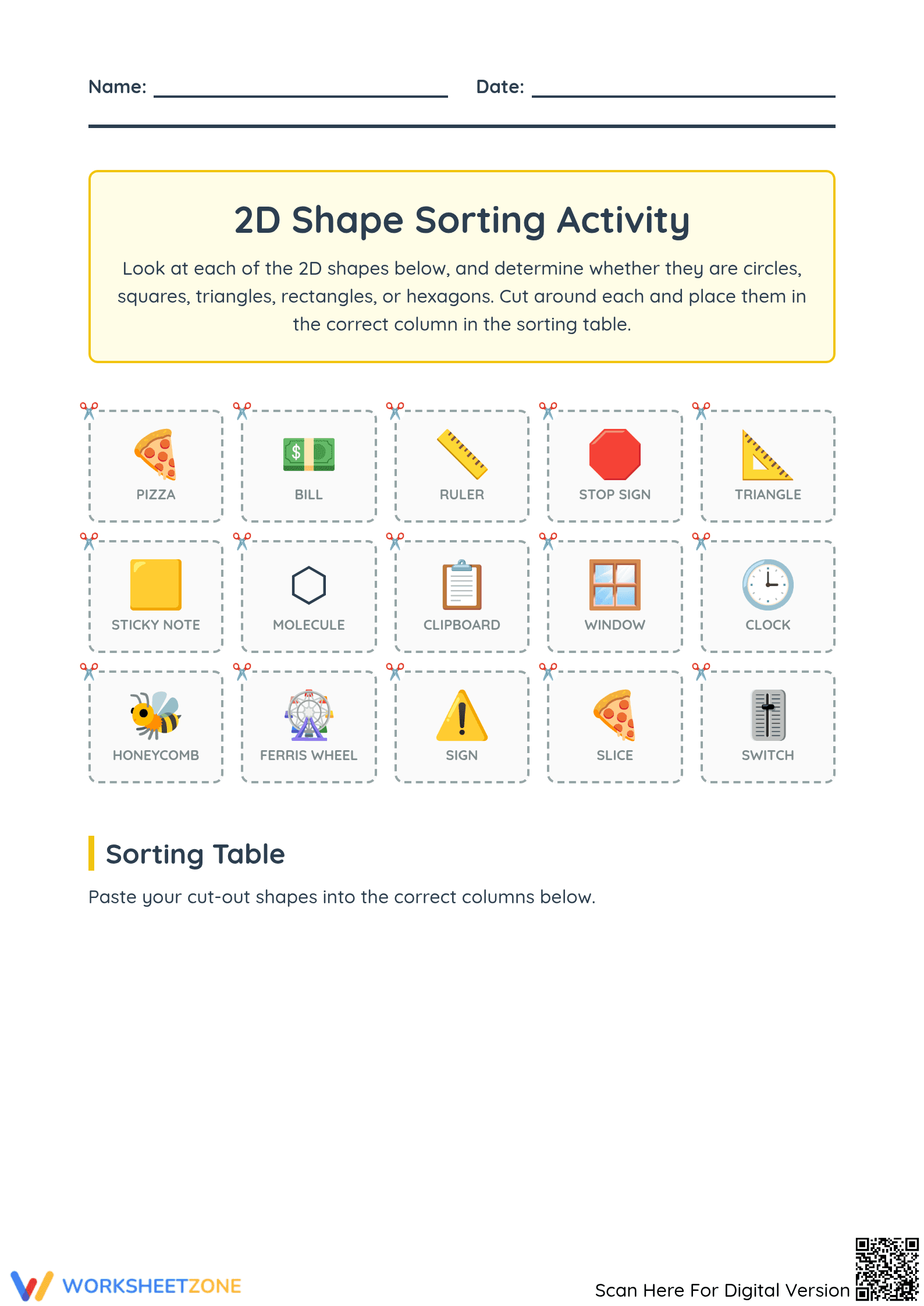
This Grade K math worksheet helps students master identifying and categorizing basic geometry concepts by sorting real-world objects into specific shape categories. By cutting and pasting 15 everyday items into the correct columns, young learners build fine motor skills while reinforcing their foundational understanding of circles, squares, triangles, rectangles, and hexagons.
At a Glance
- Grade: K · Subject: Math
- Standard:
CCSS.MATH.CONTENT.K.G.A.2— Correctly name shapes regardless of their orientations or overall size- Skill Focus: 2D Shape Sorting
- Format: 2 pages · 15 problems · PDF
- Best For: Independent practice and math centers
- Time: 15–20 minutes
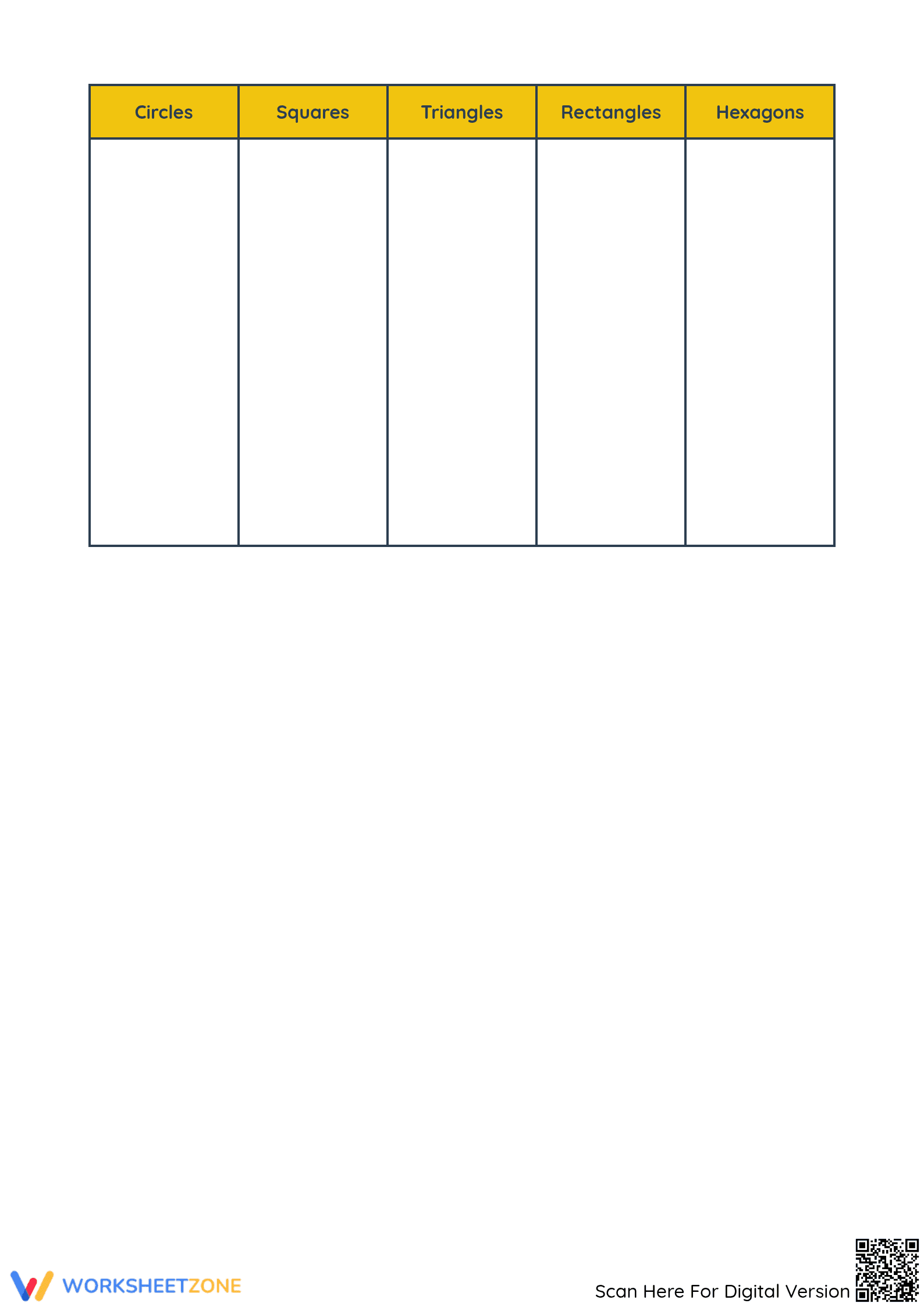
Inside this two-page resource, educators will find an engaging cut-and-paste activity for early learners. Page one features 15 colorful, real-world objects—like a pizza slice and a clock—for students to cut out. Page two provides a sorting table with five columns: Circles, Squares, Triangles, Rectangles, and Hexagons. This visual format helps students connect abstract geometric terms to tangible everyday items.
This resource offers a simple, zero-prep workflow:
- Print (1 minute): Print the two-page PDF. Just provide scissors and glue.
- Distribute (1 minute): Hand out during math centers. Instructions are self-explanatory.
- Review (2 minutes): Check sorting tables for correct placement.
With teacher prep under two minutes, this is perfect for sub plans.
This activity is directly aligned to CCSS.MATH.CONTENT.K.G.A.2, requiring students to correctly name shapes regardless of their orientations or overall size. By categorizing real-world items, students demonstrate their ability to distinguish defining attributes of various polygons and circles. It also supports early measurement and data skills by having students classify objects into given categories. Both standard codes can be copied directly into lesson plans, IEP goals, or district curriculum mapping tools.
This worksheet fits perfectly into a math center rotation. After direct instruction on 2D shapes, assign this task as independent practice. It also serves as excellent morning work. As a formative assessment tip, observe students while they sort; if a student confuses the rectangle (bill) and square (sticky note), it offers an immediate reteaching opportunity. Expected completion time is 15 to 20 minutes.
Designed for kindergarten students developing early geometry and fine motor skills, this is also beneficial for first-grade review or special education classrooms needing tactile materials. To differentiate, teachers can pre-cut the objects. This pairs naturally with a shape anchor chart.
Integrating hands-on sorting tasks into early childhood mathematics instruction significantly reinforces cognitive development and geometric reasoning. According to EdReports 2024, instructional materials that connect abstract mathematical concepts to real-world visual representations improve long-term retention and conceptual understanding in young learners. This worksheet directly supports CCSS.MATH.CONTENT.K.G.A.2 by asking students to correctly name shapes regardless of their orientations or overall size. By physically manipulating and categorizing 15 distinct objects—ranging from triangular pizza slices to hexagonal honeycombs—students actively engage in the analytical thinking required to distinguish defining attributes. This tactile approach not only builds essential geometry skills but also strengthens the fine motor coordination necessary for early writing. Utilizing such structured, visually rich categorization activities ensures that foundational math standards are met through developmentally appropriate, evidence-based practices.


