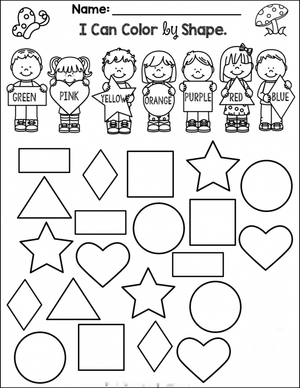
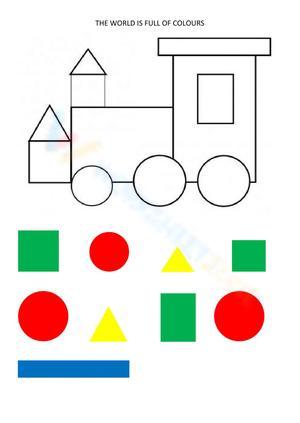
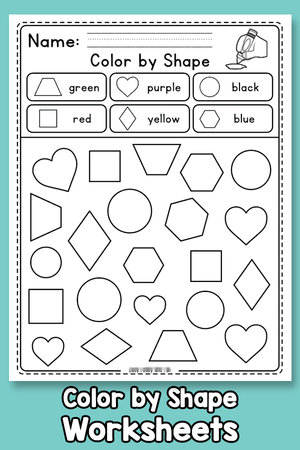
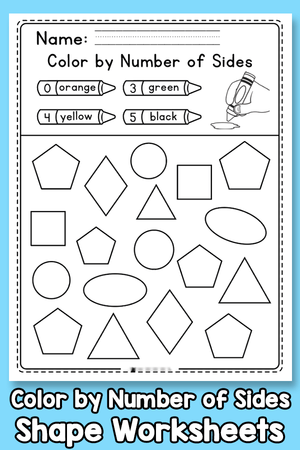
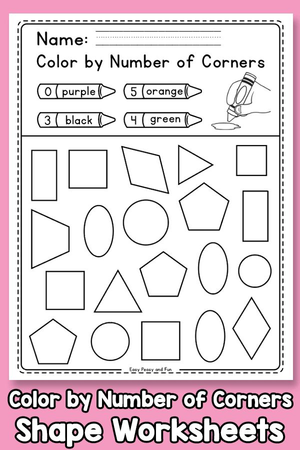
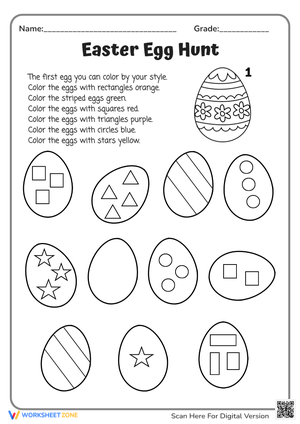
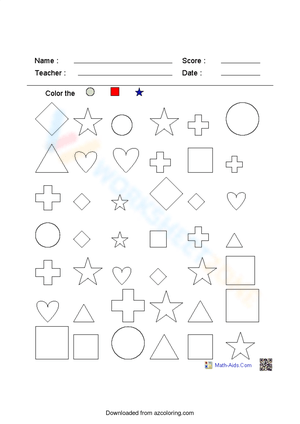
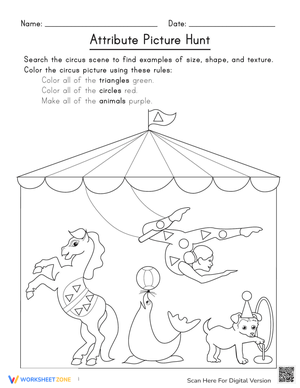
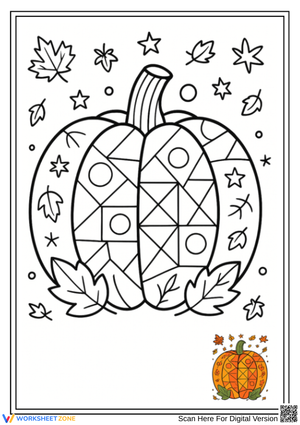
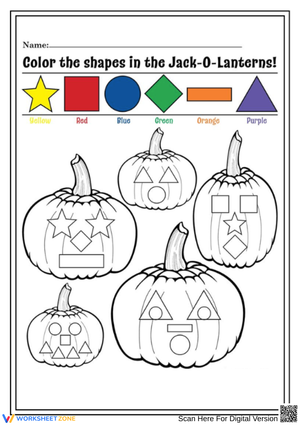
These color by shapes worksheets for kindergarten give teachers a low-prep format that kindergartners can run almost entirely on their own — which matters more at 8:10 on a Monday morning than it might sound at first glance. Each worksheet shows a picture divided into labeled shape regions, paired with a color key: students read the key, find each shape in the picture, and fill in the correct color. That three-step loop repeats across the whole picture, building shape vocabulary, direction-following, and fine motor control in a single task.
The Specific Skills These Worksheets Target
Shape recognition at the kindergarten level is not just knowing that a triangle has three sides. It means identifying a shape correctly when it appears at different sizes and orientations, in the middle of a busy picture, among other shapes that share an edge with it. That is the condition under which these worksheets ask students to work, and it makes the practice more demanding — and more useful — than a simple matching task.
The set covers the core 2D shapes expected in kindergarten geometry: circle, square, triangle, rectangle, and oval, with some worksheets including hexagon for students who are ready. Students scan each picture systematically, match each region to a shape name in the key, and make a color decision. For many five-year-olds, the scanning-and-matching process is genuinely harder than knowing the shape names themselves.
- Visual discrimination: Shape regions share edges and appear in varied sizes, which is harder than identifying shapes in isolation on a flashcard.
- Key-reading practice: Following a color code is a genuine multi-step task for kindergartners and builds the habit of checking directions before acting.
- Shape name recall: Every coloring decision requires linking a written or picture-labeled shape name to the visual form in front of them.
- Fine motor practice: Switching colors and staying within shape regions builds pencil control in a math context, not just during art time.
Student Errors Worth Anticipating Before the First Worksheet
The oval-circle confusion is the most consistent mistake in this type of activity. On a worksheet, both shapes are closed curves, and without the 3D handling that helps kindergartners at a manipulatives table — picking up a disk versus an egg shape — the elongation of an oval is easy to miss. A useful pre-coloring routine is to have students trace both shapes in the air and describe what they notice about the "stretched" one before they open their crayons.
Square-rectangle errors follow a different pattern. Students who handle pattern blocks regularly can usually identify a square with confidence. The confusion appears when a rectangle shows up in an unusual proportion — very long and narrow, or nearly square-looking — and students call it a square without checking. A brief whole-group moment where the teacher covers one end of a drawn rectangle and asks "could this be a square now?" sets up the key distinction before students work independently.
A less obvious error is what might be called picture-logic coloring: students who color a patch of sky blue because it looks like sky, or a flower yellow because flowers are yellow, without checking the key at all. This usually means the student has not yet understood what a color-by-code task is asking. Modeling the key-checking process out loud — "I find the shape first, then I look at the key, then I choose my color" — before the first worksheet closes that gap quickly.
Fitting These Worksheets Into the Lesson Week
The most practical slot for these worksheets is the 10-minute transition between morning meeting and small-group math rotations. Students already have crayons on the table, they are in math mode, and the visual task settles the room without requiring ongoing teacher direction once the routine is established. A single introduction lesson — roughly 15 minutes of whole-group modeling — is all it takes before students can begin each subsequent worksheet without prompting.
In math centers, these worksheets work well alongside a shape sorting tray or a small set of pattern blocks. The hands-on material and the coloring task reinforce each other: placing a block on the matching region before coloring it helps some students make the connection between a physical shape and its flat drawn version. As a Friday review tool, a mixed-shape worksheet gives a quick read on which students still confuse specific shape pairs without requiring a separate assessment moment.
Color by shapes worksheets for kindergarten are among the more manageable homework formats for this age group. The task is entirely visual, requires no adult explanation beyond pointing to the key, and keeps the focus on student recognition practice rather than a parent-guided teaching session.
Standard Alignment
These worksheets align with CCSS.MATH.CONTENT.K.G.A.1, which asks students to describe objects in the environment using names of shapes, and CCSS.MATH.CONTENT.K.G.A.2, which requires correctly naming shapes regardless of their orientations or overall size. In classroom terms, K.G.A.2 is the harder standard to address — a child who names a triangle when it points up may not recognize the same triangle tipped sideways. Because each picture presents shapes in varied sizes and arrangements rather than in standard textbook orientation, these worksheets directly practice that standard rather than just touching on it.
Differentiating the Set Across Ability Levels
For students still building shape vocabulary, choose worksheets that use only two or three shapes — circle, square, and triangle — with large, uncrowded regions. Naming each shape aloud with a physical object before starting removes one layer of cognitive demand so students can focus on visual matching rather than recall under pressure.
On-level students work through mixed worksheets covering all five core shapes. Asking them to say each shape name aloud before coloring adds a verbal rehearsal step that strengthens retention without changing the worksheet at all.
For students ready for more, the most useful extension is not a harder worksheet — it is a follow-up question. After coloring, ask them to count how many of each shape appear, or pick two shapes and explain one way they are the same and one way they are different. That quick verbal task moves the activity from recognition into geometry reasoning. The color by shapes worksheets for kindergarten in this set work well as a starting point for those conversations, not just an endpoint.
Frequently Asked Questions
Can these worksheets replace hands-on shape activities?
No, and they are not meant to. Kindergartners need to handle physical shapes — turning them, tracing edges, comparing faces — before and alongside paper-based tasks. These worksheets serve a different function: repeated recognition practice in a format students complete independently while you work with a small group.
How many shapes should appear on one worksheet for kindergarten?
Two to four shapes per worksheet is the practical range for most of the year. More than four starts to overload the key-reading process for students still building shape vocabulary, and the task becomes more about decoding directions than recognizing geometry. Reserve five- or six-shape worksheets for the final quarter of the year when students have genuine fluency with the core set.
Do students need to be reading to use these worksheets?
Minimally. The color key uses shape names in print, so students do need to recognize those words — but after a few shape lessons, most kindergartners associate "circle" with its visual form without decoding it in a traditional reading sense. For students not yet reading shape vocabulary, adding a small drawn shape next to each name on the key before copying removes that barrier entirely.
Where do these worksheets fit within a geometry unit?
These color by shapes worksheets for kindergarten work across the full arc of a kindergarten geometry unit. Use single-shape-focus worksheets early when students are first meeting vocabulary, shift to mixed-shape worksheets for mid-unit reinforcement, and save the most varied mixed versions for unit-end review or take-home family activities.













 Interactive Worksheet Maker
 Quiz Maker
 Word Search Maker
 Crossword Puzzle Maker
 Word Scramble Generator
 Sentence Scramble Generator
 Handwriting Worksheet Generator
 Name Tracing Generator
 Fill In The Blank Generator