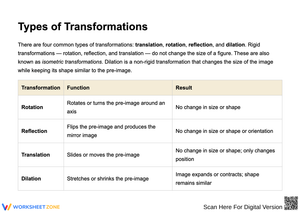
These transformations worksheets for 9th grade give geometry teachers a focused set of printable resources built around the specific demands of high school coordinate geometry — mapping rigid motions with coordinate rules, applying function notation to geometric movements, and working through multi-step composite sequences. The set addresses the critical transition that happens in 9th grade when students move from the informal visual approach introduced in 8th grade to the algebraic, function-based language required by high school geometry standards.
What's Inside the Set
Each worksheet targets one transformation type or a defined combination, organized from foundational to advanced within each category.
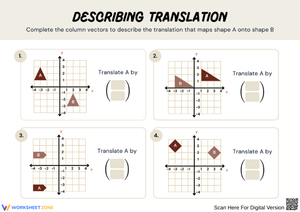
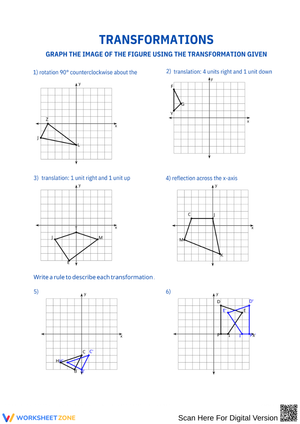
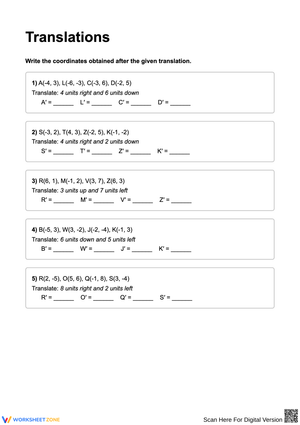
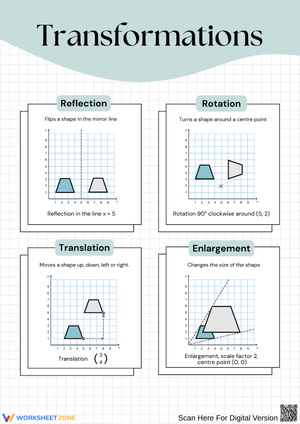
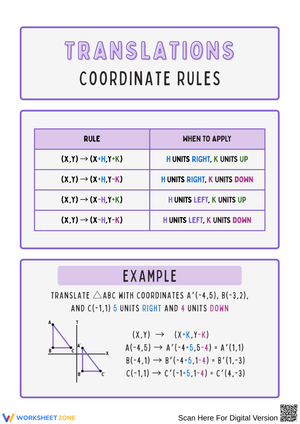
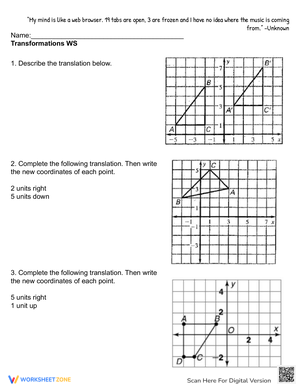
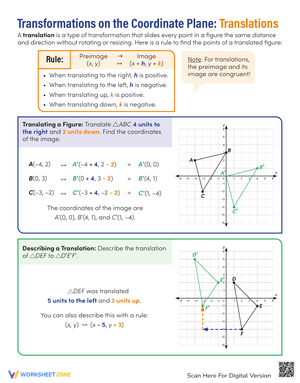
- Translations — Students apply rules of the form (x, y) → (x + a, y + b), identify translation vectors from a graphed pre-image and image, and verify that distance and angle measure are preserved.
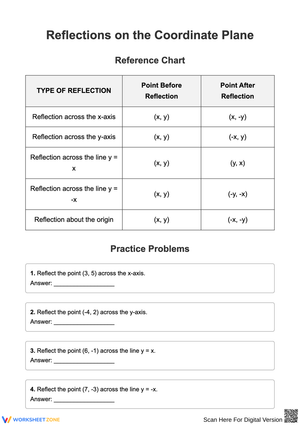
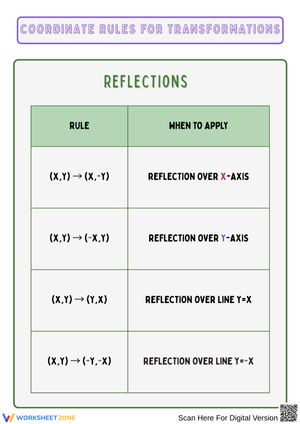
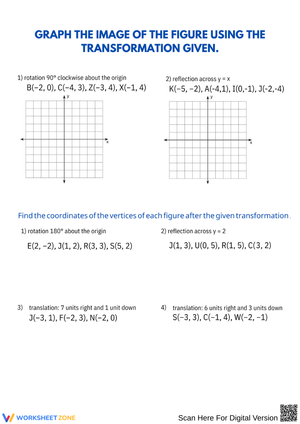
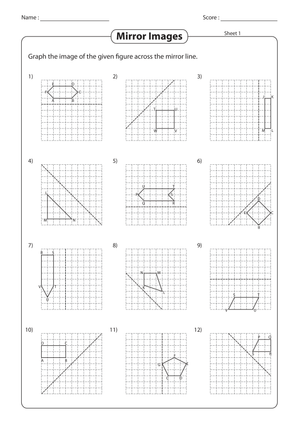
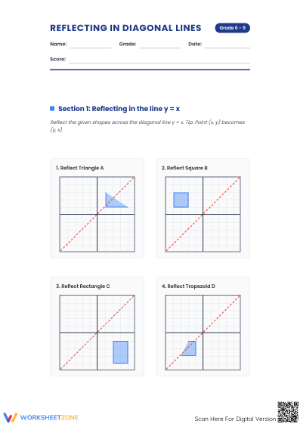
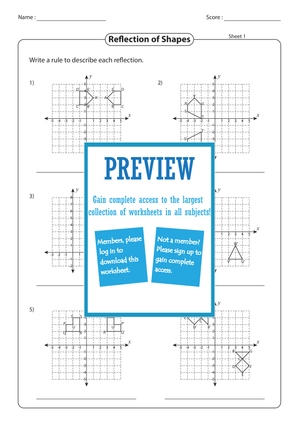
- Reflections — Worksheets cover the four standard lines of reflection: the x-axis, the y-axis, y = x, and y = -x. Additional exercises address reflections across horizontal and vertical lines of the form x = a and y = b.
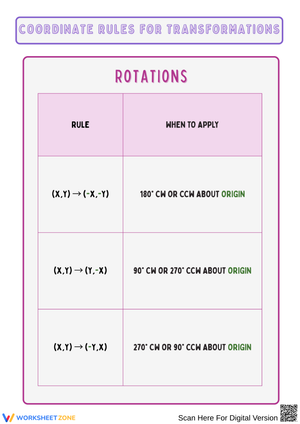
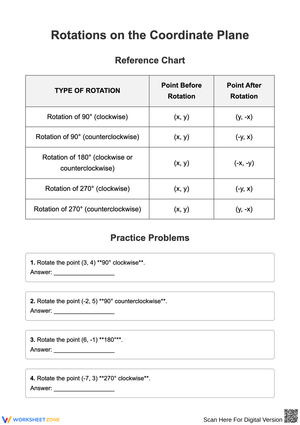
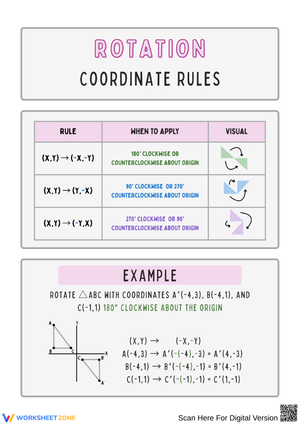
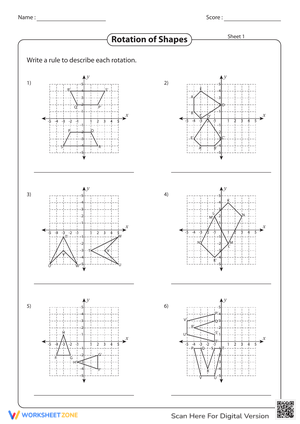
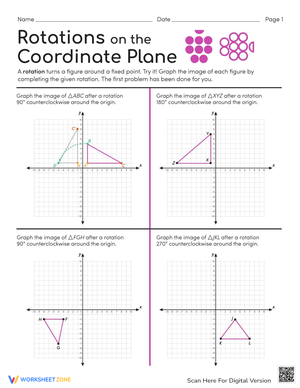
- Rotations — Students rotate figures 90°, 180°, and 270° counterclockwise around the origin and, in later worksheets, around an arbitrary center point. Each worksheet pairs the coordinate rule with a graphing task so students verify the algebraic result directly on the grid.
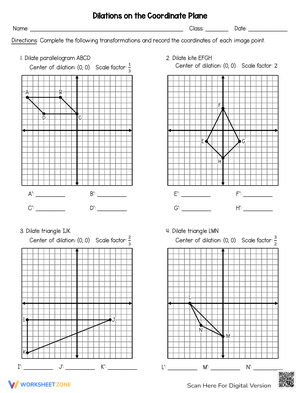
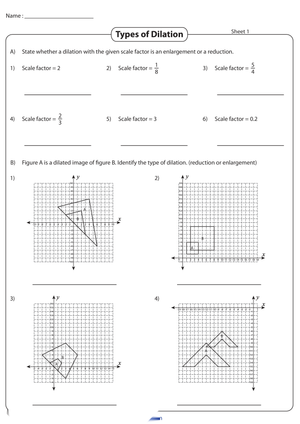
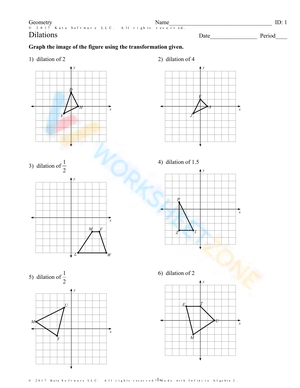
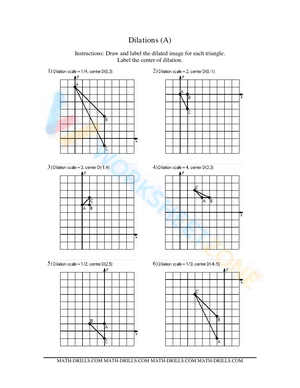
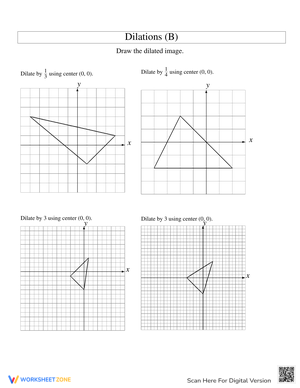
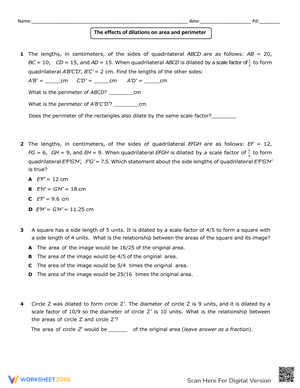
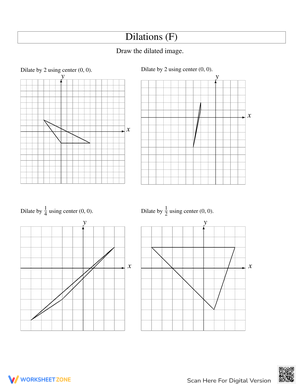
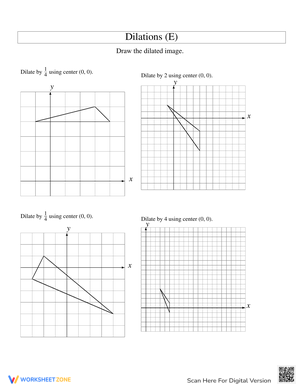
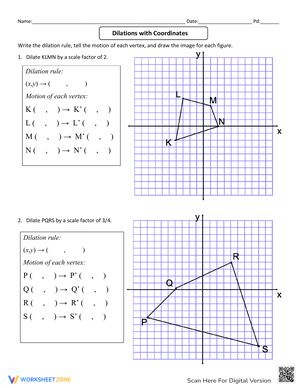
- Dilations — Exercises address scale factors applied from the origin and from an off-origin center. Students calculate image coordinates, compare side lengths, and determine whether the resulting figures are congruent or similar based on the type of transformation applied.
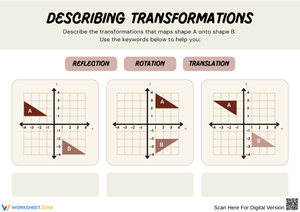
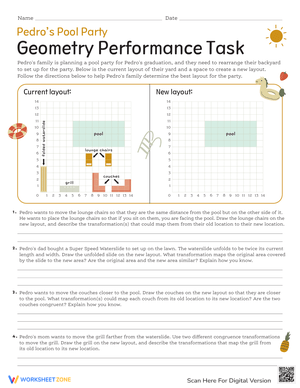
- Composite Transformations — These worksheets ask students to apply two or more transformations in sequence, recording intermediate coordinates at each step before graphing the final image.
Errors That Come Up Every Year — and What They Actually Tell You
The most consistent rotation error is sign placement in the coordinate rule for 90-degree turns. Students learn that a 90-degree counterclockwise rotation maps (x, y) to (-y, x), but a significant number write (y, -x) instead — which is the clockwise rule. What makes this worth watching closely is that the error is rarely random: students are applying a partially remembered rule, swapping the coordinates correctly but placing the negative sign in the wrong position. A student who maps (4, -1) to (1, 4) has executed the swap but dropped the negation entirely. Running several consecutive exercises with the same rotation type lets this pattern emerge clearly rather than appearing as a one-time miscalculation.
Dilation errors shift character the moment the center of dilation moves off the origin. With the center at the origin, most students apply the scale factor correctly. Move the center to a point like (2, -3) and error rates climb — students multiply the given coordinates by k without first adjusting for the position of the center, producing an image that's the right size but in the wrong location. The off-origin dilation worksheets in the set use a column format that breaks the computation into three steps: adjust for the center, apply the scale factor, reverse the adjustment. Students who skip directly to multiplication almost always land here.
In composite transformation problems, the most instructive error is reversed step order. A reflection across y = x followed by a translation two units right produces a different final image than the same translation followed by the reflection, even when students correctly apply both individual rules. When students get a sequence problem wrong, asking them to name which transformation they did first typically identifies the problem in under thirty seconds — and that question is worth asking explicitly before marking the answer incorrect.
Working These Worksheets Into Your Geometry Unit
The transformations worksheets for 9th grade work best when introduced one transformation type at a time, assigned as targeted practice immediately after direct instruction rather than collected into a mixed review. Using a translation worksheet as an exit ticket on the day you introduce translations gives you clean formative data before rotation rules enter the picture and compete for space in working memory. Students who can't yet distinguish the reflection rule from the rotation rule don't benefit from a worksheet that requires them to apply both.
Station work suits the middle of a transformations unit well. Set up four stations — one per rigid-motion type — and keep each station narrow: one type, one direction, a small problem set. Students who finish early at a station can receive a follow-up card asking them to identify the transformation rule given only the pre-image and image coordinates, reversing the typical direction of the exercise. That reversal is a reliable comprehension check that the standard format doesn't provide on its own.
The composite transformation worksheets work well as a full class-period anchor near the end of the unit. Pairing students so that one graphs while the other articulates the coordinate rule being applied — then switching roles after each step — slows the impulse to rush through multi-step sequences and catches ordering errors before they get recorded on paper. Tracing paper kept alongside the printed worksheet gives students who are uncertain about a rotation or reflection a quick physical check: trace the pre-image, rotate or flip the paper over the grid, and compare the position to the algebraic result before committing. That tactile step typically resolves sign confusion faster than re-explaining the rule does.
Standard Alignment
The transformations worksheets for 9th grade in this set address CCSS.MATH.CONTENT.HSG.CO.A.2, which requires students to represent transformations in the plane using function notation and describe them in terms of what happens to input points — where they go and why. This is the standard that formally separates 9th-grade geometry from the 8th-grade introduction to transformations under 8.G.A, where the expectation is primarily visual and descriptive rather than algebraic. The coordinate-rule and notation focus of these worksheets targets exactly that representational shift. Related standards addressed in the set include HSG.CO.A.4, which expects students to develop formal definitions of rotations, reflections, and translations in terms of angles and perpendicular lines, and HSG.SRT.A.1, which addresses the properties of dilations given by a center and a scale factor. The dilation and composite-sequence worksheets support the SRT cluster and fit naturally into the second half of a first-semester geometry course.
Adjusting the Worksheets for a Range of Learners
For students who are still uncertain about coordinate plane basics, start with the translation worksheets. Translations require only addition and subtraction on coordinates, and the graphing component is direct enough that students can self-check by counting grid squares. Providing a reference card listing the coordinate rule for each transformation type — one rule per row — lets working memory focus on applying the current rule rather than retrieving the full set simultaneously. That kind of structured support is more effective at this stage than asking students to memorize all four rule types before they've had time to internalize any one of them through practice.
Students who move through the basic transformation worksheets quickly can extend into off-origin rotation problems, which require a multi-step process: translate the center of rotation to the origin, apply the standard rotation rule, then reverse the initial translation. That process is effectively a composition of three separate transformations, making it a natural bridge to function composition for students who are ready for that connection. A strong algebraic extension is asking students to prove that reflecting across the x-axis and then the y-axis produces the same result as a 180-degree rotation around the origin — working through both coordinate rule sequences and confirming that the outputs match. Students who can explain why that equivalence holds have a much deeper grip on the relationship between transformation types than drill practice alone provides.
Frequently Asked Questions
Do the worksheets include both graphing and algebraic problems, or does each worksheet focus on one type?
Both. Most worksheets pair a coordinate-rule computation with a graphing task — students apply the rule, record the image coordinates, and plot the result on a provided grid. This two-part format makes it easier to pinpoint where a student's error occurs: in the rule itself, in transferring correct coordinates to the graph, or in the graphing step. It also serves different learners: students who find the algebra harder benefit from seeing the geometric result take shape, while students who rely on visual reasoning are pushed through the notation they need to formalize.
Are the dilation exercises limited to a center of dilation at the origin?
No. The set addresses both cases. Earlier dilation worksheets use the origin as the center so students can focus on applying the scale factor before handling the added complexity of an off-center reference point. Later worksheets move the center off the origin and require students to adjust their coordinates relative to that center before and after applying the scale factor. Scale factors in the set include values greater than 1 (enlargements), values between 0 and 1 (reductions), and the case of k = -1, which maps a figure to the opposite side of the dilation center — a result that surprises many students and generates useful class discussion.
How do the composite transformation worksheets handle the step-order problem?
Several worksheets present the same two transformations applied in reversed order and ask students to graph both outcomes side by side, making it visually obvious that the results differ. A follow-up problem asks students to work backward: given only the pre-image and the final image, determine which sequence of transformations could have produced that result. That reversal requires students to treat transformations as operations with direction, not just as procedures to execute in whatever order feels natural. This set of transformations worksheets for 9th grade includes answer keys for all composite-sequence exercises so teachers can use them for immediate self-checking or structured peer review without spending time producing a separate key.
Can these be used for test preparation alongside the main unit?
Yes. The coordinate rule format and function notation emphasized throughout the set match the form these concepts take on most end-of-course geometry assessments aligned to the Common Core high school geometry standards. The composite transformation problems in particular — which require multi-step reasoning, precise tracking of intermediate coordinates, and awareness of step order — reflect the difficulty level of constructed-response items on these assessments. Students who work through the full sequence of worksheets will have encountered the rule types, notation formats, and problem structures that appear on formal tests, in the same form rather than in a simplified or modified version.














 Interactive Worksheet Maker
 Quiz Maker
 Word Search Maker
 Crossword Puzzle Maker
 Word Scramble Generator
 Sentence Scramble Generator
 Handwriting Worksheet Generator
 Name Tracing Generator
 Fill In The Blank Generator




 BACK TOSCHOOL