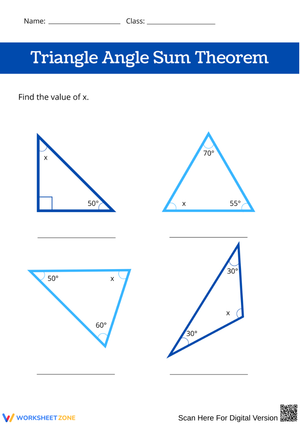
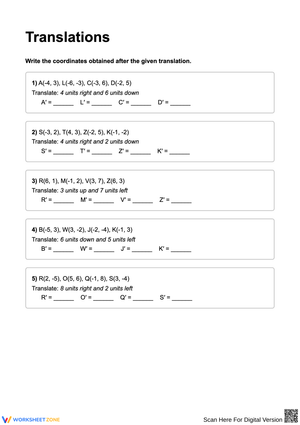
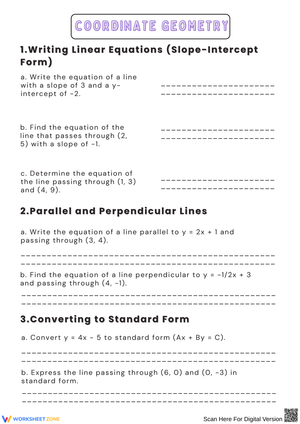
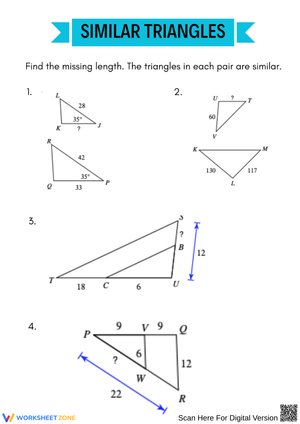
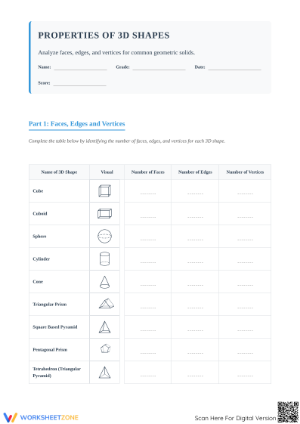
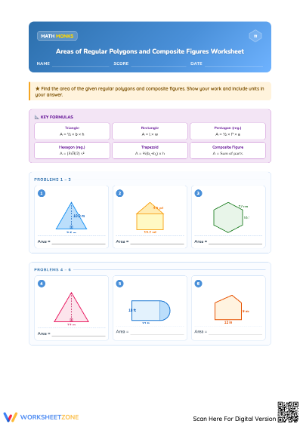
These geometry worksheets for 9th grade cover the full arc of a standard high school geometry course — rigid motion transformations, formal proof construction, right triangle trigonometry, and coordinate proof — packaged in print-ready PDFs that teachers can pull the night before a lesson and use the next morning without modification. Each worksheet targets one concept, keeping the cognitive load manageable while students are simultaneously learning to reason deductively for the first time.
The Specific Skills Targeted
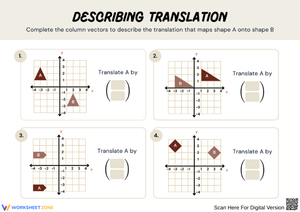
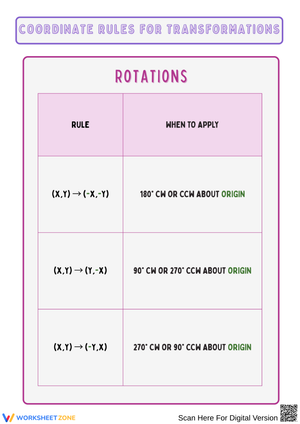
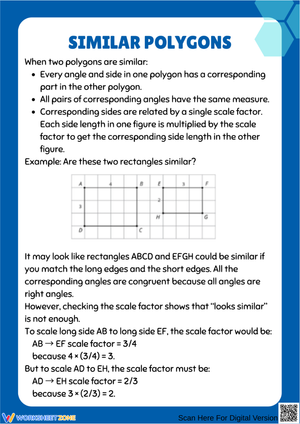
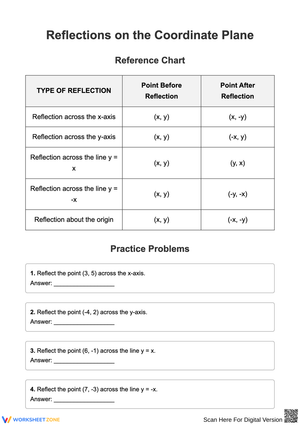
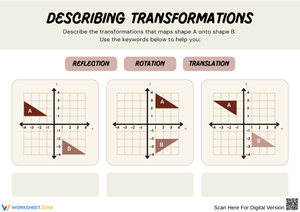
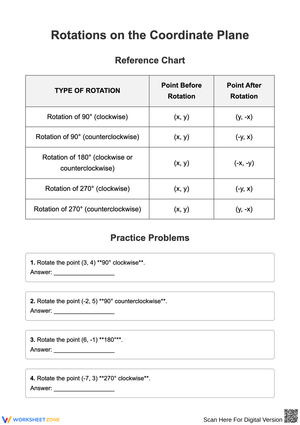
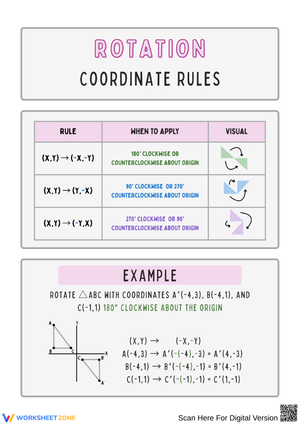
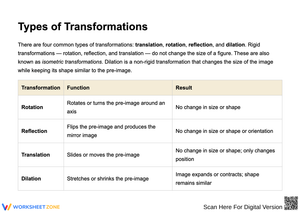
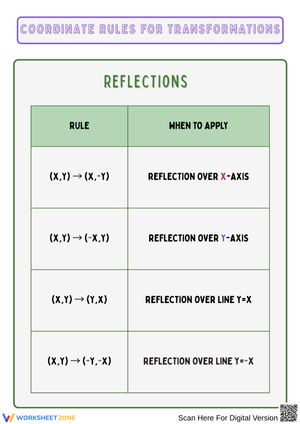
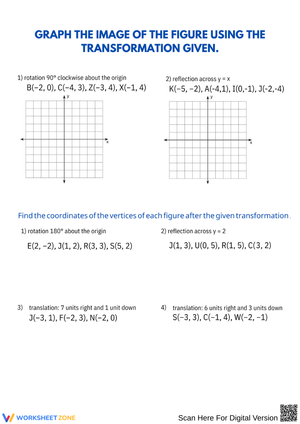
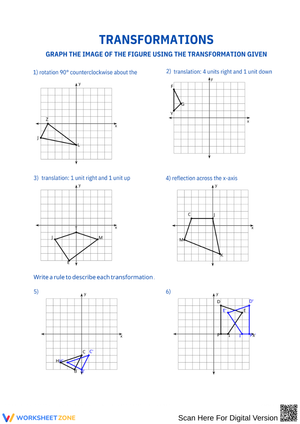
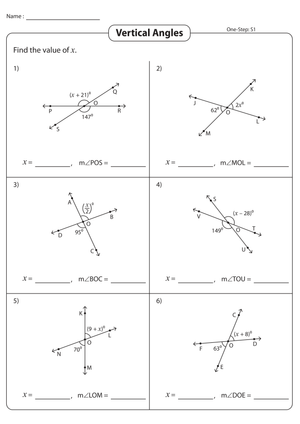
The set opens with transformations and congruence. Students translate, rotate, and reflect figures across a coordinate plane, then argue that two figures are congruent by identifying the sequence of rigid motions that maps one onto the other. This approach — grounded in the Common Core framework — builds stronger spatial reasoning than the traditional "match the tick marks and invoke SSS" method, because students have to explain why congruence follows from rigid motion rather than simply recognizing a visual pattern.
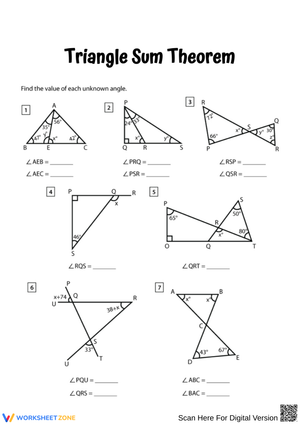
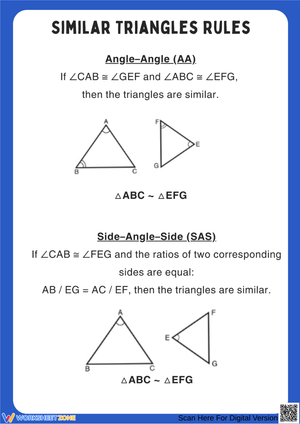
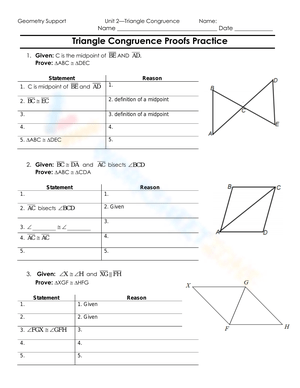
Proof writing gets its own cluster. The earlier worksheets in this group use structured formats — two-column templates where students supply only the reasons, or alternating-step formats where every other statement is missing — so students can study a proof's logic before they're responsible for generating the entire argument. Later worksheets remove that support entirely: students receive only the given information and the goal and must select the appropriate congruence criterion (SAS, ASA, AAS, or HL) and construct the proof themselves.
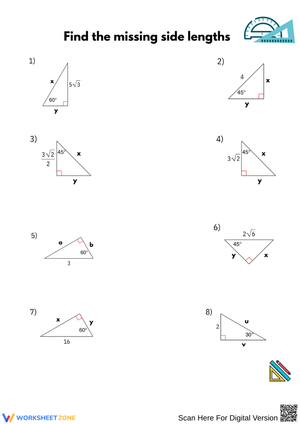
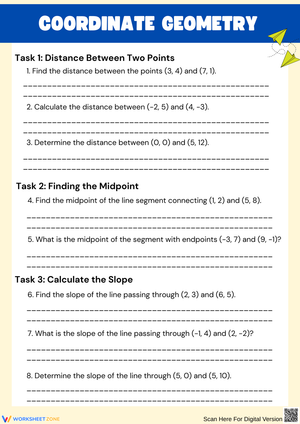
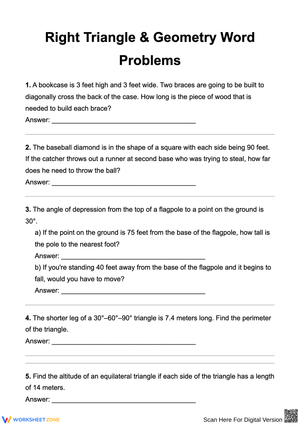
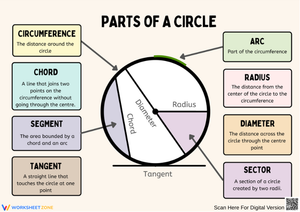
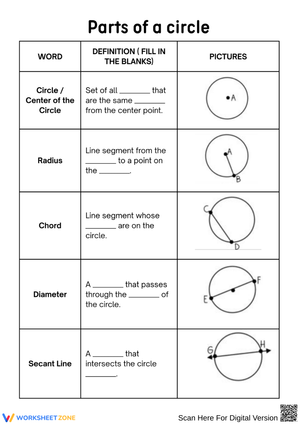
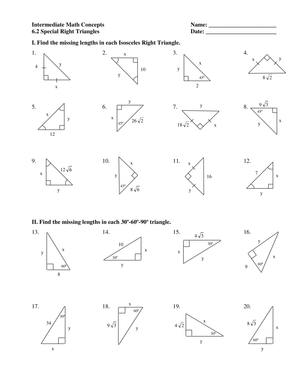
Right triangle trigonometry worksheets begin with ratio identification and build toward multi-step word problems involving angles of elevation and depression. Coordinate geometry worksheets ask students to verify properties of specific polygons using slope, the distance formula, and the midpoint formula — for instance, confirming that a quadrilateral with given vertices is a rectangle by establishing perpendicular diagonals of equal length. A separate cluster addresses circles: writing the equation from center and radius, and working backward from a standard-form equation by completing the square, a skill students carry over from Algebra 1.
Where Students Go Wrong — Proof, Trig, and Coordinate Reasoning
The most predictable proof error involves SAS. A student correctly identifies two pairs of congruent sides, then marks whatever angle is convenient — not the angle between those two sides, which is what the theorem requires. Because the structured worksheets ask students to justify each step in order rather than work backward from a conclusion, the error surfaces visibly: the student writes SAS as a reason before establishing that the marked angle is the included angle, and the gap appears right there in the sequence.
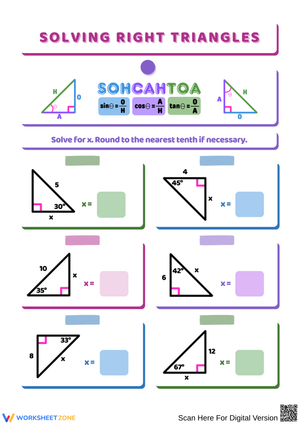
In right triangle trigonometry, the breakdown usually starts with labeling. Without a clear identification of the reference angle before labeling the legs, students routinely swap opposite and adjacent. Working with a 5-12-13 triangle, a student might write sin(θ) = 12/13 when the correct ratio relative to the marked angle is cos(θ) = 12/13. Worksheets that require students to annotate each triangle — writing "H," "O," and "A" next to the appropriate sides before setting up any ratio — make the labeling step gradeable rather than invisible.
Coordinate geometry produces a subtler problem: a category error. Students who can compute slopes and distances correctly on isolated exercises will confuse the two when asked to prove something about a figure. Asked to show that a quadrilateral is a rhombus, a student computes slopes to argue about side length — a mistake that reveals they have learned the procedures without internalizing what each formula actually measures.
Getting These Worksheets Into Your Daily Routine
Bell-ringers are the most reliable use. Project one trig diagram or one proof-starter from a worksheet as students arrive, give them eight minutes while attendance gets taken, then debrief before new instruction starts. Students who retained the previous lesson will finish quickly; students who didn't understand the homework get a second pass before new content arrives. Either way, the debrief gives you real-time data about what carried over — and occasionally surfaces a misconception worth addressing before you build on top of it.
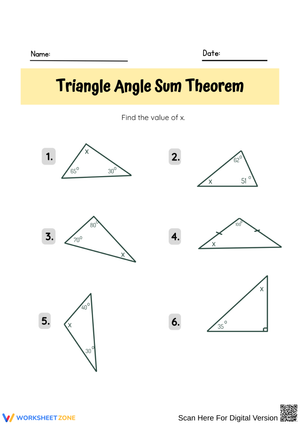
A set of geometry worksheets for 9th grade that spans this many topic areas also makes a reverse-engineering activity straightforward to run. Take a completed worksheet and introduce three or four intentional errors: a mislabeled rigid motion, a trig ratio written from the wrong reference angle, a proof step citing the Angle Addition Postulate where the Segment Addition Postulate applies. Ask students to grade it. Written corrections that require students to name the specific error and explain the right reasoning produce more diagnostic information than a standard worksheet response — and students who complete the exercise can usually explain why SAS requires an included angle, not because you told them, but because they caught someone getting it wrong.
For station rotations, three stations map cleanly onto this content: proof writing using the two-column templates, coordinate geometry with grid paper and plotted polygon vertices, and trig word problems requiring annotated diagrams. Each station runs about fifteen minutes. Students encounter three distinct types of geometric reasoning in one class period rather than working a single problem type for the full hour.
Standard Alignment
The geometry worksheets for 9th grade in this set address the following Common Core domains for High School Geometry:
- HSG-CO.A.1–5 — Defining and applying rigid motions; establishing congruence through sequences of transformations
- HSG-CO.B.7–8 — Triangle congruence criteria derived from rigid motion arguments (SSS, SAS, ASA, AAS, HL)
- HSG-CO.C.9–11 — Theorems about parallel lines, triangles, and parallelograms, proven using the congruence criteria above
- HSG-SRT.C.6–8 — Sine, cosine, and tangent ratios; applying those ratios to find missing sides and angles in right triangles
- HSG-GPE.B.4–7 — Coordinate proof: using distance, slope, and midpoint to verify geometric properties algebraically
These standards form the conceptual core of the course, not elective extensions. The NCTM's guidance for high school mathematics consistently positions congruence through transformation, formal proof, and coordinate reasoning as the backbone of the curriculum — skills from every domain above reappear in Algebra 2, Pre-Calculus, and physics, and a student who leaves 9th-grade geometry without them carries that gap forward.
Differentiating the Set for Mixed-Level Geometry Classes
For students still consolidating prerequisite algebra, the coordinate geometry worksheets work better when the distance and midpoint formulas appear on the worksheet itself. The goal isn't to excuse them from eventually memorizing the formulas — it's to keep the reasoning process intact. Stopping mid-problem to reconstruct a formula from memory interrupts exactly the kind of thinking the worksheet is trying to build. Remove the reference once fluency with the formulas is solid.
Students working above grade level respond well to a simple extension on the proof worksheets: after completing the assigned proof, determine whether the converse of the theorem is also true and, if so, prove it. The converse of the Isosceles Triangle Theorem is both true and provable using the same tools — but identifying what the converse says, writing it as a conditional statement, and constructing the argument requires qualitatively different reasoning than the original problem. No additional worksheet is needed; a written prompt on the existing one covers it.
Students who freeze when a diagram appears in an unfamiliar orientation present a specific challenge. A triangle that's immediately recognizable upright becomes confusing when it's rotated 45 degrees or reflected across a vertical axis — not because the geometry changes, but because the visual cues students have learned to rely on disappear. Having a handful of worksheets that present the same figure in multiple orientations trains students to read the labeled parts rather than the shape's visual appearance, a flexibility that matters because non-standard configurations show up frequently in proof-based problems.
Frequently Asked Questions
Can these worksheets be used as bell-ringers on days when the lesson moves on to a new topic?
Yes — and that's sometimes the better choice. Using a trig ratio problem as a warm-up on a day you're teaching coordinate geometry is spaced retrieval in practice: students revisit a skill after a gap, which research consistently shows strengthens long-term retention more than massing practice on the day of first instruction. Treat the bell-ringer as a low-stakes memory check rather than a preview of new content, and vary which topic you pull from so students never know which concept will appear.
Do the answer keys show proof reasoning or just final values?
The geometry worksheets for 9th grade in this set include answer keys that walk through both statements and reasons in sequence for every proof problem. For numerical problems, intermediate steps — the trig ratio set-up, the distance formula substitution — appear in the key alongside the final answer. This matters most when grading proofs, because most proof errors are procedural rather than computational. A student might write the correct conclusion while citing the wrong theorem, and that error is invisible if you only check the final line.
How do the proof worksheets handle the move from structured formats to independent writing?
The proof cluster moves in three stages. The first worksheets give students all statements and ask only for the reasons. The second stage provides alternating steps — one statement given, the next blank — and students supply what's missing. By the third stage, students receive only the given information and the goal and must write the full argument themselves. Teachers who skip directly to the third stage with students who have never written a formal proof typically spend several class periods managing format confusion rather than teaching logic. Moving through all three stages removes that obstacle without softening the eventual expectation.
Is there value in having students complete trig worksheets without a calculator?
For ratio-identification worksheets — where the task is writing the correct sine, cosine, or tangent expression rather than computing a decimal — no calculator is the right call. Students with a calculator in hand tend to skip the labeling step and jump straight to computation, which is where the most common errors hide. Reserve the calculator for applied word problems where computing the actual angle measure or missing side length is the point. When the goal is recognizing which ratio applies to which sides relative to the reference angle, removing the calculator keeps attention on that decision.














 Interactive Worksheet Maker
 Quiz Maker
 Word Search Maker
 Crossword Puzzle Maker
 Word Scramble Generator
 Sentence Scramble Generator
 Handwriting Worksheet Generator
 Name Tracing Generator
 Fill In The Blank Generator




 BACK TOSCHOOL