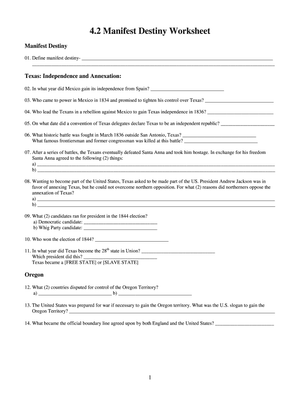
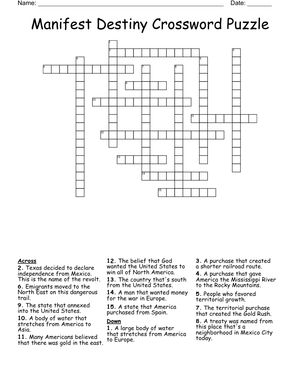
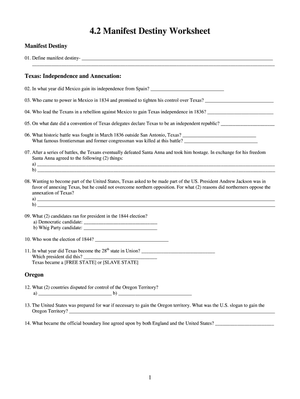
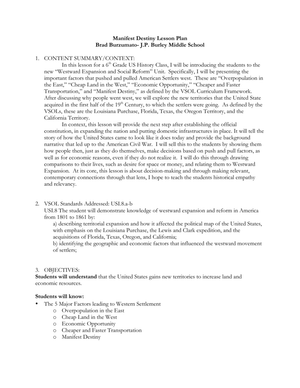
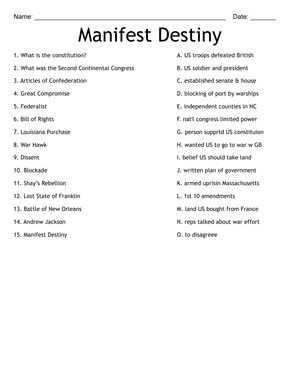
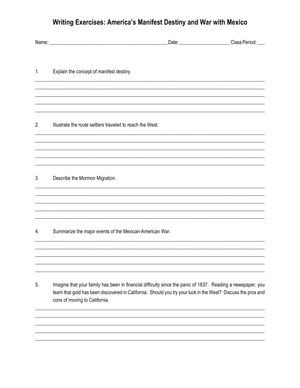
Manifest destiny worksheets for 8th grade give teachers a structured way to move students past the phrase itself and into the actual history — the contested choices, the land transfers, and the people who paid the costs of expansion. This set covers vocabulary in context, map work, timeline sequencing, perspective analysis, and short written response, which makes it practical across a standard U.S. history unit on westward expansion.
The Specific Skills These Worksheets Build
Grade 8 social studies instruction expects students to do more than name events. They need to identify causes, weigh evidence, and write supported claims — skills this set practices through several connected tasks rather than isolated drills.
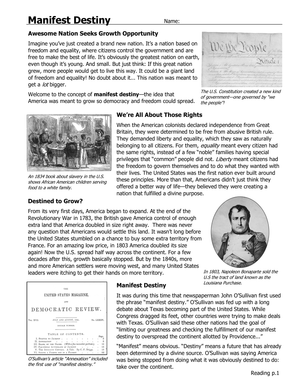
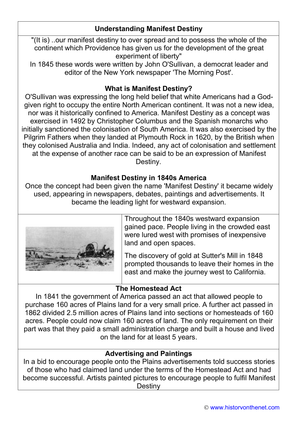
- Vocabulary in context: Students define Manifest Destiny, annexation, territory, and cession using a brief reading rather than isolated word matching. The reading gives enough historical grounding that definitions carry meaning beyond the quiz.
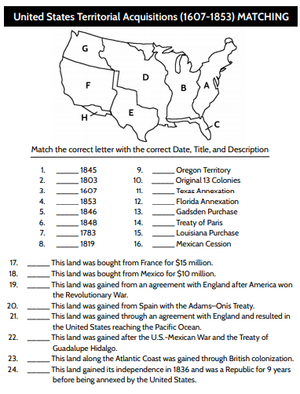
- Map interpretation: Students label the Oregon Country, the Mexican Cession, and Texas, then annotate to explain how each acquisition connected to expansionist ideology.
- Timeline sequencing: Students place the Texas annexation, the Oregon Treaty, and the outbreak of the Mexican-American War in order and identify the shared belief that ran through all three.
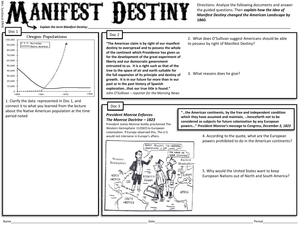
- Cause-and-effect reasoning: Students trace how the ideology influenced specific political decisions and record outcomes for Native communities, Mexico, and the sectional debate over slavery.
- Claim and evidence writing: Students take a position — whether expansion was primarily an economic, political, or ideological project, or who bore the greatest burden of its costs — and support it with evidence from the reading or organizer.
The full set of manifest destiny worksheets for 8th grade also includes a two-column organizer pairing arguments that expansion supporters made against documented consequences. That structure gives students the raw material for analytical writing before they have to produce full sentences.
Thinking Errors That Surface in Student Writing on Manifest Destiny
The most consistent error is treating Manifest Destiny as a natural law rather than a contested belief. Students write things like "America expanded west because it was its destiny" — which reproduces the ideology rather than analyzing it. A well-built task requires students to identify who held that belief, who challenged it, and who experienced its effects without accepting its premise. That shift from endorser to analyst is the hardest move at this grade level, and it rarely happens unless the task explicitly demands it.
A second pattern shows up in how students write about Native peoples and Mexico. They describe displacement and conflict as unfortunate side effects rather than direct outcomes of deliberate policy. The cause-and-effect organizer in this set addresses that gap by asking students to name the policy decision first and then name the outcome — which makes the relationship visible on paper before it has to appear in a written sentence.
Map tasks reveal a third problem worth anticipating: many 8th graders cannot locate the Oregon Country, the Mexican Cession, and the Republic of Texas on the same map. That geographic gap means their written arguments lack specific grounding, and vague claims follow. The labeling task solves this early, before it becomes a problem in discussion or on a unit assessment.
Teaching the Belief and Its Costs in the Same Lesson
Most middle school lessons on this topic spend the majority of class time on motives — settlers wanting land, politicians wanting Pacific ports, leaders invoking national destiny — and give consequences a paragraph near the end. That imbalance leaves students with four strong pieces of evidence for one side of any argument and little to say about the other. The writing gets shallow because the preparation was uneven.
Each worksheet in this set deliberately pairs a motive with a consequence in the same task. Students do not move through a section on westward settlement before encountering displacement; they see both in the same row of the organizer. That design requires students to hold both ideas simultaneously, which is the historical thinking skill grade 8 standards actually call for — and it produces better written responses because students have evidence to work with on both sides of a question. National Geographic Society materials on the ideology itself and the National Archives resource on the Treaty of Guadalupe Hidalgo both integrate naturally with this approach, adding sourced evidence to the organizer without requiring a separate document lesson.
Where These Worksheets Fit in a Westward Expansion Unit
Manifest destiny worksheets for 8th grade work best in the middle third of a westward expansion unit — after students have basic geographic context but before the most analytically demanding primary-source work on the Mexican-American War and its sectional consequences. The vocabulary and map tasks front-load the content knowledge students need to make sense of sources they encounter later.
For a 50-minute class, a straightforward sequence is a five-minute prior-knowledge prompt (what do students already associate with westward movement?), a brief whole-class reading, 25 to 30 minutes on the map and cause-effect tasks, and then the written response as an exit ticket. That last piece provides immediate formative data: students who can name a specific consequence of expansion and explain it in two sentences have the concept. Students who write in vague generalities need another pass, and the same worksheet works again in small-group the following day with direct teacher prompting.
These worksheets also function well as Monday re-entry material after a weekend interrupted a longer sequence. The timeline task asks students to reconstruct event order before confirming with the worksheet, which is a lower-stakes way to rebuild momentum than jumping straight into new content.
Using These Worksheets Across Different Readiness Levels
Manifest destiny worksheets for 8th grade carry real analytical and reading demands, and not every student enters the unit at the same point. These resources support a range of readiness levels without requiring a completely separate version of the materials for each group.
Students who need more support can start with the map task, which provides historical context visually rather than through dense text. For the written response, a sentence frame — "Supporters of Manifest Destiny argued that ______, while Native communities and Mexico experienced ______" — keeps the analytical structure intact while lowering the barrier of generating that structure from scratch. Students still have to locate and insert the evidence, which keeps the thinking at grade level.
Students ready for greater challenge can extend the written response into a full argument with a counterclaim requirement: identify the strongest objection to their position — from a political opponent of expansion, a historical figure, or a displaced community — and address it directly. That extension lives inside the same task rather than requiring separate materials, which keeps whole-class pacing manageable.
Standard Alignment
These worksheets align to CCSS.ELA-Literacy.RH.6-8.1, which asks students to cite textual evidence to support analysis of informational and historical text — the exact skill the reading passage and written response practice. They also address CCSS.ELA-Literacy.RH.6-8.6, identifying a source's point of view and distinguishing it from the reader's own perspective, which the two-column organizer reinforces directly. For social studies content, the materials map onto the C3 Framework's D2.His.4.6-8 (analyzing multiple factors that influenced perspectives during a historical era) and D2.His.1.6-8 (analyzing connections among events and developments in broader historical contexts). Teachers working with NCSS-aligned state standards will find the cause-effect reasoning and evidence-based writing consistent with most eighth-grade U.S. history content expectations for westward expansion.
Frequently Asked Questions
What is included in this set?
The set includes a vocabulary-in-context reading, a labeled map task covering the Oregon Country, Texas, and the Mexican Cession, a timeline sequencing activity, a two-column cause-and-effect organizer, and a written response prompt. Each worksheet functions as a standalone task and can be used independently or in sequence within a unit.
How do I handle the sensitive content around Native displacement and the Mexican-American War?
The worksheets frame displacement and conflict as documented historical consequences of deliberate policy rather than peripheral details. Students name the policy decision first and then the outcome, which supports honest analysis without requiring teachers to build a separate lesson around difficult content. Setting a clear frame at the start of class — the goal is historical analysis, not a moral verdict on individual settlers — helps keep discussion focused and productive.
Can these worksheets substitute for a primary-source document set?
They are not a document-based question set, but they integrate well with one. The reading and organizer tasks build the content knowledge students need to read primary sources with more independence. The Library of Congress resources on westward expansion and the National Archives materials on the Treaty of Guadalupe Hidalgo both connect naturally to the written response task, giving students sourced evidence to draw on when they compose their final argument.
At what point in the unit do these work best?
Mid-unit, after at least one class period of direct instruction on the belief itself. The map and vocabulary work are strong entry points at the start of the Manifest Destiny section. The cause-effect organizer and written response land better once students have enough content background to generate their own examples rather than relying entirely on the reading for every answer.












 Interactive Worksheet Maker
 Quiz Maker
 Word Search Maker
 Crossword Puzzle Maker
 Word Scramble Generator
 Sentence Scramble Generator
 Handwriting Worksheet Generator
 Name Tracing Generator
 Fill In The Blank Generator




 BACK TOSCHOOL