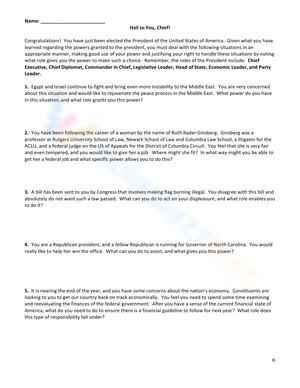
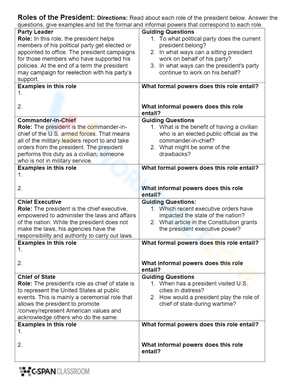
Roles of the President Worksheets for 8th Grade Civics Review
These 8th grade roles of the president worksheets give civics teachers a printable set of practice resources built around the six presidential roles that appear across most middle school government units. Each worksheet moves students past definition-copying — they match actions to roles, sort powers by constitutional versus informal authority, and identify which branch can check a given executive action. The set fits bell ringers, guided notes, station rotations, and short formative checks without requiring lesson redesign.
The Six Roles Students Need to Actually Distinguish
Most grade 8 civics units work from the same core list: chief executive, commander in chief, chief diplomat, legislative leader, economic leader, and head of state. The challenge is not covering the list — it is getting students to discriminate among roles when the actions look superficially similar. Students who can write a definition of commander in chief will still mark "directing the Department of Homeland Security's response to a domestic crisis" as a military role because the president is directing something. That is the gap these worksheets close.
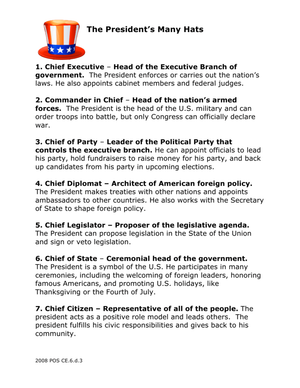
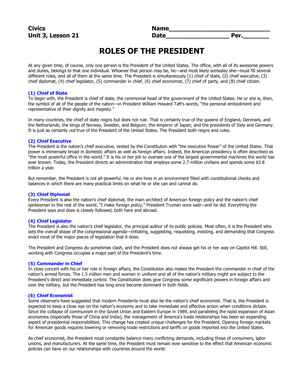
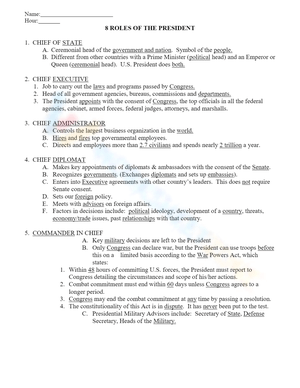
- Chief executive: leading the executive branch and enforcing laws passed by Congress — running agencies, overseeing cabinet departments, and carrying out federal policy.
- Commander in chief: directing the armed forces specifically, a role with a distinct constitutional anchor that sits apart from broader executive branch management.
- Chief diplomat: managing foreign affairs, negotiating treaties, and formally representing the country in international relationships.
- Legislative leader: signing or vetoing legislation, recommending bills to Congress, and using public influence to advance or oppose specific measures.
- Economic leader: shaping national economic priorities through budget proposals and public messaging — more an informal leadership function than a formal constitutional power.
- Head of state: performing ceremonial and symbolic duties that represent the country, including state dinners, national addresses, and official ceremonies.
Pairing each role with a specific action statement produces more usable knowledge than copying definitions. Students who can correctly separate "ordering an air strike" from "directing the EPA to enforce a regulation" have built the precision this unit requires.
Where Student Thinking Goes Wrong in a Presidential Roles Unit
The chief executive / commander in chief collapse is the most consistent error in this unit. Both involve the president directing an institution, so students treat them as interchangeable. Placing "ordering troops into a military operation" alongside "directing a federal agency to enforce a regulation" in the same worksheet — and requiring students to distinguish them — creates the productive friction that correction needs. Without that side-by-side comparison, many students carry the misconception through an entire unit and surface it only on the assessment.
A second pattern is assigning equal constitutional weight to every presidential action. Delivering the State of the Union, attending a foreign dignitary's state dinner, and vetoing a spending bill are not equivalent acts. The first is a statutory obligation, the second is ceremonial tradition, and the third is a formal constitutional power with a specific legislative remedy. Worksheets that ask students to mark each action as formal, informal, or symbolic train the triage thinking that transfers to open-response questions on unit tests.
Overstating presidential independence is the third consistent error. Students who know the president nominates federal judges may not know the Senate confirms them. Students who know the president can veto a bill may not know Congress can override that veto with a two-thirds majority in both chambers. Catching all three of these patterns before a unit assessment is exactly what 8th grade roles of the president worksheets are built to support — the format puts those pairings in front of students repeatedly rather than saving them for review day.
Constitutional Authority and Informal Leadership — The Distinction That Sharpens Discussion
Article II anchors the formal presidential powers, and students who understand that anchor answer civics questions with far more precision. When a worksheet prompt asks whether the president has constitutional authority to direct military operations or to unilaterally alter tax rates, students who have sorted powers by constitutional versus informal have a framework for the answer. Students who have only memorized role names reach for a label and stop there.
A two-column sorting approach works reliably here. One column holds constitutional powers: the veto, nominating officials and judges, treaty negotiation, command of the military. The other holds informal leadership functions: economic agenda-setting, ceremonial representation, bully pulpit communication. When students sort twelve to fifteen presidential actions this way, they begin to see that chief executive and commander in chief cluster toward the constitutional side, while economic leader and head of state sit mostly in the informal column. That pattern carries forward into checks-and-balances questions because students can already identify which presidential actions are subject to formal limits from another branch.
Working These Worksheets Into a Government Unit Efficiently
The most practical entry point is the bell ringer. Four action statements at the start of class — asking students to label each with a presidential role — takes under eight minutes and surfaces confusion before direct instruction begins. Pulling two or three student disagreements into a brief whole-class conversation before moving forward is faster than discovering the same confusion on a quiz. The 8th grade roles of the president worksheets support exactly that pattern: short tasks that yield immediate diagnostic information without displacing lesson content.
During a guided notes sequence, pausing after introducing Article II to sort six or eight actions by role gives students a consolidation moment between input cycles. Students who have to apply content once before receiving the next chunk arrive at the second half of notes with sharper questions — about edge cases and role overlaps rather than basic recall. For station rotations, three stations distribute the work usefully: one matching roles to actions, one connecting actions to possible checks from other branches, and one correcting planted student errors. Mixed formats across stations prevent surface-skimming. On review days, ask students to circle the operative verb in each prompt — sign, veto, nominate, negotiate, direct, represent — which forces careful reading before partner comparison.
Standard Alignment
These worksheets align with C3 Framework D2.Civ.1.6-8, which asks students to distinguish the powers and responsibilities of civic and political institutions, and D2.Civ.4.6-8, which focuses on explaining the powers and limits of the three federal branches. Both standards position checks and balances as central to middle school civics, which is why the strongest worksheet prompts ask students to name not only the presidential role but also the branch that can respond to or limit that action.
For teachers integrating social studies literacy, the worksheets connect to CCSS.ELA-LITERACY.RH.6-8.1. When prompts include a short executive order excerpt or a summary of a presidential address, students practice source-based reasoning — reading closely and citing textual evidence — skills built into most state social studies frameworks at the middle school level.
Matching Each Worksheet to Different Levels of Student Readiness
Students still building foundational knowledge benefit from a word bank of the six roles printed at the top of each worksheet. Reducing the retrieval demand keeps the focus on application — students still have to make the matching decision, but they are not stopped before they can even begin. A brief reference card with each role and one example action gives those students a model to compare against without doing the task for them.
Students who grasp the core roles quickly benefit from an added layer: after identifying the role, write one sentence explaining which branch could check that action and how. That sentence forces them to articulate the underlying civics logic rather than stopping at a label. Asking this group to also identify whether each power is constitutional or customary adds difficulty without changing the worksheet format — and it is a distinction they will encounter again in AP Government.
For English language learners, the short action-statement format is an asset. Concrete prompts are easier to parse than multi-sentence scenarios with embedded qualifications. Pairing each worksheet with a bilingual glossary of the six roles supports comprehension without altering the task itself. The core cognitive work — distinguishing roles, identifying checks — stays intact.
Frequently Asked Questions
Do these worksheets address all six presidential roles, or do they concentrate on a few?
The set addresses all six roles that appear in most grade 8 civics curricula: chief executive, commander in chief, chief diplomat, legislative leader, economic leader, and head of state. Each worksheet incorporates multiple roles within the same task so students practice discriminating among them rather than studying each in isolation.
What question formats appear across the set?
The worksheets include role-matching tasks, constitutional-versus-informal sorting, short written responses, and checks-and-balances pairing questions. That variety matters because it prevents students from pattern-matching their way through a task without reading carefully. Multiple choice alone does not show whether a student can explain why an action fits a given role or identify how another branch responds.
Can these be used alongside a textbook, or do they need to stand alone?
Either works. Teachers have used them alongside textbook chapters on the executive branch, as supplemental review after completing a unit, and as the primary practice resource in classrooms that rely on primary source documents rather than a textbook. Placement depends on what the lesson needs at that point in the unit.
How long does a typical worksheet take in class?
Most teachers report that a ten-item worksheet takes eight to twelve minutes when students work independently and five to seven minutes with a partner. That timing makes the 8th grade roles of the president worksheets practical as bell ringers, mid-lesson checks, or exit activities without crowding out direct instruction. They also work as pre-assessment at the start of a unit to establish what students already know before instruction begins.
Clear All