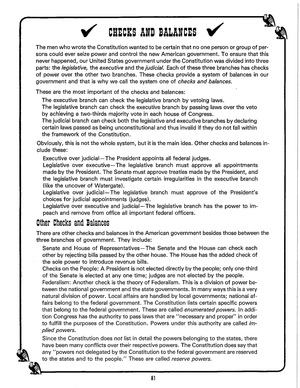
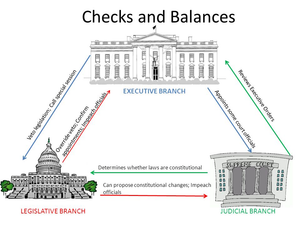
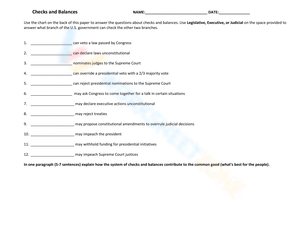
These 8th grade checks and balances printable worksheets give civics teachers a structured route into one of the Constitution's most tested design principles — the system each branch uses to limit the others. Each worksheet moves students through a clear sequence: identify branch roles, connect each role to a specific constitutional power, then explain how that power serves as a check. That third step is where real understanding surfaces, and where matching-only practice consistently falls short.
What's Inside the Set
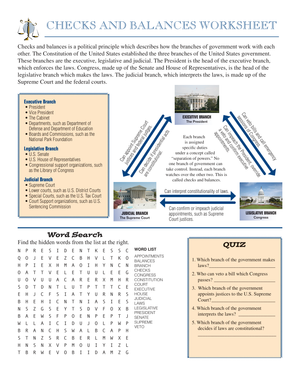
The worksheets begin with branch identification, not because 8th graders haven't encountered the three branches before, but because checks and balances only holds together once students can place legislative, executive, and judicial authority precisely. From that baseline, the tasks increase in demand:
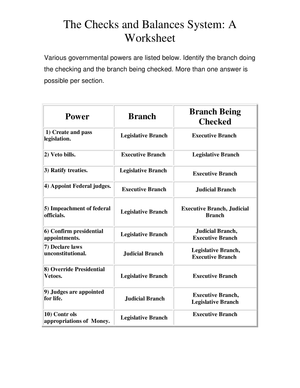
- Sort constitutional powers into the correct branch
- Match specific government actions to the check they represent
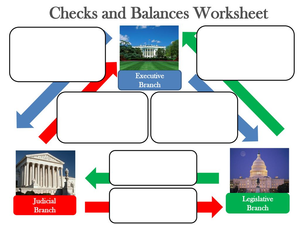
- Label short scenarios — identify which branch is acting and which is being checked
- Write one sentence explaining the purpose of each check
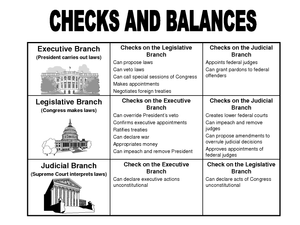
One worksheet focuses on the four examples that appear most reliably in 8th grade assessment: presidential veto, Senate confirmation of appointments, congressional impeachment, and judicial review. Each is presented as a two-step task — students name the branches involved, then write one sentence explaining why the check exists. Students can score correctly on matching items while holding an imprecise understanding of why the limit matters; the written sentence forces that gap into the open.
A direct comparison task between separation of powers and checks and balances rounds out the set. Students consistently collapse those two concepts into a single idea. Separation of powers divides authority among the three branches. Checks and balances describes what those branches do with that division to prevent any one from dominating. A written comparison task gives students a clear anchor before they encounter the distinction under test conditions.
Mistakes Students Make That These Worksheets Help You Catch
The most persistent error at this level is not confusing the branches with each other — it is confusing roles with relationships. A student who correctly labels "legislative, executive, judicial" will still write "the president can pass laws if Congress approves" when explaining a veto. That is a relationship error: the student has not fully built the distinction between making a law and signing or rejecting one. When that error appears on an 8th grade checks and balances printable worksheets scenario item, it is visible and correctable. The task requires three separate moves — name the action, name the acting branch, name the branch being checked — which makes the gap impossible to conceal behind a correct label.
A second pattern: students write that "the branches check each other because powers are separated," collapsing both concepts into one. The distinction worth pressing is straightforward — separation of powers is the arrangement; checks and balances is what makes that arrangement function under real governmental pressure. Teachers who catch this conflation early can use it as a discussion prompt before students tackle the written explanation items, preventing the same error from reappearing in unit assessment responses.
How to Work These Worksheets Into Your Unit Plan
In a constitutional design unit, these resources slot naturally at two points. The first is directly after branch-roles instruction, when students need a processing task before the concept of mutual limits is introduced. A matching worksheet at that stage consolidates fresh content and reveals gaps before new material arrives. The second is mid-unit review, when students are ready for scenario analysis and short written explanations.
For station-based classrooms, one worksheet runs as a silent independent task while another becomes a discussion prompt for partners. For test prep, the scenario worksheet works as a timed fifteen-minute practice — assign it, debrief as a class, then isolate the two or three items where the most errors landed and reteach those specifically. The day before a unit exam is not the moment for another full-period lecture; it is the moment for a focused printable and a class debrief built around the items students actually missed.
One teacher move that transfers across both contexts: before collecting a completed worksheet, ask students to circle the one item they are least confident about. That self-report takes under a minute and gives a faster read on where reteaching is needed than scanning twenty-five papers individually.
Standard Alignment
These worksheets align to the C3 Framework for Social Studies State Standards, specifically D2.Civ.5.6-8, which asks students to explain the origins, functions, and structure of government with reference to the U.S. and state constitutions, and D2.Civ.8.6-8, which calls for analyzing principles in the founding documents and explaining how those principles shape the political system. In classroom terms, those standards push branch instruction past identification — students are expected to connect constitutional design choices to how the government actually operates, which is exactly what the written explanation prompts in these worksheets require. The response items directly reflect the C3 emphasis on explaining, not merely naming.
Differentiating the Set Across Readiness Levels
For students still building confidence with branch roles, the identification and matching worksheets provide a lower-stakes entry point. They can sort constitutional powers without yet needing to explain the check in writing. Once they are solid on placement, they move into the scenario items, which require a complete sentence of justification. That progression — recall first, then application — gives every student a place to start without lowering the expectation for where they should arrive by the end of the unit.
With 8th grade checks and balances printable worksheets, teachers can maintain the same content across readiness groups by varying the response demand rather than replacing the worksheet. A student who needs more structure works with a sentence frame: The ___ branch checks the ___ branch by ___ing ___. A student ready for a higher demand completes the same scenario without the frame, then adds a second sentence connecting the check to the framers' concern about concentrated power. That second sentence is a meaningful stretch for students moving toward constitutional reasoning rather than just constitutional recall. Peer explanation works here as well — students often solidify their own thinking by walking a partner through one example aloud before writing the answer down.
Frequently Asked Questions
What should 8th graders be able to do with the concept of checks and balances?
By the end of 8th grade, students should move past the definition and into application. That means naming the three branches, identifying each branch's constitutional role, and explaining how one branch limits another using a specific example — not just recognizing "checks and balances" as a vocabulary term. The four examples worth anchoring instruction to: presidential veto, Senate confirmation, congressional impeachment, and judicial review of legislation.
How do you explain the difference between separation of powers and checks and balances?
Separation of powers is the arrangement — authority is divided among three branches so no single institution holds all of it. Checks and balances is what the arrangement does in practice — each branch has specific tools to limit the others. The clearest classroom anchor: separation of powers is the structure; checks and balances is the action inside that structure. Students need both ideas clearly distinguished before they can write about either one accurately on an assessment.
What's a practical way to introduce checks and balances using concrete examples?
Start with one action and two questions: which branch is acting, and which branch is being checked? A presidential veto answers both clearly — Congress passes, the president rejects. Senate confirmation of a federal judge adds a second angle — executive appointment, legislative approval required. Running three or four examples in quick succession before any written practice gives students enough pattern recognition to work through worksheet scenarios independently.
How should teachers use these worksheets differently for review versus test prep?
For same-week content review, the matching and identification worksheets from the 8th grade checks and balances printable worksheets set work best — students process what was recently taught and surface gaps before the next lesson moves forward. For test prep, shift to the scenario and explanation worksheets, which require students to read a short government action, identify the check, and explain the purpose in writing. That written justification is where misconceptions appear most clearly, and it mirrors the kind of short-answer response students encounter on most 8th grade civics assessments.












 Interactive Worksheet Maker
 Quiz Maker
 Word Search Maker
 Crossword Puzzle Maker
 Word Scramble Generator
 Sentence Scramble Generator
 Handwriting Worksheet Generator
 Name Tracing Generator
 Fill In The Blank Generator




 BACK TOSCHOOL