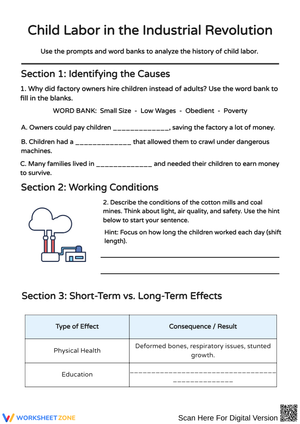
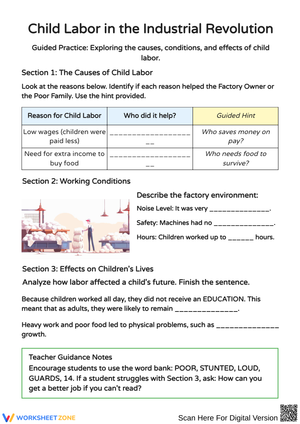
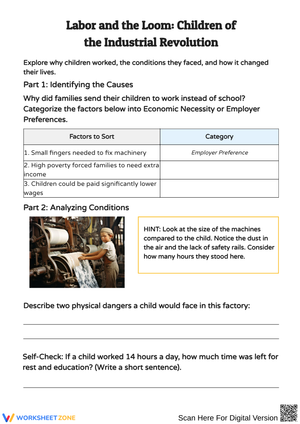
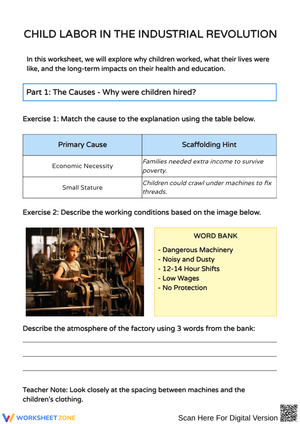
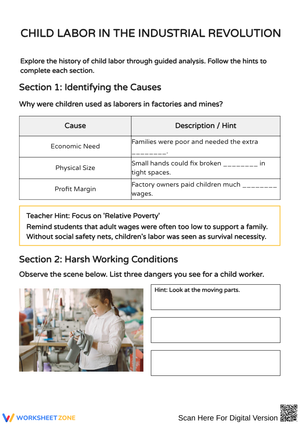
These child labor during the industrial revolution worksheets for 8th grade give teachers a structured path from the economic causes of industrial-era child labor through primary-source analysis and evidence-based writing — all in formats that work for direct instruction, station rotations, or independent practice. Each worksheet stands alone, so teachers can assign the full set sequentially or pull individual pieces to fit what a lesson actually needs.
What's Inside the Set
The worksheets cover child labor during the industrial revolution from multiple angles rather than asking students to absorb it as a single grim fact. One worksheet provides a background reading with cause-and-effect annotation tasks — students mark causes of child labor expansion in one color and downstream effects in another, which makes the underlying economic logic visible before any discussion begins. A second targets vocabulary in context: industrialization, wages, labor reform, compulsory education, factory system. Students encounter these terms inside sentences drawn from historical materials, not in isolation.
Two worksheets focus on primary-source analysis. One builds a structured Lewis Hine photograph task — students work through observation, inference, and sourcing in sequence, including a question about why a photograph moved public opinion differently than written testimony did. The other pairs a brief factory rules excerpt with a short reformer quote, asking students to compare what each document assumes about children, work, and risk. A final worksheet presents a DBQ-style prompt — Was child labor during the industrial revolution driven primarily by poverty, industrial demand, or the choices of factory owners? — with a pre-writing ranking step built in before the written response.
How to Work These Worksheets Into Your Planning
A two-day sequence works well for most 8th grade classes. On day one, open with the background reading and annotation task — about 15 minutes — then move directly into the photograph analysis worksheet. If time allows, end with a brief discussion of what the photograph does that a written description cannot. On day two, students complete the document comparison worksheet as partner work, then move to the DBQ response individually. The ranking step takes about five minutes and pays off immediately in paragraph quality.
For a compressed schedule, the photograph analysis worksheet functions as a strong 10-minute bell-ringer. Three observation questions and one written claim fit the time before morning announcements or the last few minutes before dismissal without feeling rushed. For teachers running stations, the five worksheets map cleanly onto five rotations: vocabulary, background reading, photograph analysis, document comparison, and written response.
This topic drops naturally into a larger industrialization or Progressive Era unit. After students have studied factory conditions and urban growth in general terms, the child labor worksheets give them a specific, human-scale case to examine. The reform thread — how reformers built a public argument using evidence — connects directly to civics work on how law changes and who drives that change.
Adjusting the Worksheets for a Mixed-Ability Classroom
The background reading worksheet includes annotation directions that can be simplified for students who need more structure — rather than choosing their own colors for causes and effects, you can pre-label the first two examples so students have a model before working independently. For students who finish early, the document comparison worksheet has a natural extension: ask them to write a third source they wish existed and explain what historical question it would answer. That question tends to generate more sophisticated historical thinking than adding more response length.
For students who struggle with the open DBQ prompt, breaking the ranking into a forced-choice format first helps — present poverty, industrial demand, and factory owner decisions as three cards to physically order before writing. Students who freeze at a blank prompt often move confidently once they have committed to a sequence. On the other end, students ready for more challenge can be asked to argue that all three causes were structurally linked rather than independent, which requires a different kind of claim than ranking allows.
Frequently Asked Questions
What jobs did children actually perform during this period?
In textile mills, children cleaned beneath running machinery and rethreaded bobbins — tasks that put them close to moving equipment for hours at a stretch. In coal mines, they worked as trappers (operating ventilation doors in dark tunnels) or pushed coal carts through shafts too low for adults. Urban children worked as chimney sweeps, newsboys, and street vendors. These distinctions matter for the worksheets because students can connect specific job types to specific hazards rather than treating "dangerous conditions" as a single undifferentiated idea.
Why did families send children to work rather than resist it?
Household economics in industrial cities left little margin. A father's mill wage frequently did not cover rent, food, and fuel together. Children's wages — even when lower than adults' — made the difference between stability and debt. Reformers understood this, which is why serious labor reform eventually included compulsory education and adult wage legislation together rather than treating child labor as a separate problem.
How should I handle the more upsetting content for 8th graders?
Keep the analytical frame on systems and decisions rather than physical suffering. The worksheets are written to ask why child labor expanded and how it changed — economic and civic questions — not to document injury in detail. Lewis Hine's photographs are effective precisely because they show children in their work context without graphic content, and the structured observation questions direct student attention toward evidence rather than emotion.
Can these worksheets serve as an assessment rather than practice?
The DBQ response worksheet works as a formative assessment for historical argumentation. It generates a written claim with evidence that shows clearly whether students can explain causes at a systemic level or whether they are still describing events without interpretation. The photograph analysis and document comparison worksheets are better used as practice, since their scaffolding reduces the demand level for independent assessment purposes.












 Interactive Worksheet Maker
 Quiz Maker
 Word Search Maker
 Crossword Puzzle Maker
 Word Scramble Generator
 Sentence Scramble Generator
 Handwriting Worksheet Generator
 Name Tracing Generator
 Fill In The Blank Generator




 BACK TOSCHOOL