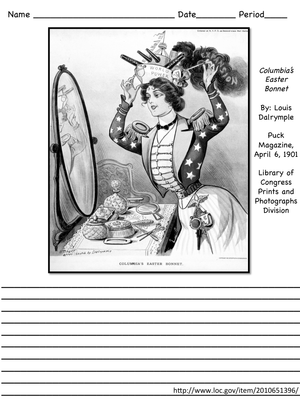
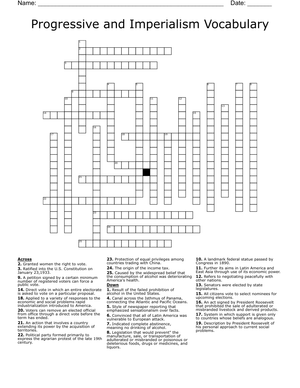
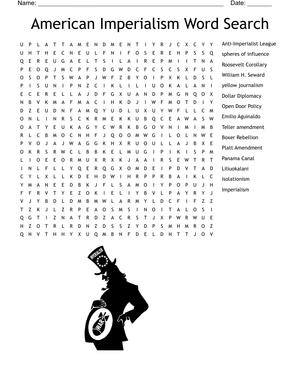
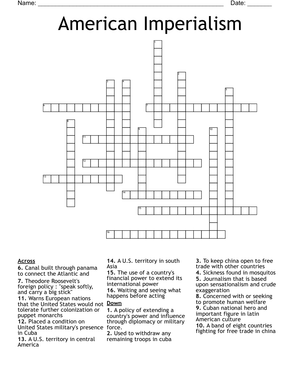
These 8th grade american imperialism printable worksheets give teachers a concrete way to handle one of the more conceptually demanding turns in the grade 8 US history sequence — the moment when the United States stops expanding across the continent and starts extending military and political control overseas. Each worksheet targets a distinct piece of the unit: cause-and-effect reasoning about the road to war in 1898, map work on territories transferred through the Treaty of Paris, vocabulary practice for terms students routinely confuse, political cartoon analysis, and short evidence-based writing about competing arguments over annexation. The set requires no prep beyond copying and works across whole-group instruction, station rotations, and independent review.
Historical Thinking Skills in Each Worksheet
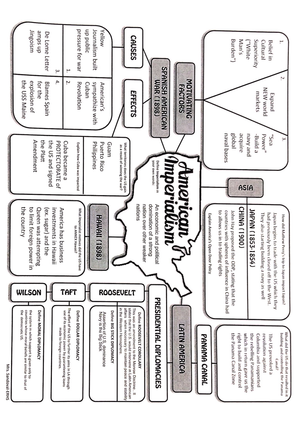
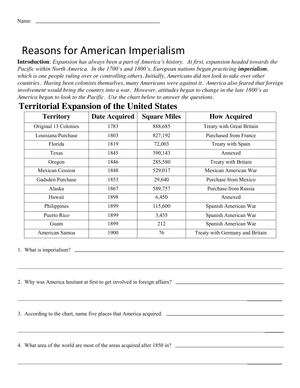
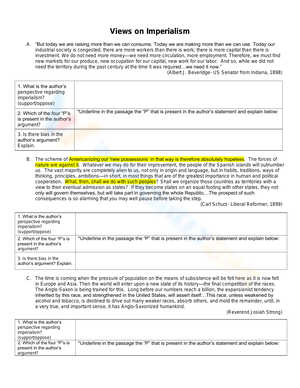
The skills targeted here go beyond identifying facts. Students underline evidence in primary source excerpts, annotate political cartoons to identify persuasive techniques, sort pro-annexation and anti-imperialist arguments into a comparison chart, and rewrite vague claims as supported historical statements. A cause-and-effect organizer asks students to trace the chain from yellow journalism and the USS Maine explosion through public pressure to the declaration of war — which forces them to distinguish contributing causes from immediate triggers, a distinction that resurfaces when they study the Philippine conflict. Map worksheets ask students to label Cuba, Puerto Rico, Guam, and the Philippines and then explain in writing what the geographic spread of those territories reveals about what the United States was building in 1898.
The 8th grade american imperialism printable worksheets in this set distribute vocabulary instruction across multiple worksheets rather than front-loading every term in one concentrated activity. That placement matters. When students encounter annexation for the first time inside a cause-and-effect chart rather than a glossary box, they see immediately why the word carries weight — not as a definition to copy but as a decision that divided Americans sharply.
Separating the Spanish-American War from What Came After
The most consequential instructional choice in this unit is whether the lesson stops at the Treaty of Paris or continues into the Philippine-American War. Most students — and some instructional materials — treat 1898 as the end of the story: the United States defeated Spain, gained territories, and became a world power. That summary is factually incomplete and historically misleading. The Philippine conflict that followed demonstrated that controlling a territory and governing its people were entirely different problems, and that many Filipinos were unwilling to trade Spanish rule for American rule without resistance.
Using separate worksheets for each conflict makes this distinction visible without requiring a long lecture. When students complete a Spanish-American War cause-and-effect chart and then pick up a separate worksheet focused on the Philippines, the structural break itself signals: something changed. Ask them to name what changed, and the historical reasoning starts immediately. Many eighth graders are genuinely surprised to learn the fighting continued well after the peace treaty, and that surprise is a productive entry point for the harder question — what the United States actually did versus what it said it was doing in the Pacific.
How to Build These Worksheets Into a Full Lesson Cycle
A 50-minute class moves well with this structure: open with a bell ringer asking students to define "world power" in their own words before any instruction, run a brief teacher overview of 1898 and the Treaty of Paris (10 to 12 minutes), then transition students into two printable tasks — a map or timeline worksheet followed by a primary source analysis. Close with a three-sentence exit ticket asking whether imperialism strengthened or contradicted American democratic ideals. That closing question reappears productively on review days and short constructed response assessments.
For homework, the 8th grade american imperialism printable worksheets that include short written responses work better than long reading passages — students return to class the next day with something to say rather than something they skimmed. These worksheets also make strong sub plans because each task includes enough context for students to work without the teacher present. The vocabulary and map worksheets function well as independent tasks; the comparison chart and source analysis worksheets are better suited to partner work or a small teacher-led group.
Student Errors Worth Anticipating Before the Unit Starts
The most common factual error in student work is treating the explosion of the USS Maine as a confirmed Spanish attack. Students write confidently that "Spain blew up our ship" — often because early instructional materials imply it without clarifying that the cause was never proven. The cause-and-effect worksheets address this directly by asking students to distinguish between what newspapers claimed and what was actually established, which also connects naturally to the yellow journalism lesson.
A subtler problem: students who can define yellow journalism as a concept still cannot identify it reliably in an actual headline. They label a source "biased" without explaining what specific word choice or claim makes it propaganda rather than reporting. The political cartoon and headline analysis worksheets build that more precise skill by asking students to circle the specific language that signals exaggeration or intent to provoke — work that transfers directly to DBQ and short-response formats students encounter in high school history.
Students also tend to read anti-imperialist arguments as obviously correct by current standards, which collapses what was genuinely a contested debate in 1898. Helping them understand why many Americans supported expansion — naval positioning, trade access, national prestige — makes the unit historically honest and gives students something real to argue about rather than a predetermined answer to confirm.
Standard Alignment
These worksheets align with C3 Framework standard D2.His.14.6-8, which asks students to explain multiple causes and effects of events and developments in the past. The cause-and-effect organizers and comparison charts address that standard directly by requiring students to move between evidence and explanation rather than simply listing events in sequence. The set also supports CCSS.ELA-LITERACY.RH.6-8.6, which asks students to identify aspects of a text that reveal an author's point of view or purpose — precisely what students practice when they annotate political cartoons and compare a newspaper headline against a primary source speech. Both standards place this content squarely in the grade 8 disciplinary literacy sequence, where historical thinking and text analysis are taught together rather than treated as separate skills.
Frequently Asked Questions
How should I sequence these worksheets across a multi-day unit?
Start with vocabulary and map work on the first day to build factual grounding. Move to the cause-and-effect and timeline worksheets on day two, once students can locate the territories and place key events in order. Use primary source analysis and the comparison chart — pro-annexation arguments set against anti-imperialist responses — later in the week when students have enough context to evaluate competing claims. The Philippine conflict worksheet fits best after students have already processed the Spanish-American War, so the contrast reads as a meaningful shift rather than more of the same content.
Can these worksheets function as formative assessments?
Yes, and several are particularly useful that way. The exit ticket format — a three-sentence response to a focused historical question — tells teachers immediately which students can make and support a claim and which students are still cataloging isolated facts. The 8th grade american imperialism printable worksheets that include short constructed responses give teachers written evidence of student reasoning before any formal summative assessment, which makes reteaching decisions considerably easier to act on.
How do I use these with students who find the reading level difficult?
The most useful adjustment is pairing a vocabulary worksheet with a source analysis worksheet so students have working definitions before they encounter a primary source excerpt. Word banks and labeled diagrams within each worksheet reduce the cognitive demand of unfamiliar terminology without lowering the level of historical thinking expected. For students who need more structured support, the comparison chart format — where the question and categories are already defined — lets them focus on finding and recording evidence rather than simultaneously managing the organizational challenge of an open-ended writing task.
What makes a printed yellow journalism analysis task more useful than discussing it as a class?
Discussion alone does not give teachers evidence of individual understanding. A printed analysis task where students annotate a specific headline or cartoon, circle the persuasive language, and write a sentence explaining its likely effect on public opinion produces something teachers can actually examine. It also ensures every student engages with the source rather than letting a few voices carry the conversation — a practical difference that matters in any class with a wide range of reading confidence.












 Interactive Worksheet Maker
 Quiz Maker
 Word Search Maker
 Crossword Puzzle Maker
 Word Scramble Generator
 Sentence Scramble Generator
 Handwriting Worksheet Generator
 Name Tracing Generator
 Fill In The Blank Generator




 BACK TOSCHOOL