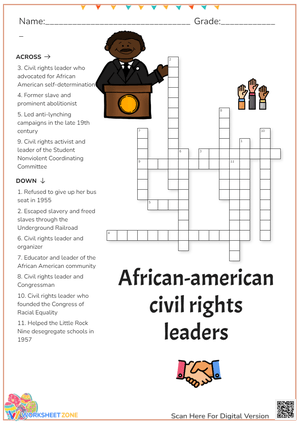
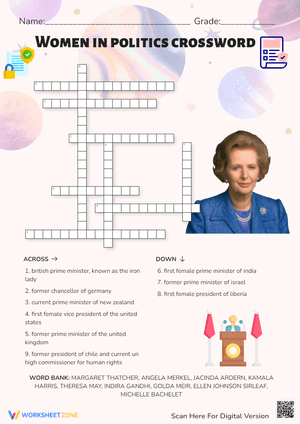
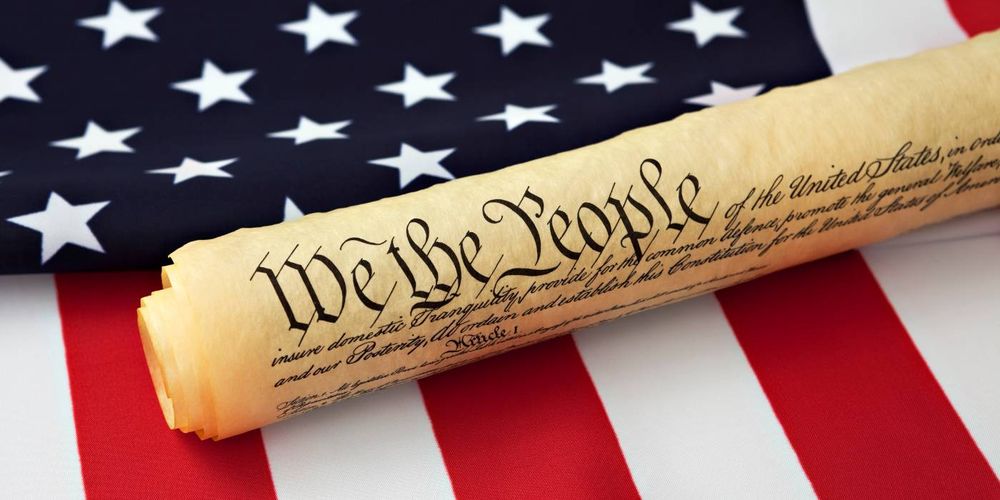
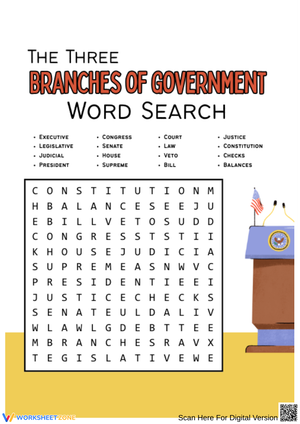
Teachers reaching for civics and government printable worksheets for 8th grade are usually mid-unit — building a Constitution review, prepping a sub plan, or looking for a station activity that holds students accountable without requiring live instruction. This set covers the core civics content that comes back repeatedly at this level: constitutional structure, branch roles and limits, checks and balances, federalism, amendments, and citizen participation.
What Each Worksheet Builds
Grade 8 is where students stop treating civics as a vocabulary list and start working with it as a system. The Constitution is not just a document to memorize — it is a framework that organizes power, limits government action, and describes how citizens take part in public decisions. Each worksheet in the set targets one area of that system while still pointing back to the whole.
- Constitutional principles: purposes, structure, and core ideas including limited government, popular sovereignty, and separation of powers — with tasks that ask students to apply the principle rather than repeat the definition.
- Three branches: powers specific to the legislative, executive, and judicial branches, including scenarios where students identify which branch acts and why.
- Checks and balances: short situations — a presidential veto, a Senate confirmation, a court ruling — where students name the check, identify the branch exerting it, and explain the limit it places on the others.
- Federalism: shared, delegated, and reserved powers, with comparison tasks that ask students to distinguish national and state authority in concrete cases.
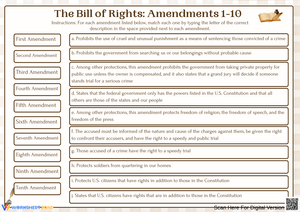
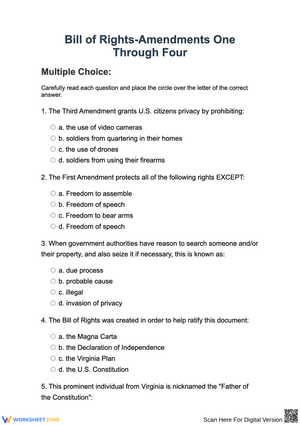
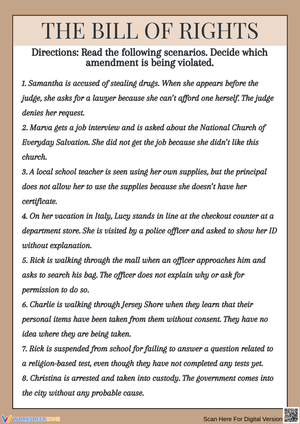
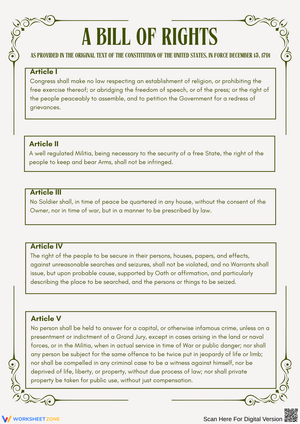
- Rights and amendments: Bill of Rights protections, civil liberties, and how specific amendments modify constitutional authority over time.
- Civic participation: voting, advocacy, petitioning, and community action as practical expressions of constitutional rights and responsibilities.
A useful internal rule for raising rigor at this level: keep roughly one-third of items application-based. If a worksheet includes twelve questions, four of them should ask students to classify a scenario, defend a position, or explain how a principle operates in a real case — not just recall its name. That ratio keeps printable practice from slipping entirely into low-level recall.
Errors Students Make That These Worksheets Help You Catch
Two persistent misconceptions show up in Grade 8 civics work more reliably than others. First, students routinely confuse delegated and reserved powers, often writing that the Tenth Amendment means states can pass any law they want. They miss the modifier: states hold the powers not granted to the federal government and not prohibited to the states — a distinction that changes how they read federalism questions entirely. Second, students can tell you that Congress makes laws but cannot explain why the president cannot simply issue one instead. They have the label without the structural logic, which means they cannot reason through a scenario that tests separation of powers at the action level.
A third pattern is subtler but just as consistent. Students who correctly label a veto as an executive power will describe it as the president "stopping a law" rather than returning a bill to Congress. That framing misses the entire mechanism: the president does not kill legislation — Congress can still override. Any question about how checks and balances constrain power in practice will expose this gap. Each worksheet that addresses the veto traces the full sequence rather than stopping at the name of the action, which pushes students past the surface-level understanding that most of them carry in.
Building These Worksheets Into Your Weekly Lesson Plan
Civics and government printable worksheets for 8th grade do their most useful work when they have a clear job in the lesson sequence — not as the lesson itself, but as the practice layer that keeps instruction focused. During a Monday warm-up after a long weekend, a short matching worksheet on branch powers takes five to seven minutes and reactivates prior content before the new lesson starts. During a station rotation on amendments, a reading-response worksheet gives students a structured task to work through without needing teacher proximity at every seat.
For sub plans, the most reliable format is a reading passage followed by response questions, because the directions stay self-contained and the completed worksheet shows exactly what students did. That format works especially well for Constitution or federalism content where a short primary source excerpt — even one sentence from the Preamble or the Tenth Amendment — anchors the questions and reduces ambiguity for students working without direct teacher support.
Formative use is often the most actionable part of working with these worksheets. Scanning a class set for the same wrong answer — students placing the power to declare war in the executive branch rather than Congress — reveals a specific gap that can be addressed in five minutes the next day before moving forward. That is a more useful planning signal than a completion grade.
Standard Alignment
The C3 Framework for Social Studies State Standards organizes Grade 6–8 civics expectations around several related indicators. D2.Civ.1.6-8 asks students to distinguish the powers and responsibilities of local, state, and national institutions. D2.Civ.4.6-8 asks them to explain the powers and limits of the three branches and the role of public officials at different levels of government. D2.Civ.6.6-8 addresses civic participation and how individuals and groups take action to influence public decisions.
These indicators sit at the application and analysis level — students are not just identifying branches but explaining their limits, not just listing rights but connecting them to constitutional authority. Worksheets built around short scenarios, branch comparisons, and written explanation tasks fit those expectations more directly than matching-only formats. Because D2.Civ indicators also expect students to construct arguments with evidence, the set includes short writing prompts alongside structured recall items so teachers have something to assess beyond identification.
Adjusting the Set for a Range of Learners
For students who need additional support, the most practical adjustment is to provide partial structure before independent work begins. On a checks and balances worksheet, that might mean prefilling the branch column and asking students to write only the explanation, rather than identifying both the branch and the rationale. On a federalism comparison task, a teacher can place two or three examples in the correct category in advance so students have a reference anchor before classifying the remaining items on their own.
Students ready for extension can move past identification toward evaluation. Instead of naming which branch holds a specific power, they write a short paragraph defending why that placement makes constitutional sense — or argue whether a particular check is effective in practice. That shift uses the same worksheet content but changes the cognitive demand from recognition to reasoned judgment. Civics and government printable worksheets for 8th grade that include a short writing component are especially easy to extend this way, since the prompt can be tightened or opened without altering the underlying civics content the class is studying.
Frequently Asked Questions
Can these worksheets serve as formative assessment tools rather than just practice?
Yes, and that is often their most productive use. A worksheet with four or five items and one application question at the end gives teachers a quick read on whether students can use a concept — not just name it. Scanning a class set for the same wrong answer takes about three minutes and produces clearer reteach targets than a verbal exit check at the door.
What formats hold up best for 8th grade civics sub plans?
Reading response worksheets — a short adapted passage or primary source excerpt followed by structured questions — give substitute teachers the clearest direction and give students a concrete task with a defined endpoint. Graphic organizers comparing branches or summarizing amendments also work well because the format shows students where to put information without requiring verbal explanation. Avoid open-ended writing-only tasks for sub days unless the directions are unusually complete and specific.
How many worksheets per unit do teachers typically find useful?
Most teachers find three to five worksheets per unit covers the range of classroom jobs: a warm-up or bell ringer, a guided practice task during instruction, a review or reteach resource for students who need it, and a formative check at the close of the unit. Adding a vocabulary worksheet for homework or substitute use rounds out the set. The goal is a few repeatable formats applied across different civics topics — not a different structure for every day of the unit.
Do these worksheets transfer to intervention or enrichment work outside of regular class time?
Civics and government printable worksheets for 8th grade with structured formats — matching tasks, organizers, short-answer prompts — travel well to intervention blocks and tutoring sessions because they do not depend on a specific class discussion to make sense. A student can pick up a branch comparison worksheet or a federalism sorting task without needing the previous day's lesson as background, which makes them practical for pull-out support, homework completion, or afterschool programs.












 Interactive Worksheet Maker
 Quiz Maker
 Word Search Maker
 Crossword Puzzle Maker
 Word Scramble Generator
 Sentence Scramble Generator
 Handwriting Worksheet Generator
 Name Tracing Generator
 Fill In The Blank Generator




 BACK TOSCHOOL