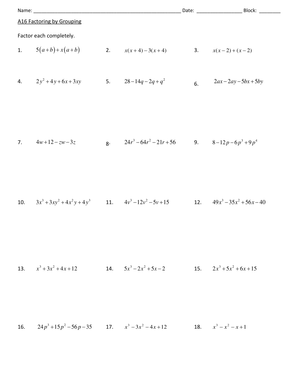
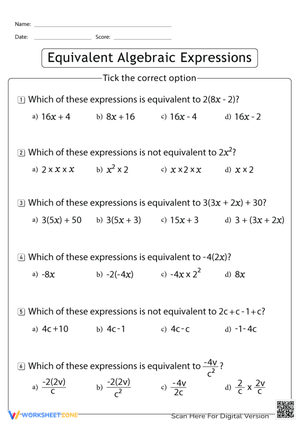
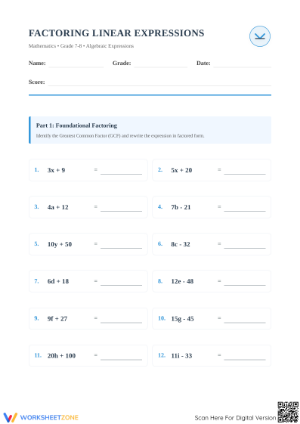
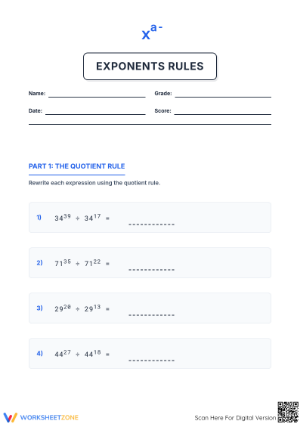
These expressions pdf worksheets for 8th grade cover the cluster of algebraic expression skills that separates students who move confidently into equation work from those who stall — evaluating expressions with integer substitution, combining like terms across multi-variable expressions, applying the distributive property with negative coefficients, and reading and computing integer exponents. The set gives teachers ready-to-assign practice organized by skill, with enough problem variety that student errors surface clearly rather than hiding behind repetitive arithmetic. Answer keys accompany each worksheet, which matters most when the goal is quick, usable feedback inside a 45-minute class.
The Core Algebraic Skills in This Set
Grade 8 expression practice covers a narrower range than the word "algebra" implies, but the skills within that range carry real cognitive weight. The worksheets address six specific moves students need under control before equation solving becomes the main event:
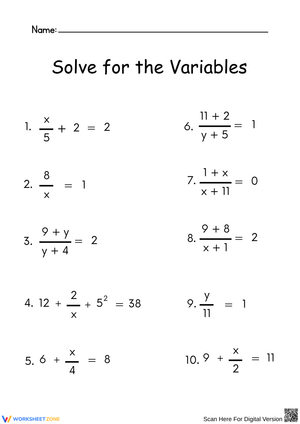
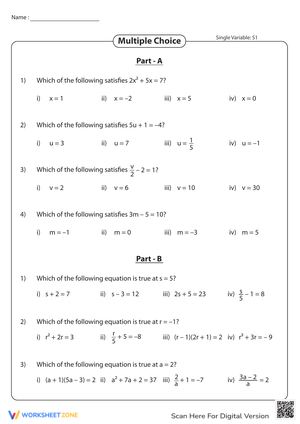
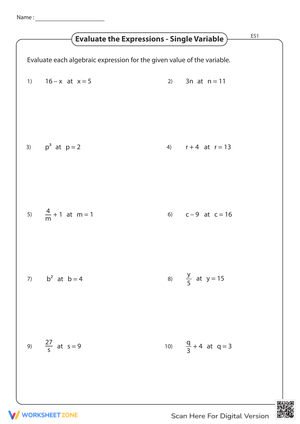
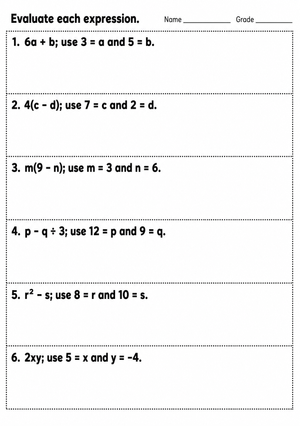
- Substitution and order of operations: replacing variables with positive and negative integer values, then evaluating accurately — including expressions with grouped terms and multiple variables
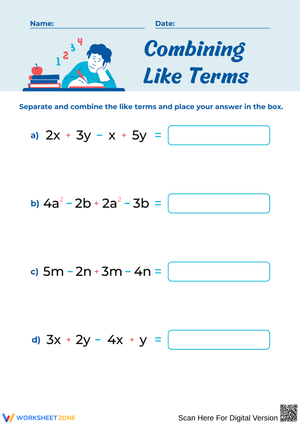
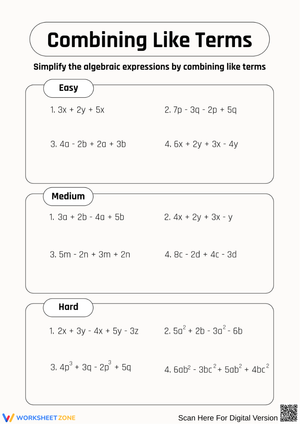
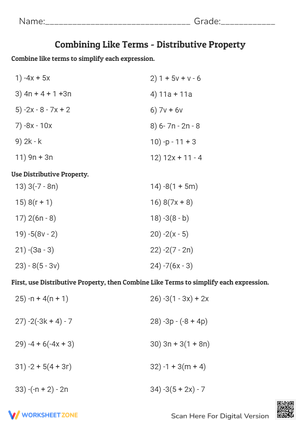
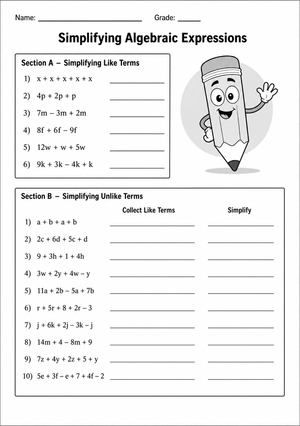
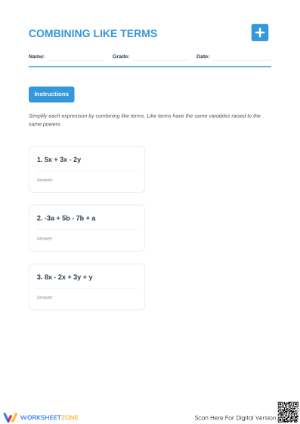
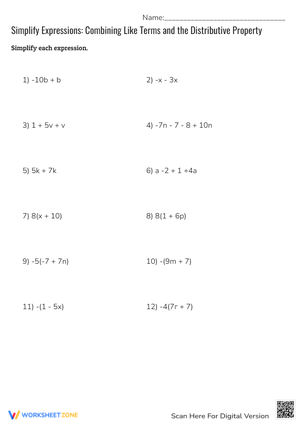
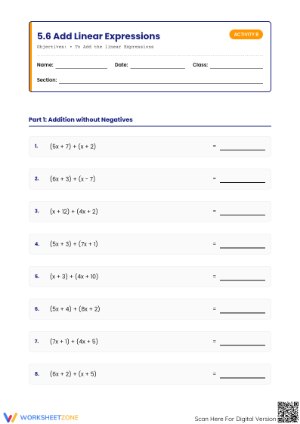
- Combining like terms: identifying terms that share the same variable part and simplifying correctly, including cases where a term carries an implied coefficient of 1 or -1
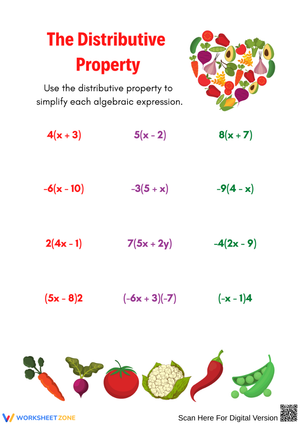
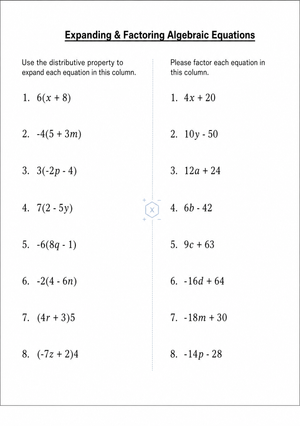
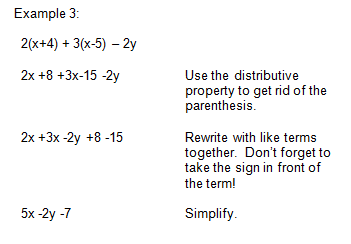
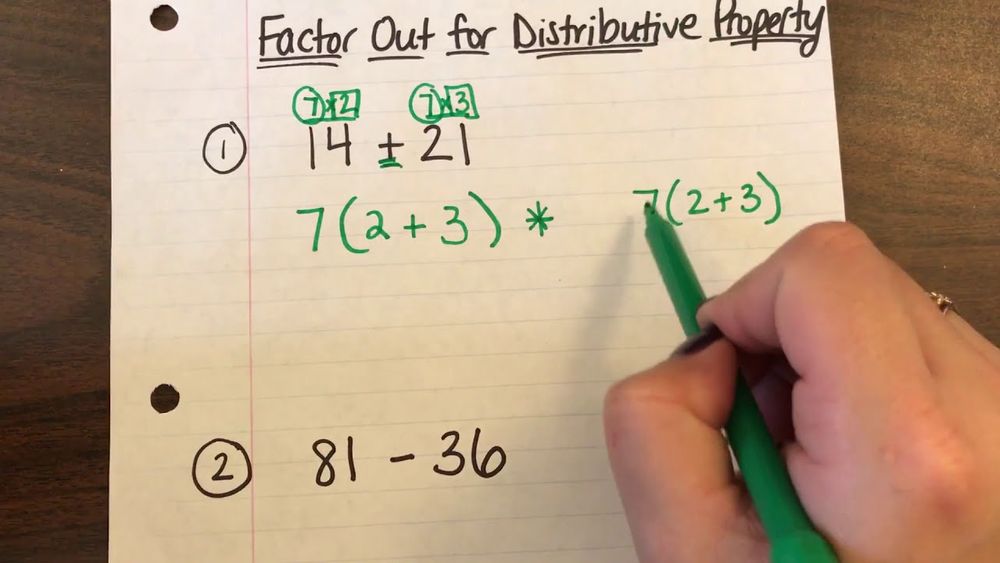
- Distribution with negative factors: expanding expressions where a negative coefficient distributes across subtraction — the exact context where sign errors cluster in student work
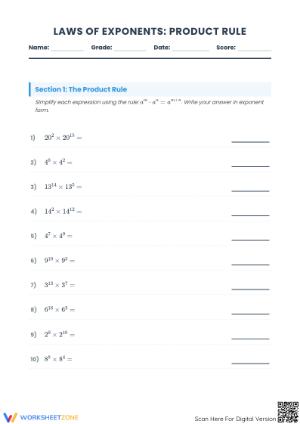
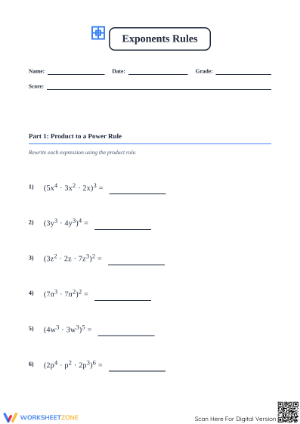
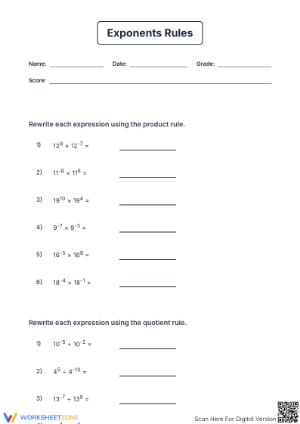
- Integer exponents: evaluating expressions with positive, negative, and zero exponents, skills that CCSS places at Grade 8 specifically because they require structural reasoning rather than straightforward calculation
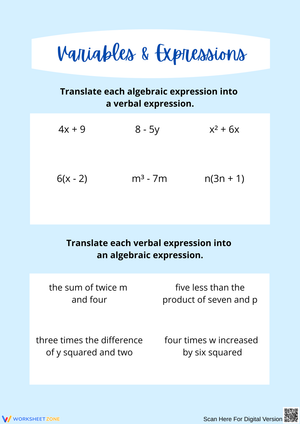
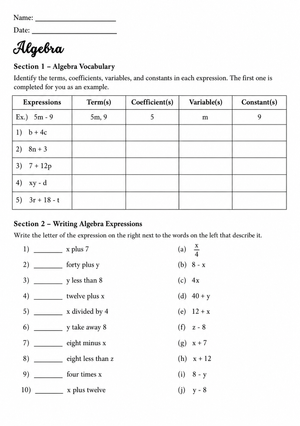
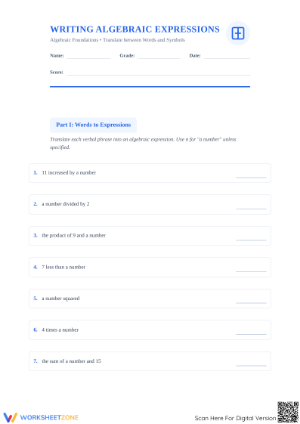
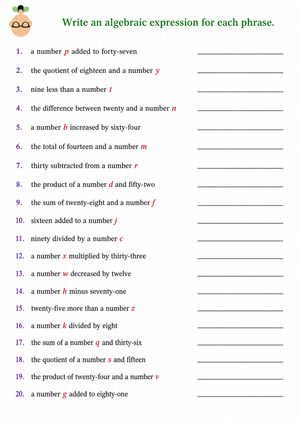
- Translating verbal phrases: writing algebraic expressions from word phrases and short situational contexts, attending to how order and operation words map to symbolic notation
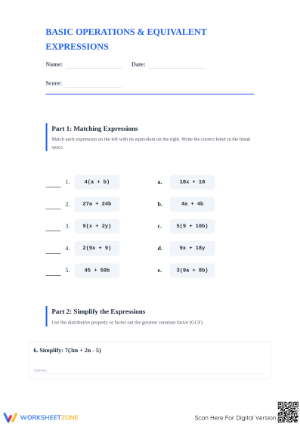
- Multi-step simplification: distributing and then combining like terms in sequence, which requires students to track two moves without collapsing or skipping either one
These six skills are not parallel in difficulty. Combining like terms with positive integer coefficients is a 6th-grade standard that Grade 8 reinforces; fluency with negative exponents and multi-step distribution is genuinely new territory for most 8th graders. Teachers who recognize that range assign the set strategically — using simpler worksheets for reteach and the multi-step and exponent worksheets for on-grade-level and advanced practice.
Mistakes Students Make That These Worksheets Help You Catch
The error that appears most consistently in 8th-grade expression work is sign error during distribution. Students who correctly expand 3(x + 4) as 3x + 12 will still write -(2x - 5) as -2x - 5, treating the subtraction inside the parentheses as unaffected by the negative factor outside. This is not carelessness — it reflects a real gap in understanding what the negative distributes to. The worksheets include enough distribution-over-subtraction problems that this pattern becomes visible quickly, before it gets reinforced through uncorrected practice.
A second consistent pattern involves substitution with negative values and exponents together. When students evaluate -x² for x = -3, many write -(-3)² and then disagree with themselves about whether the answer is -9 or 9 depending on which negative they process first. The correct answer is -9, but seeing students produce 9 — or, occasionally, an incorrect result from a misread of how the exponent applies — is not unusual. This error points specifically to a notation problem: students are uncertain whether the leading negative sign belongs to the base or operates separately on the result. That is a different gap from a multiplication error, and it warrants a different response from the teacher.
A third error is subtler: students will group 4x and 4y as like terms because they share the same coefficient. This is the mirror image of the usual mistake. Instead of combining different variable terms by ignoring the variable part, these students focus only on the number. Both versions of the error reveal the same root misunderstanding — "like terms" is defined by the variable factor, not the numerical one. Problems in the set that present multi-variable expressions make this misconception surface directly.
Working These Worksheets Into Your Weekly Lesson Sequence
For daily structure, a 10-problem worksheet handles the first 8 to 10 minutes of class cleanly when used as a bell ringer. The most efficient rhythm is assigning 4 to 5 problems during the transition into class, then reviewing them briefly before the main lesson. That creates a spaced retrieval moment — students are returning to expression work from the previous day or two — without turning the warm-up into its own lesson.
For small-group intervention, a single-skill worksheet isolates the gap more precisely than a mixed review. Students who evaluate accurately but fall apart during distribution do not benefit from mixed practice that masks where the difficulty actually is. A focused 15-minute pull-aside using the distribution worksheet, followed by a quick check with a different targeted worksheet two days later, tells teachers more than a full mixed-review session. Expressions pdf worksheets for 8th grade organized by individual skill make that kind of targeted reteaching possible without requiring extra preparation time.
One move that works reliably at the end of a period: assign the first half of a worksheet during guided practice, then use the remaining problems as an exit ticket. Students are already familiar with the format, and teachers get a clean formative read without printing a separate assessment. No additional materials needed.
Standard Alignment
The evaluating-with-exponents worksheets align to CCSS 8.EE.A.1, which asks students to know and apply the properties of integer exponents to produce equivalent expressions. This standard sits at Grade 8 specifically because reasoning about exponent rules — particularly zero and negative exponents — requires students to think about structure rather than execute a calculation. Teachers using these worksheets as part of an 8.EE unit can use the exponent-focused practice to determine whether students have internalized the rules or are applying them as memorized procedures without understanding.
The combining-like-terms and distribution worksheets align to the algebra strand running from 6.EE through the high school A-SSE cluster (A-SSE.A.1 and A-SSE.A.2). In most Grade 8 courses, expression fluency serves as the prerequisite for the multi-step equation work in 8.EE.C.7 — equations with variables on both sides. Teachers using these worksheets for intervention are addressing prior-grade gaps while simultaneously building the readiness that 8.EE.C.7 requires.
Adjusting the Set for a Range of Student Readiness
For students who need more foundational support, restrict the number set to positive integers before introducing negatives. Evaluating 3x + 7 for x = 5 gives students a result they can verify mentally, which builds confidence in their process before the arithmetic becomes less forgiving. A practical support structure: ask students to write the substitution step explicitly as a separate line — 3(5) + 7 — before computing the final answer. That one intermediate step catches the majority of substitution errors before they become habits. On the distribution side, start with 4(2x + 3) before moving to 4(2x - 3) and then -4(2x - 3), adding one layer of complexity at a time rather than introducing everything at once.
For students who handle the standard problems without difficulty, multi-step expressions that require distribution, combining like terms, and a written justification of why two expressions are equivalent push the work from procedure into structure. A prompt like "write a different expression that simplifies to the same result" moves students toward the algebraic reasoning that A-SSE standards formalize at the high school level. Expressions pdf worksheets for 8th grade that include this kind of extension task are especially practical in mixed-ability classes where some students finish the core problems in under 10 minutes and need something substantive to move to next.
Frequently Asked Questions
Are these worksheets appropriate for both standard Grade 8 math and Algebra 1 courses?
Yes. Evaluating expressions, combining like terms, applying the distributive property, and working with integer exponents all appear in both Grade 8 pre-algebra and introductory Algebra 1, since expression fluency is the prerequisite for equation solving in either course. Teachers running an accelerated 8th-grade Algebra 1 class find the multi-step and exponent worksheets particularly useful before students move into polynomial operations.
How should I use these worksheets when students are at very different readiness levels?
Start by identifying which specific skill each student needs, not which grade-level label applies. A student who struggles with distribution gains little from a mixed-review worksheet where that error gets buried among other problem types. Assign the distribution worksheet to that student while others work on mixed review or exponent practice. Having expressions pdf worksheets for 8th grade sorted by individual skill makes this kind of targeted assignment straightforward — teachers differentiate by worksheet type rather than by building separate tasks from scratch.
Do the worksheets include verbal translation problems, or is the work primarily symbolic?
The set includes worksheets focused specifically on translating verbal phrases into algebraic expressions, as well as worksheets that work entirely in symbolic notation. Teachers targeting verbal translation can assign those worksheets separately; teachers who need pure simplification practice can pull the symbolic worksheets without the word-phrase component. Most Grade 8 units benefit from both, since verbal translation is assessed as a distinct skill on standardized tests and requires students to connect language to algebraic structure — a different cognitive move from simplifying a given expression.













 Interactive Worksheet Maker
 Quiz Maker
 Word Search Maker
 Crossword Puzzle Maker
 Word Scramble Generator
 Sentence Scramble Generator
 Handwriting Worksheet Generator
 Name Tracing Generator
 Fill In The Blank Generator