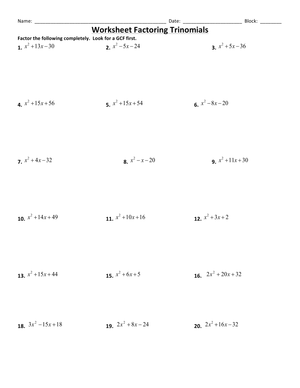
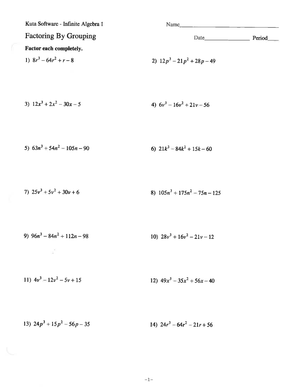
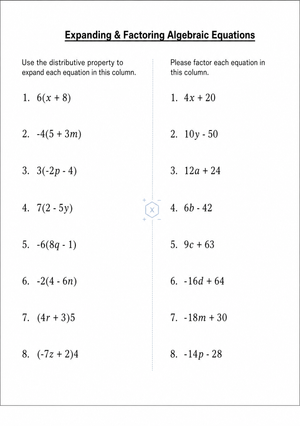
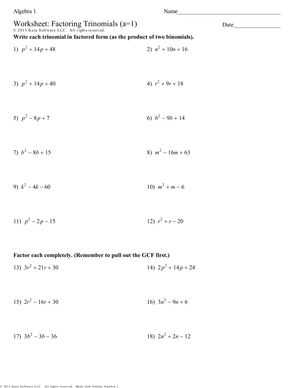
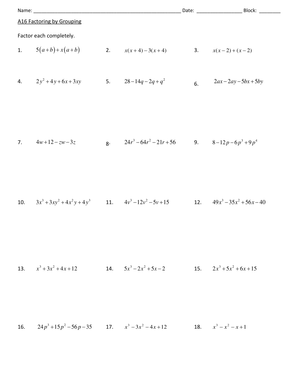
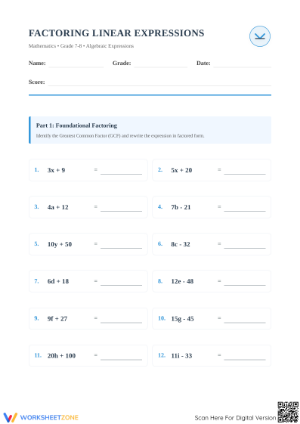
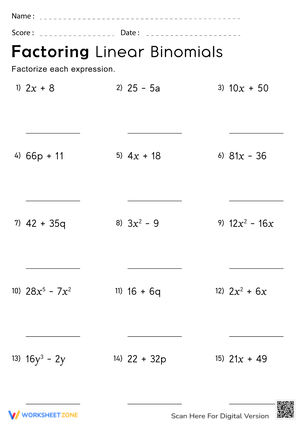
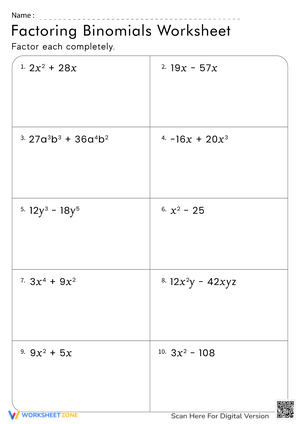
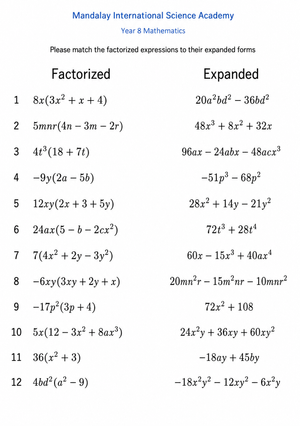
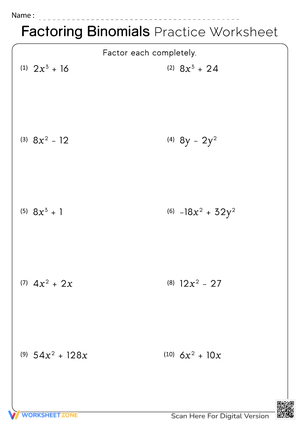
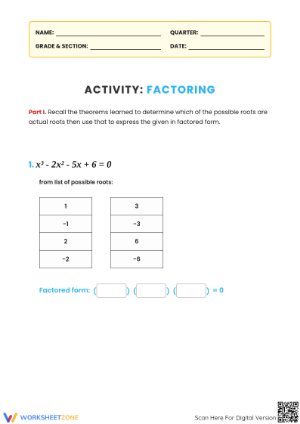
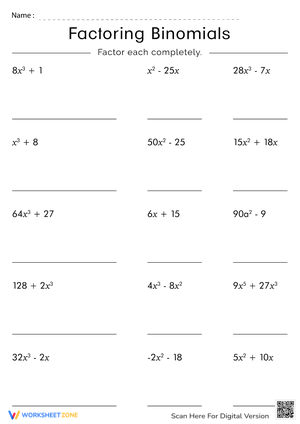
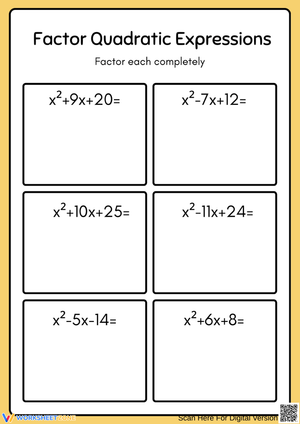
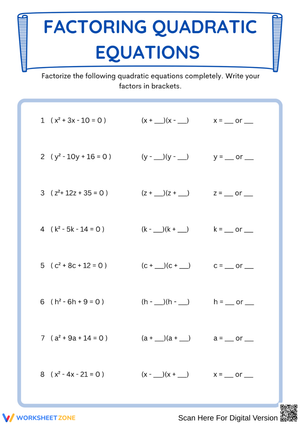
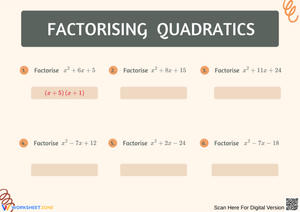
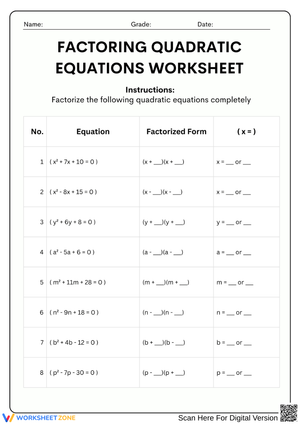
These factoring expressions worksheets for 8th grade give teachers print-ready algebra practice that moves from greatest common factor identification through multi-term expressions and equivalent form reasoning. The set fits without extra prep into warm-ups, post-instruction follow-up, homework, and reteach blocks. An included answer key keeps checking fast in any of those formats.
What Each Worksheet Has Students Do
Eighth grade is when students stop treating expressions as things to simplify and start recognizing them as structures that can be rewritten. Factoring sits at that transition — it asks students to reverse the distributive property, find shared structure, and produce an equivalent form rather than a single answer. That shift in thinking is what makes factoring practice valuable at this level beyond the procedural steps.
Each worksheet moves students through a focused sequence:
- GCF identification: Students find the greatest common factor for sets of terms, including both numerical and variable components.
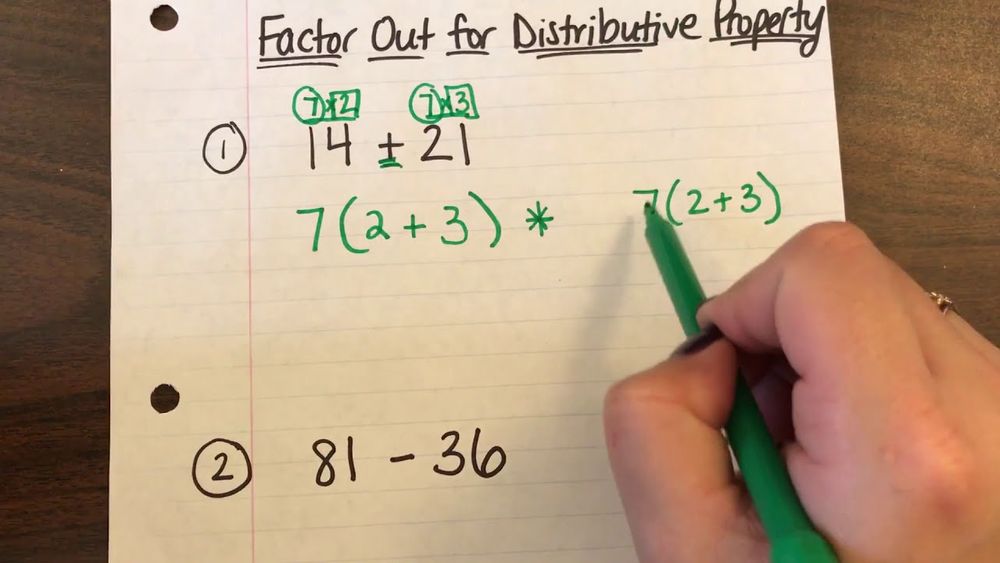
- Reverse distribution: Students rewrite expanded expressions as products — the core factoring operation.
- Signed terms: Students factor expressions with negative terms and maintain correct signs through the full rewrite.
- Equivalence verification: Students expand their factored form to confirm it matches the original expression.
- Mixed task practice: Students identify whether an expression should be factored, expanded, or left as written — a decision that trips up students who can execute the steps but haven't internalized when to apply each one.
That last type of problem is worth including early. Students who can factor when the direction is explicit often stall when it isn't. Mixed task practice surfaces that gap before it shows up on an assessment.
Frequent Student Mistakes That These Worksheets Help You Catch
The most predictable error at this level is incomplete factoring — pulling out a common factor, but not the greatest one. A student working on 6x² + 9x might write 3(2x² + 3x) and consider the problem finished. Technically, 3 is a common factor, but 3x is the GCF, and that answer leaves shared structure unfactored. These students aren't wrong in their instinct; they stop one step short. Requiring students to circle every shared component — numbers and variables separately — before writing the factored form slows the rush and makes incompleteness visible before the expression is locked in.
Negative terms trigger a second wave of predictable errors. When students factor −12x + 8, many correctly identify −4 as the leading factor but then second-guess the sign inside the parentheses and flip it incorrectly. The resulting form doesn't distribute back to the original, but students rarely notice without being explicitly asked to check. Building the distribute-back step into the routine — not optional, not extra credit — breaks this habit before it becomes automatic.
A third pattern worth watching: some students distribute when the problem asks them to factor. Expanding feels like doing something; factoring can feel like undoing it, which creates directional confusion for students still uncertain about what each operation accomplishes. A worksheet that mixes factoring and expanding tasks reveals this confusion quickly — teachers circulating the room can spot and redirect before the error becomes a pattern.
Fitting These Worksheets Into Your Week
Short, repeated exposure across a week produces more retention than one long block of practice. These factoring expressions worksheets for 8th grade support that rhythm because each worksheet is focused enough to run in five to ten minutes without sacrificing instructional depth.
- Warm-up: Three to five GCF problems at the start of class. Students work independently, teacher circulates, group review takes under five minutes. That daily repetition builds common-factor fluency faster than concentrated practice in a single session.
- Immediate post-instruction check: Assign half a worksheet in the eight to ten minutes after the lesson closes. Circulating during that window gives more accurate formative data than waiting for homework to return the next day.
- Homework: A full mixed worksheet, followed by answer-key review the following morning. Students mark their own errors against the key; the teacher addresses the two or three problems that most of the class missed.
- Reteach rotation: Pull GCF-only problems for a small group that needs another pass at the skill while the rest of the class moves forward.
- Exit ticket: Two factoring items and one written prompt — How do you know this is the greatest common factor, not just a common factor? — takes under five minutes and gives a clear read on who is ready for the next concept.
One technique that consistently improves accuracy: require students to circle the greatest common factor before writing any factored expression. That single step forces a visible commitment to the GCF, slows sign errors and incomplete factoring, and gives teachers an immediate checkpoint when scanning work during guided practice. If a student circled the wrong factor, the error is catchable before the expression is finalized.
Standard Alignment
Factoring expressions most directly addresses CCSS 7.EE.A.1 — Apply properties of operations as strategies to add, subtract, factor, and expand linear expressions with rational coefficients. That standard sits formally at 7th grade, but in practice many students arrive at 8th grade without reliable fluency in GCF factoring, especially when signed terms or multi-variable expressions are involved. Revisiting the skill in 8th grade builds the structural foundation students need for the equation-solving work of 8.EE.C, where rewriting expressions in equivalent forms becomes directly useful for isolating variables and simplifying both sides of an equation.
These factoring expressions worksheets for 8th grade also address Mathematical Practice Standard MP.7 — Look for and make use of structure — which asks students to recognize patterns across an expression rather than treat each problem as isolated arithmetic. The equivalence-check tasks, where students expand their factored form to verify it matches the original, build exactly this habit in a concrete, verifiable context before students encounter more abstract structural reasoning in high school algebra.
Adjusting the Worksheets for a Range of Learners
For students who need a more supported entry point, start with numerical expressions before introducing variables. A student who can factor 18 + 24 as 6(3 + 4) has the underlying logic in place. Moving to 18x + 24 is a smaller step than it looks — same GCF, same structure, one added variable. This approach also helps students whose multiplication fluency is shaky enough to interfere with identifying shared factors. The worksheets won't close a multiplication gap, but keeping the first problems numerical prevents the factoring concept from getting buried under arithmetic difficulty.
On-level practice should include numerical GCFs, variable GCFs, and signed terms in combination. Including a few expressions where the GCF is 1 — meaning the expression doesn't factor meaningfully — adds a useful layer: students learn to recognize when factoring applies and when it doesn't, rather than always producing a factored form regardless of whether the expression supports one.
For students who move quickly, short written explanation prompts alongside selected problems shift the work from procedural to conceptual without requiring different materials. Asking a student to explain in one sentence why their factor is the greatest common factor — not just a common factor — surfaces whether understanding is genuine or only pattern-matching. These factoring expressions worksheets for 8th grade include enough problem variety that extension prompts can be added to existing items without creating a separate worksheet.
Frequently Asked Questions
What factoring topics are appropriate for 8th grade?
For most 8th grade classrooms, the right scope is GCF factoring, reverse distributive property, and equivalence verification. Trinomial factoring and difference-of-squares patterns are high school algebra content. Staying at GCF level gives students solid structural understanding without reaching past grade-level expectations, and it directly reinforces the equation-solving work students encounter in 8th grade.
Do these worksheets come with answer keys?
Yes. Each worksheet includes an answer key for fast checking during homework review, reteach blocks, or center rotations. Answer keys also allow intervention teachers and paraprofessionals to use the same materials without extra prep on their end.
How can I use these worksheets with students who need more support?
Start with numerical common factors before adding variables, and ask students to list all factors of each term before identifying the greatest. Keeping the first few problem sets short — four to six items — builds confidence before the complexity increases. Requiring students to check every answer by distributing it back out also catches sign errors before they become ingrained.
Can these be completed digitally instead of printed?
PDF worksheets upload cleanly to platforms such as Google Classroom, Schoology, and Notability. Students can annotate, type, or write directly on the file without printing. The same resource works for both paper-based classrooms and one-to-one device environments with no reformatting needed.













 Interactive Worksheet Maker
 Quiz Maker
 Word Search Maker
 Crossword Puzzle Maker
 Word Scramble Generator
 Sentence Scramble Generator
 Handwriting Worksheet Generator
 Name Tracing Generator
 Fill In The Blank Generator